

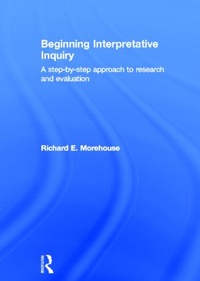
Beginning Interpretative Inquiry
A Step-by-Step Approach to Research and Evaluation
1st Edition
Published on 22. August 2011
Book
Hardback
152 pages
978-0-415-60188-7 (ISBN)
Description
Beginning Interpretive Inquiry importantly makes the distinction between the use of 'inquiry' rather than interpretive research or interpretive evaluation. Richard Morehouse explores how inquiry is a far more inclusive concept that allows for a detailed understanding of both research and evaluation. The author draws on his personal experiences and observations that many academics and practitioners in education, psychology and many other academic disciplines are successfully engaged in both research and evaluation and that in practice these enterprises share much in common. This book provides detailed examples of different projects; some that are primarily research oriented, others that are primarily evaluation; and projects that effectively and seamlessly combine both research and evaluation.
Having provided a solid philosophical foundation for an understanding of interpretive inquiry, the author gives a detailed and accessible step-by-step approach that explores all stages of the process including:
How the processes of interpretive inquiry fit together
Understanding where inquiry ideas come from
How to develop an appropriate inquiry sample
Data collection mechanisms
Effective data analysis
Writing successfully for publication
Complete with case studies of a wide variety of interpretive inquiry projects this vital new book is an essential tool for researchers from a wide range of disciples. It will help them plan, conduct and evaluate research that successfully blends both qualitative and quantitative approaches.
Having provided a solid philosophical foundation for an understanding of interpretive inquiry, the author gives a detailed and accessible step-by-step approach that explores all stages of the process including:
How the processes of interpretive inquiry fit together
Understanding where inquiry ideas come from
How to develop an appropriate inquiry sample
Data collection mechanisms
Effective data analysis
Writing successfully for publication
Complete with case studies of a wide variety of interpretive inquiry projects this vital new book is an essential tool for researchers from a wide range of disciples. It will help them plan, conduct and evaluate research that successfully blends both qualitative and quantitative approaches.
More details
Language
English
Place of publication
London
United Kingdom
Publishing group
Taylor & Francis Ltd
Target group
College/higher education
Illustrations
4 s/w Abbildungen, 15 s/w Tabellen
15 Tables, black and white; 4 Illustrations, black and white
Dimensions
Height: 246 mm
Width: 174 mm
Weight
444 gr
ISBN-13
978-0-415-60188-7 (9780415601887)
Copyright in bibliographic data and cover images is held by Nielsen Book Services Limited or by the publishers or by their respective licensors: all rights reserved.
Schweitzer Classification
Other editions
Additional editions
E-Book
02/2012
1st Edition
Routledge
€63.49
Available for download
E-Book
02/2012
1st Edition
Routledge
€63.49
Available for download
Richard Morehouse
Beginning Interpretative Inquiry
A Step-by-Step Approach to Research and Evaluation
Book
08/2011
1st Edition
Routledge
€79.41
Shipment within 15-20 days
Person
Richard E. Morehouse is Emeritus Professor of Psychology at Viterbo University, Wisconsin, USA and a Visiting Professor at the School of Education and Community, Glyndwr University Wrexham, Wales, UK.
Content
1. Introduction 2. Before Beginning your Inquiry Project 3. The Interpretative Stance: Inquiry in media res 4. A Closer Look at What Counts as Interpretative Inquiry 5. Transition: Key Terms to Understand in the Practice of Interpretative Inquiry 6. Where do Ideas Come From? Developing Ideas for Inquiry Projects 7. Launching the Inquiry: Literature Search and Review, Problem Statement, Design, and Sample 8. Data Collection and Data Analysis 9. Ethics and the Institutional Review Board (IRB) 10. Writing for Publication