

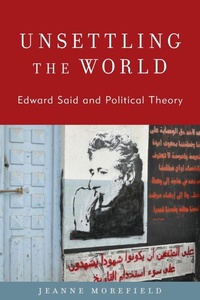
Unsettling the World
Edward Said and Political Theory
Published on 29. April 2022
Book
Paperback/Softback
346 pages
978-1-5381-6862-2 (ISBN)
Description
Unsettling the World is the first book-length treatment of Edward Said's influential cultural criticism from the perspective of a political theorist. Arguing that the generative power of Said's thought extends well beyond Orientalism, the book explores Said's writings on the experience of exile, the practice of "contrapuntal" criticism, and the illuminating potential of worldly humanism. Said's critical vision, Morefield argues, provides a fresh perspective on debates in political theory about subjectivity, global justice, identity, and the history of political thought. Most importantly, she maintains, Said's approach offers theorists a model of how to bring the insights developed through historical analyses of imperialism and anti-colonialism to bear on critiques of contemporary global crises and the politics of American foreign policy.
Reviews / Votes
Jeanne Morefield's Unsettling the World: Edward Said and Political Theory extends her already impressive body of work on the nature and function of empire and imperialism into a radical turning point. In Said she has found a kindred soul not just to interpret the world, as Marx had urged, but to change it. With this master stroke Morefield relocates us in "the middle of a raging cyclone" as she puts it which is Said's way of recasting the world not despite but against empire. The result however is not just rereading Said against the grain of the current imperial meltdown. She borrows from Said to build a whole new moral and imaginative citadel from which not just to reimagine but rebuild the world. In Said, Morefield detects and praises what she performs with uncommon verve and vitality for a whole new generation of critical thinking. -- Hamid Dabashi, Columbia University, author of On Said: Remembrance of Things Past Unsettling the World advances a riveting and revelatory account of Edward Said's political thought. Probing the complexity, contradictions, and polemics that have led other commentators to misjudge Said's anticolonial humanism, Morefield situates Said's work in the company of Aime Cesaire, Frantz Fanon, and C. L. R. James and demonstrates why political theorists cannot afford to neglect Said's profound analysis of the entanglements of race, empire, and modern political ideals. -- Lawrie Balfour, University of Virginia Jeanne Morefield's Unsettling the World is an original and outstanding interpretation of Edward Said's work and of its contribution and importance to the field of political theory. -- James Tully, Professor Emeritus, University of VictoriaMore details
Series
Language
English
Place of publication
United States
Publishing group
Bloomsbury Publishing Plc
Target group
Professional and scholarly
Dimensions
Height: 229 mm
Width: 152 mm
Thickness: 20 mm
Weight
562 gr
ISBN-13
978-1-5381-6862-2 (9781538168622)
Copyright in bibliographic data and cover images is held by Nielsen Book Services Limited or by the publishers or by their respective licensors: all rights reserved.
Schweitzer Classification
Person
Jeanne Morefield is associate professor of Political Theory and fellow at New College, University of Oxford. She is also a non-residential fellow at the Quincy Institute for Responsible Statecraft, Washington DC. She is author of Empires without Imperialism: Anglo American Decline and the Politics of Deflection (Oxford UP, 2014) and Covenants without Swords: Idealist Liberalism and the Spirit of Empire (Princeton UP, 2005).
Content
Chapter One, "Writing at a Distance: Exile, Loss, and Critique." This chapter explores the sometimes-unnerving contradictions of Said's exilic disposition, from his reflections on his own life in exile to his discordant prose style, focusing on the productive criticism that he believes flow from this unsettling disclosure. It focuses on Said's 1982 essay, "Secular Criticism" and explores his approach to analyzing filiative and affiliative modes of ideological connection. The chapter concludes by turning from Said's theoretical writing about exile to his exilic writing in 1984's After the Last Sky which offers a powerful glimpse into the attached and detached mode of seeing at work in Said's exilic orientation. It also provides a fuller sense of how this orientation twins a critique of power, nationhood, and exclusion with a deep sympathy for the ties that bind love to home, love to loss, and love to loss of home.
Chapter Two, "A Cluster of Flowing Currents: Theory Unresolved and Groundless." This chapter foc
Chapter Two, "A Cluster of Flowing Currents: Theory Unresolved and Groundless." This chapter foc