

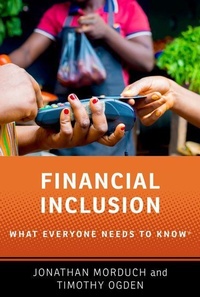
Financial Inclusion
What Everyone Needs to Know (R)
Will be published approx. on 1. January 2042
Book
Paperback/Softback
208 pages
978-0-19-024996-0 (ISBN)
Description
Over 30 percent of the world's adults lack access to basic financial tools-more often women, members of minority groups, and poor families. The abilities to buy what you need, when you need it, to put money aside for the future, and to withstand bad luck without financial ruin seem like basic elements of life in a functioning economy. But life is not that simple for people who lack financial tools. In fact, the tighter the budget, the more you need and benefit from financial services. Financial inclusion-or, put another way, having the tools necessary to take control of one's finances and make progress towards one's goals-is essential to a just and fair society.
In Financial Inclusion: What Everyone Needs to Know, prominent experts Jonathan Morduch and Timothy Ogden explain in straightforward language how the lack of financial inclusion reinforces broader inequities in our society. Using their extensive backgrounds in finance, technology, economic change, and inequality, Morduch and Ogden detail efforts to guarantee that all people, rich and poor, have access to quality financial services and the ability to make prudent financial choices.
Framed by the simple concept of equal access, this book explains the mechanisms of one of the most contentious and misunderstood parts of modern economics by answering a few core questions: What is financial inclusion? Why does it matter? How does it work? When doesn't it work? What are the risks? How can more people be included?
In Financial Inclusion: What Everyone Needs to Know, prominent experts Jonathan Morduch and Timothy Ogden explain in straightforward language how the lack of financial inclusion reinforces broader inequities in our society. Using their extensive backgrounds in finance, technology, economic change, and inequality, Morduch and Ogden detail efforts to guarantee that all people, rich and poor, have access to quality financial services and the ability to make prudent financial choices.
Framed by the simple concept of equal access, this book explains the mechanisms of one of the most contentious and misunderstood parts of modern economics by answering a few core questions: What is financial inclusion? Why does it matter? How does it work? When doesn't it work? What are the risks? How can more people be included?
More details
Series
Language
English
Place of publication
New York
United States
Dimensions
Height: 210 mm
Width: 140 mm
Thickness: 3 mm
Weight
3 gr
ISBN-13
978-0-19-024996-0 (9780190249960)
Copyright in bibliographic data and cover images is held by Nielsen Book Services Limited or by the publishers or by their respective licensors: all rights reserved.
Schweitzer Classification
Other editions
Additional editions
Book
approx. 01/2042
Oxford University Press Inc
€68.50
Not yet published
Persons
Jonathan Morduch is Professor of Public Policy and Economics at the Wagner Graduate School of Public Service at New York University. He is a founder and Executive Director of the NYU Financial Access Initiative.. He is the coauthor of The Financial Diaries: How American Families Cope in a World of Uncertainty (2017), Portfolios of the Poor: How the World's Poor Live on $2 a Day (2009),and The Economics of Microfinance (2010); and coeditor of Banking the World: Empirical Foundations of Financial Inclusion (2012). Morduch has taught on the Economics faculty at Harvard, and has held visiting positions at Stanford, Princeton, Hitotsubashi University, and the University of Tokyo.
Timothy Ogden is Managing Director of the Financial Access Initiative, a research center focused on financial services for low-income households around the world, and an adjunct professor at NYU Wagner. He is a senior fellow of the Aspen Institute's Economic Opportunities Program and Financial
Security Program.. He was also managing director of the US Financial Diaries project, an initiative which tracked the financial lives of 235 low- and moderate- income US household for a full year. Ogden serves as a director of Sona Partners, and chairman of GiveWell. He has developed and edited more than 20 books, and is co-author of Toyota Under Fire (2011) and author of Experimental Conversations (2016).
Timothy Ogden is Managing Director of the Financial Access Initiative, a research center focused on financial services for low-income households around the world, and an adjunct professor at NYU Wagner. He is a senior fellow of the Aspen Institute's Economic Opportunities Program and Financial
Security Program.. He was also managing director of the US Financial Diaries project, an initiative which tracked the financial lives of 235 low- and moderate- income US household for a full year. Ogden serves as a director of Sona Partners, and chairman of GiveWell. He has developed and edited more than 20 books, and is co-author of Toyota Under Fire (2011) and author of Experimental Conversations (2016).
Author
Professor of Economics and Public PolicyProfessor of Economics and Public Policy, Wagner Graduate School of Public Service, New York University, and Managing Director, Financial Access Initiative
Managing Director of the Financial Access InitiativeManaging Director of the Financial Access Initiative
Content
I. Finance and society
1. Why Financial Inclusion? (Introduction)
2. Financial inclusion in rich countries
3. Roots of exclusion
4. Learning from microfinance
II. Why we need finance
5. Liquidity: Managing comsumption
6. Lumpy sums: Managing investment
7. Flexibility: Managing risk
III. Providing inclusive finance
8. Can financial inclusion be profitable for financial companies?
9. Digital frontiers
10. Does it work? The evidence of impact
11. Too much inclusion? Predators, debt crises, and "financialization"
12. Improving regulation and policy
IV. What next?
1. Why Financial Inclusion? (Introduction)
2. Financial inclusion in rich countries
3. Roots of exclusion
4. Learning from microfinance
II. Why we need finance
5. Liquidity: Managing comsumption
6. Lumpy sums: Managing investment
7. Flexibility: Managing risk
III. Providing inclusive finance
8. Can financial inclusion be profitable for financial companies?
9. Digital frontiers
10. Does it work? The evidence of impact
11. Too much inclusion? Predators, debt crises, and "financialization"
12. Improving regulation and policy
IV. What next?