

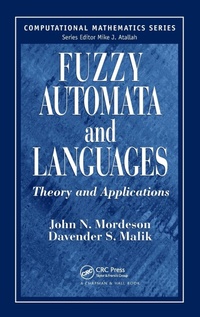
Fuzzy Automata and Languages
Theory and Applications
1st Edition
Published on 19. March 2002
Book
Hardback
576 pages
978-1-58488-225-1 (ISBN)
Description
The huge number and broad range of the existing and potential applications of fuzzy logic have precipitated a veritable avalanche of books published on the subject. Most, however, focus on particular areas of application. Many do no more than scratch the surface of the theory that holds the power and promise of fuzzy logic.
Fuzzy Automata and Languages: Theory and Applications offers the first in-depth treatment of the theory and mathematics of fuzzy automata and fuzzy languages. After introducing background material, the authors study max-min machines and max-product machines, developing their respective algebras and exploring properties such as equivalences, homomorphisms, irreducibility, and minimality. The focus then turns to fuzzy context-free grammars and languages, with special attention to trees, fuzzy dendrolanguage generating systems, and normal forms. A treatment of algebraic fuzzy automata theory follows, along with additional results on fuzzy languages, minimization of fuzzy automata, and recognition of fuzzy languages. Although the book is theoretical in nature, the authors also discuss applications in a variety of fields, including databases, medicine, learning systems, and pattern recognition.
Much of the information on fuzzy languages is new and never before presented in book form. Fuzzy Automata and Languages incorporates virtually all of the important material published thus far. It stands alone as a complete reference on the subject and belongs on the shelves of anyone interested in fuzzy mathematics or its applications.
Fuzzy Automata and Languages: Theory and Applications offers the first in-depth treatment of the theory and mathematics of fuzzy automata and fuzzy languages. After introducing background material, the authors study max-min machines and max-product machines, developing their respective algebras and exploring properties such as equivalences, homomorphisms, irreducibility, and minimality. The focus then turns to fuzzy context-free grammars and languages, with special attention to trees, fuzzy dendrolanguage generating systems, and normal forms. A treatment of algebraic fuzzy automata theory follows, along with additional results on fuzzy languages, minimization of fuzzy automata, and recognition of fuzzy languages. Although the book is theoretical in nature, the authors also discuss applications in a variety of fields, including databases, medicine, learning systems, and pattern recognition.
Much of the information on fuzzy languages is new and never before presented in book form. Fuzzy Automata and Languages incorporates virtually all of the important material published thus far. It stands alone as a complete reference on the subject and belongs on the shelves of anyone interested in fuzzy mathematics or its applications.
More details
Language
English
Place of publication
Oxford
United States
Publishing group
Taylor & Francis Inc
Target group
Professional and scholarly
Professional Practice & Development
Illustrations
64 s/w Abbildungen
64 Illustrations, black and white
Dimensions
Height: 240 mm
Width: 161 mm
Thickness: 35 mm
Weight
1024 gr
ISBN-13
978-1-58488-225-1 (9781584882251)
Copyright in bibliographic data and cover images is held by Nielsen Book Services Limited or by the publishers or by their respective licensors: all rights reserved.
Schweitzer Classification
Other editions
Additional editions
Book
09/2019
1st Edition
Chapman & Hall/CRC
€98.00
Shipment within 15-20 days
E-Book
03/2002
Chapman and Hall
€89.99
Available for download
E-Book
03/2002
Chapman & Hall/CRC
€89.99
Available for download
Persons
Mordeson, John N.; Malik, Davender S.
Content
Introduction. Max-Min Automata. Fuzzy Machines, Languages, and Grammars. Fuzzy Languages and Grammars. Probabilistic Automata and Grammars. Algebraic Fuzzy Automata Theory. More on Fuzzy Languages. Minimization of Fuzzy Automata. L-Fuzzy Automata, Grammars, and Languages. Applications. References. Index. List of symbols.