

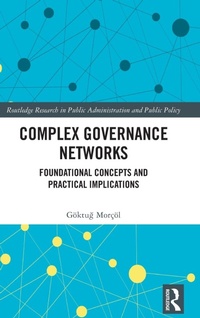
Complex Governance Networks
Foundational Concepts and Practical Implications
1st Edition
Published on 17. February 2023
Book
Hardback
226 pages
978-0-367-51328-3 (ISBN)
Description
What are the roles of governments and other actors in solving, or alleviating, collective action problems in today's world? The traditional conceptual frameworks of public administration and public policy studies have become less relevant in answering this question. This book critically assesses traditional conceptual frameworks and proposes an alternative: a complex governance networks (CGN) framework.
Advocating that complexity theory should be systematically integrated with foundational concepts of public administration and public policy, Goektug Morcoel begins by clarifying the component concepts of CGN and then addresses the implications of CGN for key issues in public administration and policy studies: effectiveness, accountability, and democracy. He illustrates the applicability of the CGN concepts with examples for the COVID-19 pandemic and metropolitan governance, particularly the roles of business improvement districts in governance processes. Morcoel concludes by discussing the implications of CGN for the convergence of public administration and public policy education and offering suggestions for future studies using the CGN conceptualization.
Complex Governance Networks is essential reading for both scholars and advanced students of public policy, public administration, public affairs, and related areas.
Advocating that complexity theory should be systematically integrated with foundational concepts of public administration and public policy, Goektug Morcoel begins by clarifying the component concepts of CGN and then addresses the implications of CGN for key issues in public administration and policy studies: effectiveness, accountability, and democracy. He illustrates the applicability of the CGN concepts with examples for the COVID-19 pandemic and metropolitan governance, particularly the roles of business improvement districts in governance processes. Morcoel concludes by discussing the implications of CGN for the convergence of public administration and public policy education and offering suggestions for future studies using the CGN conceptualization.
Complex Governance Networks is essential reading for both scholars and advanced students of public policy, public administration, public affairs, and related areas.
More details
Series
Language
English
Place of publication
London
United Kingdom
Publishing group
Taylor & Francis Ltd
Target group
College/higher education
Professional and scholarly
Academic, Postgraduate, and Undergraduate
Illustrations
9 s/w Abbildungen, 9 s/w Zeichnungen, 4 s/w Tabellen
4 Tables, black and white; 9 Line drawings, black and white; 9 Illustrations, black and white
Dimensions
Height: 235 mm
Width: 157 mm
Thickness: 18 mm
Weight
510 gr
ISBN-13
978-0-367-51328-3 (9780367513283)
Copyright in bibliographic data and cover images is held by Nielsen Book Services Limited or by the publishers or by their respective licensors: all rights reserved.
Schweitzer Classification
Other editions
Additional editions
Book
08/2024
1st Edition
Routledge
€63.30
Shipment within 15-20 days
E-Book
02/2023
1st Edition
Routledge
€55.49
Available for download
E-Book
02/2023
1st Edition
Routledge
€55.49
Available for download
Person
Goektug Morcoel is Professor of Public Policy and Administration at The Pennsylvania State University in Harrisburg. His research interests are complexity theory, metropolitan governance, business improvement districts, and research methodology. He teaches courses in research methods, program evaluation, and policy analysis.
Content
1. Introduction Part 1: Concepts 2. Governance 3. Governance Networks 4. Complexity Part 2: A Complex Governance Networks Conceptualizations 5. Introduction of the Conceptualization 6. Micro Units 7. Micro to Macro 8. Macro to Micro Part 3: Implications of the Complex Governance Networks Conceptualization for Key Issues in Governance 9. Wicked Problems and Effectiveness 10. Accountability 11. Democracy Conclusions