

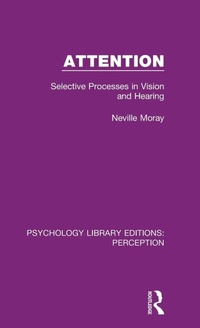
Attention
Selective Processes in Vision and Hearing
1st Edition
Published on 13. March 2017
Book
Hardback
234 pages
978-1-138-20027-2 (ISBN)
Description
The early years of modern experimental psychology were marked by a considerable amount of research on attention, and much work was carried out in the laboratories of Wundt, Titchener and Helmholtz.
For various reasons, research on attention declined from 1920 until the 1950s. Under the early philosophy of behaviourism, attention became suspect as a 'mentalistic' concept. At the time of original publication in 1969, however, much work had been done to quantify and make objective research in this area. This was of increasing importance in a world dominated by communication networks, and 'man-machine' systems, in which the human element is the weakest link due to the limits on the rate at which man can handle information.
Following the publication of Broadbent's Perception and Communication in 1958, work on attention had begun to pour from an ever increasing number of laboratories. This book is dedicated to summarising what we knew, and attempts to survey the behavioural research in vision and hearing which throw light on how we share and direct attention, what are the limits of attention, to make some general methodological recommendations, to review current theories of the time, and to provide a guide to the relevant physiological work. As far as possible, work on memory has been omitted. A bibliography of the major work to the spring of 1969 is included.
For various reasons, research on attention declined from 1920 until the 1950s. Under the early philosophy of behaviourism, attention became suspect as a 'mentalistic' concept. At the time of original publication in 1969, however, much work had been done to quantify and make objective research in this area. This was of increasing importance in a world dominated by communication networks, and 'man-machine' systems, in which the human element is the weakest link due to the limits on the rate at which man can handle information.
Following the publication of Broadbent's Perception and Communication in 1958, work on attention had begun to pour from an ever increasing number of laboratories. This book is dedicated to summarising what we knew, and attempts to survey the behavioural research in vision and hearing which throw light on how we share and direct attention, what are the limits of attention, to make some general methodological recommendations, to review current theories of the time, and to provide a guide to the relevant physiological work. As far as possible, work on memory has been omitted. A bibliography of the major work to the spring of 1969 is included.
More details
Series
Language
English
Place of publication
London
United Kingdom
Publishing group
Taylor & Francis Ltd
Target group
College/higher education
Professional and scholarly
Dimensions
Height: 222 mm
Width: 145 mm
Thickness: 16 mm
Weight
433 gr
ISBN-13
978-1-138-20027-2 (9781138200272)
Copyright in bibliographic data and cover images is held by Nielsen Book Services Limited or by the publishers or by their respective licensors: all rights reserved.
Schweitzer Classification
Other editions
Additional editions
Book
03/2019
1st Edition
Routledge
€59.80
Shipment within 10-20 days
E-Book
03/2017
1st Edition
Routledge
€52.49
Available for download
E-Book
03/2017
Routledge
€52.49
Available for download
Person
Neville Moray
Content
Editorial Foreword. 1. Attention Ancient and Modern 2. The Design, Analysis and Conceptual Framework of Experiments on Attention 3. A Review of Current Theories of Attention 4. Auditory Selection 5. Visual Selection 6. Cross-modal and Other Effects in Selective Perception 7. The Sharing of Attention Between Input and Output 8. The Time Taken to Switch Attention 9. Physiological Research on Attention Mechanisms 10. Conclusions and Theory. Bibliography. Indexes.