

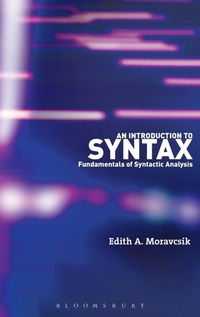
An Introduction to Syntax
Fundamentals of Syntactic Analysis
Published on 4. May 2006
Book
Hardback
288 pages
978-0-8264-8945-6 (ISBN)
Description
This comprehensive introduction presents the basic goals and tools of syntactic analysis. The conceptual framework is theory-neutral, presenting a scientific introduction to the field. The chapters in the first half of the book present a detailed introduction to synchronic description. The second half of the book examines variation and change, syntactic typology, and language acquisition, and possible explanations from structural, evolutionary and functional perspectives.
Reviews / Votes
"'Unlike most syntax textbooks, this one approaches the technicalities via a broad consideration of explanation illustrated from everyday life. The discussion presents the view of a leading scholar in the field, whose enthusiasm, wisdom and open-mindedness show through on every page. It draws from a wide range of languages and culminates in a splendid chapter about "the ultimate explanatory force for syntax: function.' Richard A. Hudson, Emeritus Professor, University College London."More details
Language
English
Place of publication
London
United Kingdom
Publishing group
Bloomsbury Publishing PLC
Target group
College/higher education
Dimensions
Height: 240 mm
Width: 161 mm
Thickness: 20 mm
Weight
599 gr
ISBN-13
978-0-8264-8945-6 (9780826489456)
Copyright in bibliographic data and cover images is held by Nielsen Book Services Limited or by the publishers or by their respective licensors: all rights reserved.
Schweitzer Classification
Other editions
Additional editions
E-Book
05/2006
1st Edition
Continuum Publishing Corporation
€48.49
Available for download
Person
Content
PREFACE; PART I. INTRODUCTION; CHAPTER 1. WHAT IS SYNTAX?; 1. Preliminaries; 2. Studying the world; 3. Studying language; 4. Why syntax?; 5. Conclusions; NOTES. QUESTIONS; PART II. SYNTACTIC DESCRIPTION; CHAPTER 2. LINEAR ORDER; 1. Preliminaries; 2. Temporal relations: some possibilities; 3. Temporal relations of words: some facts; 4. Conclusions; NOTES; QUESTIONS; CHAPTER 3. SELECTION; 1. Preliminaries; 2. Selection: some possibilities; 3. Selection in syntax: some facts; 4. Conclusions; NOTES; QUESTIONS; CHAPTER 4. CATEGORIES; 1. Preliminaries; 2. Partonomy and taxonomy: some possibilities; 3. Partonomy and taxonomy in syntax: some facts; 4. Conclusions; NOTES; QUESTIONS; CHAPTER 5. SYNTAX, MEANING, AND SOUND FORM; 1. Preliminaries; 2. Symbolic equivalence: some possibilities; 3. Symbolic equivalence in syntax: some facts; 4. Conclusions; NOTES; QUESTIONS; CHAPTER 6. VARIATION AND CHANGE; 1. Preliminaries; 2. Variation and change: some possibilities; 3. Syntactic variation; 4. Syntactic change; 5. Conclusions; NOTES; QUESTIONS; PART III. CONCLUSION; CHAPTER 7. EXPLAINING SYNTAX; 1. Preliminaries; 2. Structural explanations; 3. Evolutionary explanations; 4. Functional Explanations; 5. Conclusions; NOTES; QUESTIONS; GLOSSARY; REFERENCES.