

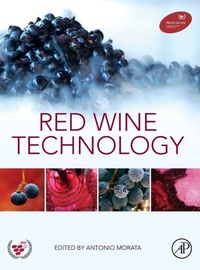
Red Wine Technology
Published on 1. November 2018
Book
Hardback
408 pages
978-0-12-814399-5 (ISBN)
Description
Red Wine Technology is a solutions-based approach on the challenges associated with red wine production. It focuses on the technology and biotechnology of red wines, and is ideal for anyone who needs a quick reference on novel ways to increase and improve overall red wine production and innovation. The book provides emerging trends in modern enology, including molecular tools for wine quality and analysis. It includes sections on new ways of maceration extraction, alternative microorganisms for alcoholic fermentation, and malolactic fermentation. Recent studies and technological advancements to improve grape maturity and production are also presented, along with tactics to control PH level.
This book is an essential resource for wine producers, researchers, practitioners, technologists and students.
This book is an essential resource for wine producers, researchers, practitioners, technologists and students.
More details
Language
English
Place of publication
San Diego
United States
Publishing group
Elsevier Science Publishing Co Inc
Target group
Professional and scholarly
Enologists, researchers, professors, wine technologist, wine microbiology, composition and analysis Industry
Professionals within the wine industry
Product notice
Laminated cover
Dimensions
Height: 284 mm
Width: 220 mm
Thickness: 30 mm
Weight
1285 gr
ISBN-13
978-0-12-814399-5 (9780128143995)
Copyright in bibliographic data and cover images is held by Nielsen Book Services Limited or by the publishers or by their respective licensors: all rights reserved.
Schweitzer Classification
Other editions
New editions
Antonio Morata
Red Wine Technology
Book
approx. 03/2026
2nd Edition
Academic Press
€161.50
Not yet published
Additional editions
Person
Antonio Morata, winner of the prestigious OIV Award in 2019, is a professor of food science and technology with a specialty in wine technology at the Universidad Politecnica de Madrid, Madrid, Spain and a professor of enology and wine technology in the European Master of Viticulture and Enology, Euromaster Vinifera-Erasmus, a Joint European Diploma that includes Montpellier SupAgro, France; Geisenheim University, Germany; Udine University, Italy; Lisbon University, Portugal; Torino University, Italy; and Universidad Politecnica de Madrid, Spain. Dr. Morata's research expertise covers a wide variety of topics including yeast selection for winemaking and repercussion in quality parameters, new fermentation biotechnologies and winemaking processes, and anthocyanin and phenolic ripeness of grapes. He has written over 100 articles, book chapters, and books, holds 3 patents, and has won 4 awards in enology.
Content
1. Grape Maturity and Selection. Automatic Grape Selection
2. Acidification and pH Control in Red Wines
3. Maceration and Fermentation. New Technologies to Increase Extraction
4. Use of Non-Saccharomyces Yeasts in Red Winemaking
5. Yeast Biotechnology for red winemaking
6. Malolactic Fermentation
7. Yeast-Bacteria Coinoculation
8. Molecular Tools to Analyze Microbial Populations in Red Wines
9. Barrel Ageing. Types of Wood
10. Emerging Technologies. Use of Chips. Microoxigenation
11. Ageing on Lees. Use of Non-Saccharomyces Yeasts. Accelerated AOL. Lees Impregnation
12. Evolution of proanthocyanidins during grape maturation, winemaking and aging process of red wines
13. Color evolution and stability
14. Polymeric pigments in red wines
15. Spoilage yeasts in red wines
16. Red Wine Clarification and Stabilization
17. Sensory analysis of red wines
18. Management of astringency in red wines
19. Aromatic compounds in red varieties
20. The instrumental analysis of aroma-active compounds for explaining the flavor of red wines
21. SO2 in wines: rational use and possible alternatives
22. Bottling and packaging
23. Red winemaking in cool climates
24. Red winemaking in cold regions with short maturity periods
2. Acidification and pH Control in Red Wines
3. Maceration and Fermentation. New Technologies to Increase Extraction
4. Use of Non-Saccharomyces Yeasts in Red Winemaking
5. Yeast Biotechnology for red winemaking
6. Malolactic Fermentation
7. Yeast-Bacteria Coinoculation
8. Molecular Tools to Analyze Microbial Populations in Red Wines
9. Barrel Ageing. Types of Wood
10. Emerging Technologies. Use of Chips. Microoxigenation
11. Ageing on Lees. Use of Non-Saccharomyces Yeasts. Accelerated AOL. Lees Impregnation
12. Evolution of proanthocyanidins during grape maturation, winemaking and aging process of red wines
13. Color evolution and stability
14. Polymeric pigments in red wines
15. Spoilage yeasts in red wines
16. Red Wine Clarification and Stabilization
17. Sensory analysis of red wines
18. Management of astringency in red wines
19. Aromatic compounds in red varieties
20. The instrumental analysis of aroma-active compounds for explaining the flavor of red wines
21. SO2 in wines: rational use and possible alternatives
22. Bottling and packaging
23. Red winemaking in cool climates
24. Red winemaking in cold regions with short maturity periods