

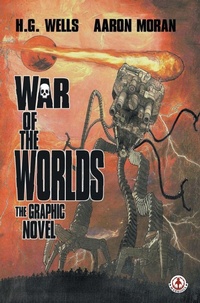
War of the Worlds
The Graphic Novel
Published on 14. November 2022
Book
Hardback
86 pages
978-1-915387-76-9 (ISBN)
Description
In the last days of the 19th century, an unseen narrator is witness to the horrific attack on earth from invaders from mars. Starting with the first falling star in England to the mass army of metal fighting machines in the execution and collection of humanity.
A wonderful illustrated adaptation of the classic H.G Wells novel.
More details
Language
English
Place of publication
Plymouth
United Kingdom
Target group
US School Grade: From Eighth Grade to Twelfth Grade
Illustrations
Colour illustrations throughout
Dimensions
Height: 250 mm
Width: 175 mm
Thickness: 10 mm
Weight
415 gr
ISBN-13
978-1-915387-76-9 (9781915387769)
Copyright in bibliographic data and cover images is held by Nielsen Book Services Limited or by the publishers or by their respective licensors: all rights reserved.
Schweitzer Classification
Person
Herbert George Wells was an influential English writer, best known for his works in science fiction, though his prolific output spanned various genres, including history, social commentary, politics, and autobiography. Born on September 21, 1866, in Bromley, London, Wells attended the Normal School of Science in London, where he studied biology under Thomas Henry Huxley. Wells initially worked as a teacher and journalist before turning to writing full time. Over his career, he penned more than fifty novels, along with numerous short stories and non-fiction works. His early works, such as "The Time Machine," "The War of the Worlds," and "The Invisible Man," helped establish him as one of the pioneers of modern science fiction. He also explored themes of social justice, the possibilities of science and technology, and the complexities of human nature in works like "The History of Mr. Polly" and "The Shape of Things to Come." Throughout his life, Wells engaged in political and philosophical discourse, influenced by thinkers like Mark Twain and Plato. He died on August 13, 1946, in London, leaving behind a legacy that shaped the development of speculative fiction and continued to inspire future generations of writers and thinkers.