

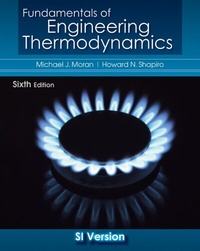
Fundamentals of Engineering Thermodynamics
SI Edition
6th Edition
Published on 8. September 2009
Book
Paperback/Softback
744 pages
978-0-470-54019-0 (ISBN)
Description
Now in a Sixth Edition, Fundamentals of Engineering Thermodynamics maintains its engaging, readable style while presenting a broader range of applications that motivate student understanding of core thermodynamics concepts. This leading text uses many relevant engineering-based situations to help students model and solve problems.
More details
Edition
6., Auflage
Language
English
Place of publication
Chichester
United Kingdom
Publishing group
John Wiley and Sons Ltd
Target group
College/higher education
Illustrations
Illustrations
Dimensions
Height: 25.4 cm
Width: 20.2 cm
Thickness: 23 mm
Weight
1252 gr
ISBN-13
978-0-470-54019-0 (9780470540190)
Schweitzer Classification
Other editions
New editions
Michael J. Moran | Howard N. Shapiro | Daisie D. Boettner
Principles of Engineering Thermodynamics
SI Version
Book
11/2011
7th Edition
Wiley
€259.00
Article exhausted; check for reprint
Previous edition
Michael J. Moran | Howard N. Shapiro
Fundamentals of Engineering Thermodynamics
Book
09/2007
6th Edition
Wiley
€182.00
Withdrawn from sale
Persons
Dr. Michael J. Moran, is Professor of Mechanical Engineering at the Ohio State University. He is a specialist in engineering thermodynamics and thermoeconomics. He also works in the area of thermal design and optimization.
Content
1. Getting Started: Introductory Concepts and Definitions.
2. Energy and the First Law of Thermodynamics.
3. Evaluating Properties.
4. Control Volume Analysis Using Energy.
5. The Second Law of Thermodynamics.
6. Using Entropy.
7. Exergy Analysis.
8. Vapor Power Systems.
9. Gas Power Systems.
10. Refrigeration and Heat Pump Systems.
11. Thermodynamic Relations.
12. Ideal Gas Mixture and Psychrometric Applications.
13. Reacting Mixtures and Combustion.
14. Chemical and Phase Equilibrium.
Appendix: Tables, Figures, and Charts.
Answers to Selected Problems.
Index.
2. Energy and the First Law of Thermodynamics.
3. Evaluating Properties.
4. Control Volume Analysis Using Energy.
5. The Second Law of Thermodynamics.
6. Using Entropy.
7. Exergy Analysis.
8. Vapor Power Systems.
9. Gas Power Systems.
10. Refrigeration and Heat Pump Systems.
11. Thermodynamic Relations.
12. Ideal Gas Mixture and Psychrometric Applications.
13. Reacting Mixtures and Combustion.
14. Chemical and Phase Equilibrium.
Appendix: Tables, Figures, and Charts.
Answers to Selected Problems.
Index.