

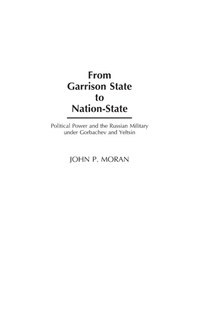
From Garrison State to Nation-State
Political Power and the Russian Military under Gorbachev and Yeltsin
Published on 30. September 2002
Book
Hardback
248 pages
978-0-275-97217-2 (ISBN)
Description
Why has the military not intervened in the post-communist political arena since the advent of democracy in Russia? Do lowered levels of professionalism actually lead to higher levels of intervention? Through a systematic exploration of professionalism within the Russian military, this study addresses these important questions. Moran suggests that by examining the notion of subjective fragmentation, both Gorbachev and Yeltsin utilized a highly effective, yet potentially troublesome, form of civil-military control. Findings that overall levels of praetorian behavior on the part of the Russian military have declined in this period, in spite of declining levels of military professionalism, challenge one of the most basic theoretical assumptions of civil-military relations.
Since 1991, post-communist Russia has exhibited all of the classic indicators of a society ripe for a military takeover. Not only have institutional interests of the Russian officer corps been gravely threatened, but surveys conducted within it have found a general lack of sympathy for democratic values. Furthermore, Russia's weak civil society is accompanied by high levels of corruption, rampant crime, secessionist movements, a significant terrorist threat, and a general disrespect for the rule of law. Even further augmenting the chances of a military coup d'^D'etat, public opinion polls of civilians have found that the military is one of the most trusted institutions in the country-so trusted, in fact, that many Russian citizens have expressed support for a military takeover. Moran explains why the military has not capitalized on these factors.
Since 1991, post-communist Russia has exhibited all of the classic indicators of a society ripe for a military takeover. Not only have institutional interests of the Russian officer corps been gravely threatened, but surveys conducted within it have found a general lack of sympathy for democratic values. Furthermore, Russia's weak civil society is accompanied by high levels of corruption, rampant crime, secessionist movements, a significant terrorist threat, and a general disrespect for the rule of law. Even further augmenting the chances of a military coup d'^D'etat, public opinion polls of civilians have found that the military is one of the most trusted institutions in the country-so trusted, in fact, that many Russian citizens have expressed support for a military takeover. Moran explains why the military has not capitalized on these factors.
More details
Language
English
Place of publication
United States
Publishing group
Bloomsbury Publishing Plc
Target group
College/higher education
Professional and scholarly
Interest Age: From 7 to 17 years
Dimensions
Height: 240 mm
Width: 161 mm
Thickness: 18 mm
Weight
540 gr
ISBN-13
978-0-275-97217-2 (9780275972172)
Copyright in bibliographic data and cover images is held by Nielsen Book Services Limited or by the publishers or by their respective licensors: all rights reserved.
Schweitzer Classification
Other editions
Additional editions
John Moran
From Garrison State to Nation-State
Political Power and the Russian Military Under Gorbachev and Yeltsin
E-Book
09/2002
1st Edition
Praeger Publishers Inc
€82.49
Available for download
Person
JOHN P. MORAN is Assistant Professor of Political Science and International Affairs at Kennesaw State University in Kennesaw, Georgia.
Content
Understanding Democratization and Civil-Military Relations in Communist and Post-Communist Russia
Democratization and Russian Military Politics
The Structures of National Security: The Military and the Power Ministries
The Russian Military and Foreign Policy
Democratization and the Military in Russian Society
The Mischiefs of Faction: Removing the Causes or Controlling its Effects?
Selected Bibliography
Index
Democratization and Russian Military Politics
The Structures of National Security: The Military and the Power Ministries
The Russian Military and Foreign Policy
Democratization and the Military in Russian Society
The Mischiefs of Faction: Removing the Causes or Controlling its Effects?
Selected Bibliography
Index