

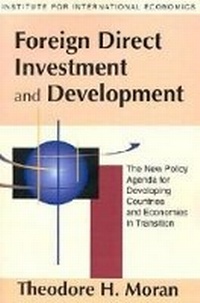
Foreign Direct Investment and Development - The New Policy Agenda for Developing Countries and Economies in Transition
The New Policy Agenda for Developing Countries and Economies in Transition
Will be published approx. on 1. December 1998
Book
Paperback/Softback
216 pages
978-0-88132-258-3 (ISBN)
Description
Foreign direct investment (FDI) has grown dramatically and is now the largest and most stable source of private capital for developing countries and economies in transition, accounting for nearly 50 percent of all those flows. Meanwhile, the growing role of FDI in host countries has been accompanied by a change of attitude, from critical wariness toward multinational corporations to sometimes uncritical enthusiasm about their role in the development process. What are the most valuable benefits and opportunities that foreign firms have to offer? What risks and dangers do they pose? Beyond improving the micro and macroeconomic "fundamentals" in their own countries and building an investment-friendly environment, do authorities in host countries need a proactive (rather than passive) policy toward FDI?
In one of the most comprehensive studies on FDI in two decades, Theodore Moran synthesizes evidence drawn from a wealth of case literature to assess policies toward FDI in developing countries and economies in transition. His focus is on investment promotion, domestic content mandates, export-performance requirements, joint-venture requirements, and technology-licensing mandates. The study demonstrates that there is indeed a large, energetic, and vital role for host authorities to play in designing policies toward FDI but that the needed actions differ substantially from conventional wisdom on the topic. Dr. Moran offers a pathbreaking agenda for host governments, aimed at maximizing the benefits they can obtain from FDI while minimizing the dangers, and suggests how they might best pursue this agenda.
In one of the most comprehensive studies on FDI in two decades, Theodore Moran synthesizes evidence drawn from a wealth of case literature to assess policies toward FDI in developing countries and economies in transition. His focus is on investment promotion, domestic content mandates, export-performance requirements, joint-venture requirements, and technology-licensing mandates. The study demonstrates that there is indeed a large, energetic, and vital role for host authorities to play in designing policies toward FDI but that the needed actions differ substantially from conventional wisdom on the topic. Dr. Moran offers a pathbreaking agenda for host governments, aimed at maximizing the benefits they can obtain from FDI while minimizing the dangers, and suggests how they might best pursue this agenda.
More details
Language
English
Place of publication
Washington
United States
Target group
College/higher education
Professional and scholarly
Product notice
Paperback (trade)
Dimensions
Height: 229 mm
Width: 152 mm
Thickness: 15 mm
Weight
28 gr
ISBN-13
978-0-88132-258-3 (9780881322583)
Copyright in bibliographic data and cover images is held by Nielsen Book Services Limited or by the publishers or by their respective licensors: all rights reserved.
Schweitzer Classification
Other editions
Additional editions
Theodore Moran
Foreign Direct Investment and Development
The New Policy Agenda for Developing Countries and Economies in Transition
E-Book
12/1998
Peterson Institute for International Economics
€9.49
Available for download
Person
Theodore H. Moran, nonresident senior fellow, has been associated with the Peterson Institute since 1998. He holds the Marcus Wallenberg Chair at the School of Foreign Service in Georgetown University. He is the founder of the Landegger Program in International Business Diplomacy at the university and serves as director there. He also serves as a member of Huawei's International Advisory Council. From 2007 to 2013 he served as Associate to the US National Intelligence Council on international business issues.