

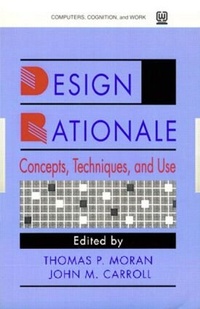
Design Rationale
Concepts, Techniques, and Use
1st Edition
Published on 1. January 1996
Book
Paperback/Softback
504 pages
978-0-8058-1567-2 (ISBN)
Description
This book focuses on design in the domain of human-computer interaction. Including a broad sampling of case studies as well as narrower theoretical or empirical studies, it includes consideration of educational uses of design rationale, methods for teaching it in industry, and applications to a variety of software and user interface/application domains. The volume promises to be the largest collection of work on design rationale ever assembled, and thereby to energize the considerable, widespread interest in this topic. It will also act as a focus for the existing but scattered work in this domain.
More details
Language
English
Place of publication
Bosa Roca
United States
Publishing group
Taylor & Francis Inc
Target group
College/higher education
Professional and scholarly
Professional Practice & Development
Dimensions
Height: 234 mm
Width: 156 mm
Weight
930 gr
ISBN-13
978-0-8058-1567-2 (9780805815672)
Copyright in bibliographic data and cover images is held by Nielsen Book Services Limited or by the publishers or by their respective licensors: all rights reserved.
Schweitzer Classification
Other editions
Additional editions
E-Book
10/2020
1st Edition
CRC Press
€116.99
Available for download
E-Book
10/2020
1st Edition
CRC Press
€116.99
Available for download
Book
01/1996
1st Edition
CRC Press
€259.98
Shipment within 10-20 days
Persons
Thomas P. Moran (Edited by) , John M. Carroll (Edited by)
Content
Contents: T.P. Moran, J.M. Carroll, Overview of Design Rationale. Part I:Different Perspectives of Design Rationale.J. Lee, K-Y. Lai, What's in Design Rationale? A. MacLean, R.M. Young, V.M.E. Bellotti, T.P. Moran, Questions, Options, and Criteria: Elements of Design Space Analysis. J.M. Carroll, M.B. Rosson, Deliberated Evolution: Stalking the View Matcher in Design Space. C. Lewis, J. Rieman, B. Bell, Problem-Centered Design for Expressiveness and Facility in a Graphical Programming System. Part II:Empirical Studies of Design Rationale.S.B. Shum, Analyzing the Usability of a Design Rationale Notation. G.M. Olson, J.S. Olson, M. Storrosten, M. Carter, J. Herbsleb, H. Rueter, The Structure of Activity During Design Meetings. M.K. Singley, J.M. Carroll, Synthesis by Analysis: Five Modes of Reasoning That Guide Design. Part III:Design Rationale Tools in Design Practice.G. Fischer, A.C. Lemke, R. McCall, A.I. Morch, Making Argumentation Serve Design. C. Potts, Supporting Software Design: Integrating Design Methods and Design Rationale. T.R. Gruber, D.M. Russell, Generative Design Rationale: Beyond the Record and Replay Paradigm. Part IV:Using Design Rationale for Teaching.G. Casaday, Rationale in Practice: Templates for Capturing and Applying Design Experience. T. Carey, D. McKerlie, J. Wilson, HCI Design Rationale as a Learning Resource. Part V:Design Rationale in Organizational Context.E.J. Conklin, K-C. Burgess-Yakemovic, A Process-Oriented Approach to Design Rationale. W. Sharrock, R. Anderson, Organizational Innovation and the Articulation of the Design Space. J. Grudin, Evaluating Opportunities for Design Capture.