

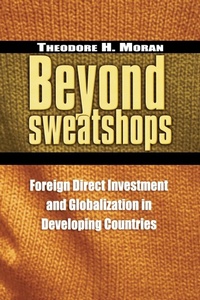
Beyond Sweatshops
Foreign Direct Investment and Globalization in Developing Countries
Published on 12. June 2002
Book
Paperback/Softback
208 pages
978-0-8157-0615-1 (ISBN)
Description
Images of sweatshop labor in developing countries have rallied opponents of globalization against foreign direct investment (FDI). The controversy is most acute over the treatment of low-skilled workers producing garments, footwear, toys, and sports equipment in foreign-owned plants or the plants of subcontractors. Activists cite low wages, poor working conditions, and a variety of economic, physical, and sexual abuses among the negative consequences of the globalization of industry. In Beyond Sweatshops, Theodore Moran examines the impact of FDI in manufacturing on growth and welfare in developing countries, and explores how host governments can take advantage of the contributions of foreign investment while avoiding the hazards to lower-skilled workers. He traces case studies of countries that have managed to produce steady improvement in worker treatment at plants exporting garments, footwear, and other labor-intensive products. The first part of the book examines multilateral proposals designed to place a floor under the treatment of workers around the world, contrasting a WTO-based system to enforce labor standards with ""voluntary"" arrangements, including corporate codes of conduct, certification organizations, and ""sweatshop free"" labeling. It explores the pros and cons of adding a ""living wage"" requirement to the ILO's core labor standards. The second part of the book presents data that significantly broadens our understanding of FDI. By analyzing the evidence from a variety of developing countries?in Asia, Latin America, and Africa?Moran demonstrates that most FDI goes to industrial sectors that employ trained workers who are not easily exploited. The flow of FDI to plants that produce electronics, auto parts, industrial equipment, chemicals, pharmaceuticals, and medical equipment, paying production workers two to five times more than what is found in lower-skilled operations, is twenty-five times the flow to garment, textile, and footwea
Reviews / Votes
"The great strength of [Moran's] book is its large quantity of solid, detailed, and up-to-date empirical evidence.... 'Beyond Sweatshops' should be mandatory reading for anyone interested in the reality rather than the rhetoric of globalization." -Guy Pfeffermann, Chief Economist and Director of Econ. Dep., IFC, Finance & Development, 12/1/2002|"The book is really quite good. Moran's style is clear, precise, and extraordinarily well researched and well organized.... [Moran's] style, reminiscent of a well-written judicial decision, allows the reader to feel as though he or she is part of an objective, fact-finding mission with no preconceived answers.... eminently readable, clear, and... interesting." -Alex Robbins, Stanford University, Stanford Journal of International Relations, 1/1/2003
|"Well written and thought-provoking, Theodore Moran's Beyond Sweatshops offers a comprehensive introduction to critical issues of labor standards in global commerce, especially in connection with foreign direct investment (FDI). Beyond Sweatshops is an important contribution to labor rights literature." -Carol Pier, Labor Rights and Trade Researcher, Human Rights Watch, Industrial and Labor Relations Review
More details
Language
English
Place of publication
United States
Publishing group
Bloomsbury Publishing Plc
Target group
Professional and scholarly
Dimensions
Height: 229 mm
Width: 152 mm
Thickness: 12 mm
Weight
346 gr
ISBN-13
978-0-8157-0615-1 (9780815706151)
Copyright in bibliographic data and cover images is held by Nielsen Book Services Limited or by the publishers or by their respective licensors: all rights reserved.
Schweitzer Classification
Person
"Theodore H. Moran is a nonresident fellow at the Center for Global Development and holds the Marcus Wallenberg Chair at the School of Foreign Service, Georgetown University. He is founder and director of the Landegger Program in International Business Diplomacy. His recent books include Does Foreign Direct Investment Promote Development? (CGD and IIE, 2005) and Beyond Sweatshops: Foreign Direct Investment and Globalization in Developing Countries (Brookings, 2002)."