

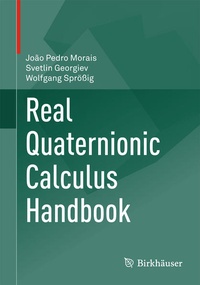
Real Quaternionic Calculus Handbook
Description
Reviews / Votes
"This book is not seen only as a handbook. The authors advocate it as a text book for a course delivered to undergraduates or graduates from disciplines other than mathematics. For this reason, the book is extensively peppered with exercises. . the book is a collaboration between three authors, from Portugal, Germany, and Bulgaria, all writing in English. Quite an achievement. As a handy reference work containing a summary of the main properties of quaternions, the book will prove useful." (Tony Crilly, The Mathematical Gazette, Vol. 105 (563), July, 2021)
From the book reviews:
"Morais (Univ. of Aveiro, Portugal), Georgiev (Sofia Univ., Bulgaria), and Spröig (Freiberg Univ. of Mining and Technology, Germany) focus on properties and formulas concerning quaternionic variations on basic special functions (exponential, logarithmic, trigonometric, hyperbolic, polynomial, binomial). Additionally, a chapter on linear algebra shows something of the delicate issues arising from noncommutative scalars. . Summing Up: Recommended. Upper-division undergraduates, faculty, and professionals/practitioners." (D. V. Feldman, Choice, Vol. 52 (5), January, 2015)
"Morais, Georgiev, and Sprößig's Real Quaternionic Calculus Handbook works through the fundamental properties and formulas necessary for working with quaternions. . there are lots of exercises throughout (with solutions), and it could be used as a text for an early graduate or advanced undergraduate course. I like it best as a self-study guide . . you are writing a test suite for quaternion computation in a computer algebra system, this is definitely the book for you." (Bill Wood,MAA Reviews, April, 2014)
"The book is structured into ten chapters followed by another one containing the solutions of the problems proposed at the end of each chapter. . the book is quite informative and could be of great value for peoples who want to enter into and advance in the fascinating world of quaternions." (Ivailo Mladenov, zbMATH, Vol. 1297, 2014)
More details
Other editions
Additional editions
Persons
João Pedro Morais (born 1982) is a Portuguese mathematician working in the areas of Clifford and quaternionic analysis. In 2009 he got his Ph.D. in mathematics from Bauhaus-University Weimar (Germany). At 2010 he joined the Institute of Applied Analysis at the Freiberg University of Mining and Technology (Germany) as a postdoctoral researcher. His research interests include approximation theory, conformal and quasiconformal mappings, signal and image processing. João Pedro Morais is currently working as a postdoctoral researcher at the University of Aveiro (Portugal).
Svetlin Georgiev (born 1974) is a Bulgarian mathematician working in areas of ordinary differential equations, partial differential equations, stochastic differential equations, Clifford algebras and Clifford analysis. He is currently a Professor at Sorbonne University (Paris, France).
Wolfgang Sprößig is Professor of Mathematics at the Technische Universität Bergakademie Freiberg (retired in 2012). His main research interests are the applications of quaternionic and Clifford algebraic methods to solve boundary and initial boundary value problems; he has published and co-authored 5 books and edited 6 further books, and special issues in several mathematical journals. Wolfgang Sproessig is Editor-in-Chief of the journal Mathematical Methods in the Applied Sciences and serves on the advisory board of 5 further journals. He has comprehensive teaching experience in different levels for about 40 years. For some years he served as external examiner at the Darussalam University (Sultanate Brunei).
Content
1 An introduction to quaternions.- 2 Quaternions and spatial rotation.- 3 Quaternion sequences.- 4 Quaternion series and infinite products.- 5 Exponents and logarithms.- 6 Trigonometric functions.- 7 Hyperbolic functions.- 8 Inverse hyperbolic and trigonometric functions.- 9 Quaternion matrices.- 10 Monomials, polynomials and binomials.- 11 Solutions.- Bibliography.- Index.