

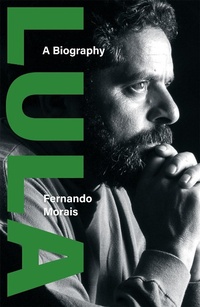
Lula
A Biography
Published on 17. September 2024
Book
Hardback
320 pages
978-1-80429-492-5 (ISBN)
Description
One of seven children raised in abject poverty by a single parent, Luiz Inacio Lula da Silva acquired his politics on the hard road of personal suffering, inspired by the selfless example of his mother. He started work at the age of eight and didn't learn to read for another two years. At twenty, he lost his wife and child. A union organizer in the 1980s, when Brazil still languished under military dictatorship, Lula helped form the Partido dos Trabalhadores (PT or Brazilian Workers' Party). His first steps in politics were faltering. He came last running for governor of Sao Paulo and would have retreated from electoral politics entirely were it not for the intercession of Fidel Castro.
More setbacks were to follow, but in 2003 Lula was elected president. He became one of the most popular politicians not only in Brazilian history but on the planet. His seven years in office saw millions of his compatriots lifted out of poverty. Disqualified from running for president in 2018, he was subsequently sentenced to nine and a half years in prison. That sentence was quashed in 2019, allowing Lula to defeat Jair Bolsonaro and win a third term.
Leading Brazilian journalist Fernando Morais has enjoyed direct, frank, and frequent access to his subject for decades. The result is a biography that paints a human portrait of grandeur and complexity.
More setbacks were to follow, but in 2003 Lula was elected president. He became one of the most popular politicians not only in Brazilian history but on the planet. His seven years in office saw millions of his compatriots lifted out of poverty. Disqualified from running for president in 2018, he was subsequently sentenced to nine and a half years in prison. That sentence was quashed in 2019, allowing Lula to defeat Jair Bolsonaro and win a third term.
Leading Brazilian journalist Fernando Morais has enjoyed direct, frank, and frequent access to his subject for decades. The result is a biography that paints a human portrait of grandeur and complexity.
Reviews / Votes
An affecting portrait which, while sympathetic - Morais repeatedly criticizes the elite distain, media bias and politically motivated lawfare Lula has suffered - feels emotionally true. -- Patrick Wilcken * Times Literary Supplement * An unconventional but riveting account -- Patrick Graney * Spectator * Morais has written his biography of Lula in a tight, suspenseful manner, keeping the reader riveted to the story unfolding with each page. -- Ron Jacobs * Counterpunch * For more than 40 years, journalist Fernando Morais and Luiz Inacio Lula da Silva have been comrades. And this has given the author of the biography of the ex-president a large collection of stories experienced not only by the character, but also by both of them, side by side. They were together, for example, when Lula led the metalworkers' strikes in the late 1970s and early 1980s, and they were also shared the tension of the days surrounding the Petista's latest arrest, decreed by former judge Sergio Moro in April 2018. -- Carlos Redel * GZH Books * Meticulously detailed...Lula's life story is crucial to understanding his rise-especially given its similarity to the experience of so many of Brazil's most downtrodden and vulnerable. -- Peter Taylor * Current Affairs * Exceptionally well written, organized and presented, "Lula" is extraordinarily informative and unreservedly recommended. * Midwest Book Review * Gramsci used to say that it is impossible to write the history of a party without at the same time writing the history of the country. Paraphrasing him, we can say that to dwell on the character embodied by Lula is to rediscover the history of Brazil over the last five decades. -- Luiz Marques * Teoria e debate * Lula: A Biography by Fernando Morais, fulfils its role by being one more voice to narrate and analyse historical facts and with this allows new understandings to emerge and through them, new ideas to be born that will be important for the transformations that the country needs. The work is relevant, also, for showing the magnetism that exists around Lula - be it for good or evil - which helps explain some of the idolatry that places him as one of the best (if not the best) President that Brazil has ever had and a strong candidate in the 2022 elections. -- Vanderson Silva * O Capacitor * The fact that the biographer is close to the subject, in principle, does not disqualify a work. After all, it will live on the shelves alongside books written by more critical authors. The question is whether the advantages of access to the character outweighed the disadvantages of the bias. From the moment Morais starts telling the story from the beginning, the answer is clearly yes. -- Celso Rocha de Barros * Folha de Sao Paulo * Fernando Morais was emphatic: in his biographies, he does not portray "bronze characters," only those of "flesh and blood." Launched in the second half of November, Lula is the 11th book by the journalist from Mariana (MG), who arrived breaking records in his nearly 50-year career as a writer: 60,000 copies sold in the first three weeks. -- Guilherme Cabral * A Uniao * In this sense, this book operates as a source for writing the history of the second half of the 20th century and the beginning of the 21st century. At the same time that it articulates with power, since it builds it as a "monument," perpetuating it voluntarily or involuntarily, Fernando Morais' work preserves a collective memory and stages the play between objectivity and subjectivity in which historical actors act simultaneously as subject and object of biographical discourse. -- Paulo Santos Silva * Mundos do Trabalho * Morais's book stands out for its access to its subject and the intimacy of its prose. The extensive research-hours of interviews with Lula and many others and firsthand reporting from recent events-is a monumental achievement, making Lula an important historical document. That its meticulous detail also makes for a compelling read is a testament to Morais's craft and Brian Mier's lively translation. -- Gianpaolo Baiocchi * The Boston Review * Morais's saga will rank among the most important examinations of one of the world's great democratic statesmen. -- Andre Pagliarini * Los Angeles Review of Books * The writing is accessible and often captivating, a style Morais has skillfully developed in his nearly five-decade journalism career. -- Alice Taylor * Spectre Journal *More details
Language
English
Place of publication
London
United Kingdom
Product notice
sewn/stitched
Cloth over boards
Dimensions
Height: 239 mm
Width: 161 mm
Thickness: 29 mm
Weight
480 gr
ISBN-13
978-1-80429-492-5 (9781804294925)
Copyright in bibliographic data and cover images is held by Nielsen Book Services Limited or by the publishers or by their respective licensors: all rights reserved.
Schweitzer Classification
Other editions
Additional editions
Person
FERNANDO MORAIS was born in Mariana, Minas Gerais, in 1946. Journalist, he worked for Jornal da Tarde, Veja, and several other Brazilian titles. He received the Esso Award three times and the Abril Journalism Award four times. He was a deputy (1979-1987) and Secretary of Culture (1988-1991) and Secretary of Education (1991-1993) of the State of Sao Paulo. He is the author of many books including The Last Soldiers of the Cold War: The Story of the Cuban Five from Verso and which was turned into a film for Netflix under the title Wasp Network - Who Were the Cuban Five?
Content
List of Political Party and Public Agency Abbreviations
Map of ABC, Sao Paulo
1. Sergio Moro orders Lula's arrest but he decides not to turn himself in to the Federal Police. "They'll have to come for me"
2. While searching Lula's home, the Federal Police stick a bug under his couch to secretly record conversations with his wife
3. GloboNews network runs a fake story-"Lula Will Resist Arrest!"-and its ratings rise by 694 percent
4. Emidio learns that the Federal Police had not one but several spies filming everything that happened inside the union hall
5. Aft er standing up to the neighbors and the Federal Police, the people spend 581 days yelling greetings to Lula. He can't see them from his cell, but he can hear them
6. A hacker named Red opens to the gates of hell and the Supreme Court buries Moro and the Car Wash investigation. Lula steps out of prison as a presidential candidate
7. Jardim Lavinia, April 1980-With the police at the door to arrest him, Lula growls, "I'm sleeping, damn it! They can go fuck themselves!"
8. Navy intelligence intercepts communications from the Curia and reveals that Cardinal Arns asked the German Catholic Church to support the ABC Metalworkers' strike fund
9. After a cruel childhood in abject poverty, Lula receives the key to paradise: a diploma from SENAI technical school
10. Lula's fiancee gives an ultimatum: "You have to choose between the union and marriage. You can't have both"
11. "I know, doctor, my baby was born dead." "Be strong, Mr. Lula, because the news is worse: Your wife Lourdes died too"
12. During his first visit to a foreign country, Lula rushes home from Tokyo: his brother is being tortured in a DOI-CODI prison
13. After years denigrating the political class, Lula starts building the foundation for the Workers' Party
14. While Lula faces the police and the bosses in ABC, Brizola tries to resuscitate the PTB party and is blocked by Golbery
15. Lula brings together workers, politicians, intellectuals, and leftist activists to create the Workers' Party and is arrested two months later
16. In the middle of the night, a polite man in a tie interrogates Lula in a cubicle in DOPS, sent by a general codenamed "the chief"
17. Clobbered in the polls, Lula sinks into depression and decides to abandon politics. He travels to Cuba, listens to Fidel, and returns to Brazil to become the best-elected congressman in history
Epilogue
Appendix: An X-ray of the Large Communications Companies' War against Lula and His Party
Index
Map of ABC, Sao Paulo
1. Sergio Moro orders Lula's arrest but he decides not to turn himself in to the Federal Police. "They'll have to come for me"
2. While searching Lula's home, the Federal Police stick a bug under his couch to secretly record conversations with his wife
3. GloboNews network runs a fake story-"Lula Will Resist Arrest!"-and its ratings rise by 694 percent
4. Emidio learns that the Federal Police had not one but several spies filming everything that happened inside the union hall
5. Aft er standing up to the neighbors and the Federal Police, the people spend 581 days yelling greetings to Lula. He can't see them from his cell, but he can hear them
6. A hacker named Red opens to the gates of hell and the Supreme Court buries Moro and the Car Wash investigation. Lula steps out of prison as a presidential candidate
7. Jardim Lavinia, April 1980-With the police at the door to arrest him, Lula growls, "I'm sleeping, damn it! They can go fuck themselves!"
8. Navy intelligence intercepts communications from the Curia and reveals that Cardinal Arns asked the German Catholic Church to support the ABC Metalworkers' strike fund
9. After a cruel childhood in abject poverty, Lula receives the key to paradise: a diploma from SENAI technical school
10. Lula's fiancee gives an ultimatum: "You have to choose between the union and marriage. You can't have both"
11. "I know, doctor, my baby was born dead." "Be strong, Mr. Lula, because the news is worse: Your wife Lourdes died too"
12. During his first visit to a foreign country, Lula rushes home from Tokyo: his brother is being tortured in a DOI-CODI prison
13. After years denigrating the political class, Lula starts building the foundation for the Workers' Party
14. While Lula faces the police and the bosses in ABC, Brizola tries to resuscitate the PTB party and is blocked by Golbery
15. Lula brings together workers, politicians, intellectuals, and leftist activists to create the Workers' Party and is arrested two months later
16. In the middle of the night, a polite man in a tie interrogates Lula in a cubicle in DOPS, sent by a general codenamed "the chief"
17. Clobbered in the polls, Lula sinks into depression and decides to abandon politics. He travels to Cuba, listens to Fidel, and returns to Brazil to become the best-elected congressman in history
Epilogue
Appendix: An X-ray of the Large Communications Companies' War against Lula and His Party
Index