

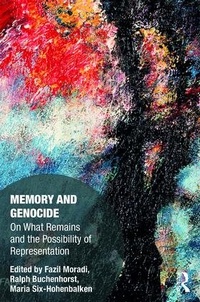
Memory and Genocide
On What Remains and the Possibility of Representation
1st Edition
Published on 6. April 2017
Book
Hardback
198 pages
978-1-4724-8201-3 (ISBN)
Description
This book focuses on the ethical, aesthetic, and scholarly dimensions of how genocide-related works of art, documentary films, poetry and performance, museums and monuments, music, dance, image, law, memory narratives, spiritual bonds, and ruins are translated and take place as translations of acts of genocide. It shows how genocide-related modes of representation are acts of translation which displace and produce memory and acts of remembrance of genocidal violence as inheritance of the past in a future present. Thus, the possibility of representation is examined in light of what remains in the aftermath where the past and the future are inseparable companions and we find the idea of the untranslatability in acts of genocide. By opening up both the past and lived experiences of genocidal violence as and through multiple acts of translation, this volume marks a heterogeneous turn towards the future, and one which will be of interest to all scholars and students of memory and genocide studies, transitional justice, sociology, psychology, and social anthropology.
Reviews / Votes
'When the survivors of genocide have passed away, their testimonies have aged, and guilty camps have turned into museums, then this superb collection will help us understand the unending attempts to remember and represent the horrendous violence in performances, narratives, and art works.' - Antonius C. G. M. Robben, Utrecht University, Netherlands, author of Political Violence and Trauma in Argentina'This remarkable collection engages with the challenging problem of how human beings cope with genocidal violence, through narratives, performances, visual representations and other modes of translation and remembrance. These richly contextualized case studies go a long way towards reminding us that extreme violence can be an occasion for socially productive forms of narration and recollection which resist the utter despair and speechlessness that accompany genocide.' - Arjun Appadurai, New York University, USA
More details
Series
Language
English
Place of publication
London
United Kingdom
Publishing group
Taylor & Francis Ltd
Target group
College/higher education
Illustrations
4 s/w Photographien bzw. Rasterbilder
4 Halftones, black and white
Dimensions
Height: 234 mm
Width: 156 mm
Weight
530 gr
ISBN-13
978-1-4724-8201-3 (9781472482013)
Copyright in bibliographic data and cover images is held by Nielsen Book Services Limited or by the publishers or by their respective licensors: all rights reserved.
Schweitzer Classification
Other editions
Additional editions
Fazil Moradi | Ralph Buchenhorst | Maria Six-Hohenbalken
Memory and Genocide
On What Remains and the Possibility of Representation
Book
10/2018
1st Edition
Routledge
€64.00
Shipment within 15-20 days
Fazil Moradi | Ralph Buchenhorst | Maria Six-Hohenbalken
Memory and Genocide
On What Remains and the Possibility of Representation
E-Book
04/2017
Routledge
€64.49
Available for download
Fazil Moradi | Ralph Buchenhorst | Maria Six-Hohenbalken
Memory and Genocide
On What Remains and the Possibility of Representation
E-Book
04/2017
Routledge
€64.49
Available for download
Persons
Fazil Moradi is finalizing his PhD thesis at Max Planck Institute for Social Anthropology and the University of Halle-Wittenberg in Germany.
Ralph Buchenhorst is a Senior Researcher at Halle University. He received his PhD from the University of Vienna and his habilitation from the University of Potsdam in Germany. Buchenhorst has been a DAAD Guest Professor at the University of Buenos Aires (2002-2006) and at the Hebrew University of Jerusalem (2013).
Maria Six-Hohenbalken is a Researcher at the Institute for Social Anthropology, Austrian Academy of Sciences, and Lecturer at the Department for Social and Cultural Anthropology, University of Vienna.
Ralph Buchenhorst is a Senior Researcher at Halle University. He received his PhD from the University of Vienna and his habilitation from the University of Potsdam in Germany. Buchenhorst has been a DAAD Guest Professor at the University of Buenos Aires (2002-2006) and at the Hebrew University of Jerusalem (2013).
Maria Six-Hohenbalken is a Researcher at the Institute for Social Anthropology, Austrian Academy of Sciences, and Lecturer at the Department for Social and Cultural Anthropology, University of Vienna.
Content
List of Figures
Acknowledgements
Notes on Contributors
Preface, by Guenther Schlee
Introduction: The Past in Translation
Fazil Moradi, Maria Six-Hohenbalken, Ralph Buchenhorst
Intimate Interrogations: The Literary Grammar of Communal Violence
Christi Merill
Oral Performers and Memory of Mass Violence: Dynamics of Collective and Individual Remembering
Laury Ocen
Parallel Readings: Narratives of Violence
Eva Kovacs
Genocide in Translation: On Memory, Remembrance, and Politics of the Future
Fazil Moradi
Remembering the Poison Gas Attack on Halabja: Questions of Representations in the Emergence of Memory on Genocide
Maria Six-Hohenbalken
Afterlives of Genocide: Return of Human Bodies from Berlin to Windhoek, 2011
Memory Biwa
Communicating the Unthinkable: A Psychodynamic Perspective
Ivana Macek
Between Nakba, Shoah and Apartheid: Notes on a Film from the Interstices
Heidi Grunebaum
The Rethinking of Remembering: Who Lays Claim to Speech in the Wake of Catastrophe?
Rachmi Diyah Larasati
Field, Forum, and Vilified Art: Recent Developments in the Representation of Mass Violence and its Remembrance
Ralph Buchenhorst
Afterword: Wonder Woman, the Gutter, and Critical Genocide Studies
Alexander Laban Hinton
Index
Acknowledgements
Notes on Contributors
Preface, by Guenther Schlee
Introduction: The Past in Translation
Fazil Moradi, Maria Six-Hohenbalken, Ralph Buchenhorst
Intimate Interrogations: The Literary Grammar of Communal Violence
Christi Merill
Oral Performers and Memory of Mass Violence: Dynamics of Collective and Individual Remembering
Laury Ocen
Parallel Readings: Narratives of Violence
Eva Kovacs
Genocide in Translation: On Memory, Remembrance, and Politics of the Future
Fazil Moradi
Remembering the Poison Gas Attack on Halabja: Questions of Representations in the Emergence of Memory on Genocide
Maria Six-Hohenbalken
Afterlives of Genocide: Return of Human Bodies from Berlin to Windhoek, 2011
Memory Biwa
Communicating the Unthinkable: A Psychodynamic Perspective
Ivana Macek
Between Nakba, Shoah and Apartheid: Notes on a Film from the Interstices
Heidi Grunebaum
The Rethinking of Remembering: Who Lays Claim to Speech in the Wake of Catastrophe?
Rachmi Diyah Larasati
Field, Forum, and Vilified Art: Recent Developments in the Representation of Mass Violence and its Remembrance
Ralph Buchenhorst
Afterword: Wonder Woman, the Gutter, and Critical Genocide Studies
Alexander Laban Hinton
Index