

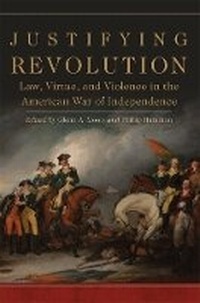
Justifying Revolution
Law, Virtue, and Violence in the American War of Independence
Published on 30. June 2018
Book
Hardback
336 pages
978-0-8061-6013-9 (ISBN)
Description
The American imagination still exalts the Founders as the prime movers of the Revolution, and the War of Independence has become the stuff of legend. But America is not simply the invention of great men or the outcome of an inevitable political or social movement. The nation was the result of a hard, bloody, and destructive war. Justifying Revolution explores how the American Revolution's opposing sides wrestled with thorny moral and legal questions. How could revolutionaries justify provoking a civil war, how should their opponents subdue the uprising, and how did military commanders restrain the ensuing violence?
Drawing from a variety of disciplines and specialties, the authors assembled here examine the Revolutionary War in terms of just war theory: jus ad bellum, jus in bello, and jus post bellum - right or justice in going to, conducting, and concluding war. The chapters situate the Revolution in the context of early modern international relations, moral philosophy, military ethics, jurisprudence, and theology. The authors invite readers to reconsider the war with an eye to the justice and legality of entering armed conflict; the choices made by officers and soldiers in combat; and attempts to arrive at defensible terms of peace. Together, the contributions form the first sustained exploration of Americans' and Britons' use of just war theory as they battled over American independence.
Justifying Revolution raises important questions about the political, legal, military, religious, philosophical, and diplomatic ramifications of eighteenth-century warfare - questions essential for understanding America's origins.
Drawing from a variety of disciplines and specialties, the authors assembled here examine the Revolutionary War in terms of just war theory: jus ad bellum, jus in bello, and jus post bellum - right or justice in going to, conducting, and concluding war. The chapters situate the Revolution in the context of early modern international relations, moral philosophy, military ethics, jurisprudence, and theology. The authors invite readers to reconsider the war with an eye to the justice and legality of entering armed conflict; the choices made by officers and soldiers in combat; and attempts to arrive at defensible terms of peace. Together, the contributions form the first sustained exploration of Americans' and Britons' use of just war theory as they battled over American independence.
Justifying Revolution raises important questions about the political, legal, military, religious, philosophical, and diplomatic ramifications of eighteenth-century warfare - questions essential for understanding America's origins.
More details
Series
Language
English
Place of publication
Oklahoma
United States
Target group
Professional and scholarly
Illustrations
1 table
Dimensions
Height: 229 mm
Width: 152 mm
Thickness: 26 mm
Weight
594 gr
ISBN-13
978-0-8061-6013-9 (9780806160139)
Copyright in bibliographic data and cover images is held by Nielsen Book Services Limited or by the publishers or by their respective licensors: all rights reserved.
Schweitzer Classification
Persons
Glenn A. Moots is Professor of Political Science and Philosophy at Northwood University, Midland, Michigan, and the author of Politics Reformed: The Anglo-American Legacy of Covenant Theology.
Phillip Hamilton is Professor of History at Christopher Newport University, Newport News, Virginia, and the author of The Making and Unmaking of a Revolutionary Family: The Tuckers of Virginia, 1752-1830.
Phillip Hamilton is Professor of History at Christopher Newport University, Newport News, Virginia, and the author of The Making and Unmaking of a Revolutionary Family: The Tuckers of Virginia, 1752-1830.