

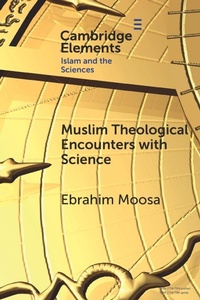
Muslim Theological Encounters with Science
Kaleidoscopes of Knowledge Over Time
Published on 28. May 2026
Book
Paperback/Softback
90 pages
978-1-009-30847-2 (ISBN)
Description
Muslim Theological Encounters with Science dismantles the 'Islamic decline' narrative by showing how science and theology have long coexisted in Muslim civilization. Premodern thinkers navigated enduring tensions between reason and revelation, ensuring that intellectual disagreement fostered growth rather than hostility. Modern friction between science and Muslim theology-driven by colonialism, limited scientific literacy, and the absence of a science-attuned common sense among theologians-has often, though not exclusively, stemmed from adherence to outdated theological models. The author proposes a 'symphonic and braided' framework for relating science and theology, treating them as distinct yet complementary languages of meaning-making. Cultivating humility and imagination emerges as essential to human understanding. By avoiding the trap of forced convergence, this framework allows science to explain the 'how' while theology addresses the 'why,' together weaving a more complex and resilient pursuit of the truth. This title is also available as Open Access on Cambridge Core.
More details
Series
Language
English
Place of publication
Cambridge
United Kingdom
Product notice
Paperback (trade)
Illustrations
Worked examples or Exercises
Dimensions
Height: 229 mm
Width: 152 mm
Thickness: 6 mm
Weight
145 gr
ISBN-13
978-1-009-30847-2 (9781009308472)
Copyright in bibliographic data and cover images is held by Nielsen Book Services Limited or by the publishers or by their respective licensors: all rights reserved.
Schweitzer Classification
Other editions
Additional editions
Book
05/2026
Cambridge University Press
€68.20
Shipment within 15-20 days
Person
Content
1. Introduction; 2. Sketch of antique Muslim dialectical theology (?ilm al-kalam) and natural philosophy; 3. Traditional hermeneutics and the interpretation of natural signs in the Qur?an; 4. Towards a symphonic and braided Islamic theology; 5. Conclusion: Symphonic and braided thinking; Bibliography.