

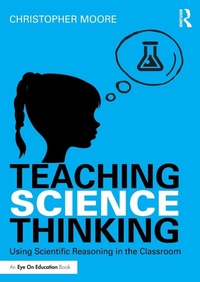
Teaching Science Thinking
Using Scientific Reasoning in the Classroom
1st Edition
Published on 20. November 2018
Book
Paperback/Softback
210 pages
978-1-138-23796-4 (ISBN)
Description
Teach your students how to think like scientists. This book shows you practical ways to incorporate science thinking in your classroom using simple "Thinking Tasks" that you can insert into any lesson. What is science thinking and how can you possibly teach and assess it? How is science thinking incorporated into the Next Generation Science Standards (NGSS) and how can it be weaved into your curriculum? This book answers these questions.
This practical book provides a clear, research-verified framework for helping students develop scientific thinking as required by the NGSS. Your students will not be memorizing content but will become engaged in the real work scientists do, using critical thinking patterns such as:
Recognizing patterns,
Inventing new hypotheses based on observations,
Separating causes from correlations,
Determining relevant variables and isolating them,
Testing hypotheses, and
Thinking about their own thinking and the relative value of evidence.
The book includes a variety of sample classroom activities and rubrics, as well as frameworks for creating your own tools. Designed for the busy teacher, this book also shows you quick and simple ways to add deep science thinking to existing lessons.
This practical book provides a clear, research-verified framework for helping students develop scientific thinking as required by the NGSS. Your students will not be memorizing content but will become engaged in the real work scientists do, using critical thinking patterns such as:
Recognizing patterns,
Inventing new hypotheses based on observations,
Separating causes from correlations,
Determining relevant variables and isolating them,
Testing hypotheses, and
Thinking about their own thinking and the relative value of evidence.
The book includes a variety of sample classroom activities and rubrics, as well as frameworks for creating your own tools. Designed for the busy teacher, this book also shows you quick and simple ways to add deep science thinking to existing lessons.
More details
Language
English
Place of publication
London
United Kingdom
Publishing group
Taylor & Francis Ltd
Target group
Professional and scholarly
Professional and Professional Practice & Development
Illustrations
14 s/w Photographien bzw. Rasterbilder, 22 s/w Zeichnungen, 31 s/w Tabellen
31 Tables, black and white; 22 Line drawings, black and white; 14 Halftones, black and white
Dimensions
Height: 246 mm
Width: 174 mm
Thickness: 12 mm
Weight
387 gr
ISBN-13
978-1-138-23796-4 (9781138237964)
Copyright in bibliographic data and cover images is held by Nielsen Book Services Limited or by the publishers or by their respective licensors: all rights reserved.
Schweitzer Classification
Other editions
Additional editions
Book
11/2018
1st Edition
Routledge
€133.69
Shipment within 10-20 days
E-Book
11/2018
Routledge
€36.49
Available for download
E-Book
11/2018
1st Edition
Routledge
€36.49
Available for download
Person
Christopher Moore is the Dr. George F. Haddix Community Chair in Physical Science and associate professor of physics education at the University of Nebraska Omaha, USA. He is also the author of Creating Scientists: Teaching and Assessing Science Practice for the NGSS.
Content
Introduction: Cooks versus chefs. Knowing versus understanding. Part I: Teaching and learning science thinking Chapter 1: What is science thinking? Chapter 2: How is science thinking integrated into next generation standards? Chapter 3: How do you teach and assess science thinking? Part II: Science thinking in the classroom Chapter 4: Recognizing patterns and making connections Chapter 5: What's important, what's not, and designing a fair test Chapter 6: Testing our crazy ideas with experiments Chapter 7: What does this evidence tell me, and do I believe it? Part III: Putting it all together Chapter 8: Weaving science thinking into curriculum