

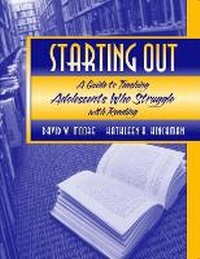
Starting Out
A Guide to Teaching Adolescents Who Struggle with Reading
Published on 30. October 2002
Book
Paperback/Softback
256 pages
978-0-321-07810-0 (ISBN)
Description
Starting Out presents feasible classroom practices for teaching middle and high school students who struggle as readers and writers.
Respected authors David Moore and Kathleen Hinchman provide sound advice on how to address the fundamentals of teaching adolescents. This affordable, long-awaited text is a practical, down-to-earth guide written in easy-to-read prose. Ideal for today's busy teachers, it emphasizes the important preliminary steps to take during the first few days and weeks of class. In an era of teacher shortages, this text is a welcome addition and a must-have for people entering the profession with abbreviated preparation and who are, for the first time, encountering adolescents who struggle with literacy.
Respected authors David Moore and Kathleen Hinchman provide sound advice on how to address the fundamentals of teaching adolescents. This affordable, long-awaited text is a practical, down-to-earth guide written in easy-to-read prose. Ideal for today's busy teachers, it emphasizes the important preliminary steps to take during the first few days and weeks of class. In an era of teacher shortages, this text is a welcome addition and a must-have for people entering the profession with abbreviated preparation and who are, for the first time, encountering adolescents who struggle with literacy.
More details
Language
English
Place of publication
United States
Publishing group
Pearson Education (US)
Target group
Professional and scholarly
Dimensions
Height: 235 mm
Width: 178 mm
Weight
426 gr
ISBN-13
978-0-321-07810-0 (9780321078100)
Copyright in bibliographic data and cover images is held by Nielsen Book Services Limited or by the publishers or by their respective licensors: all rights reserved.
Schweitzer Classification
Other editions
New editions
David W. Moore | Kathleen A. Hinchman
Teaching Adolescents Who Struggle with Reading
Practical Strategies
Book
04/2005
Pearson
€50.24
Article is exhausted; no reprint
Content
Every chapter concludes with "Conclusion" and "References."
1. Perspectives.
An Instructional Setting for All Learners.
Metaphors for Adolescent Literacy and Instruction.
Background on Adolescents Who Struggle as Readers.
2. Before School Starts.
Classroom Culture.
Classroom Structure.
3. Framing and Launching Units of Instruction.
Framing Units.
Launching Units.
4. Weaving Literacy Through Units of Instruction.
Selecting Literacy Strands.
Isolating and Integrating Unit Strands.
Examples of Literacy Strands.
5. Moving Toward Differentiation.
Initiating Group Instruction.
Accommodating Individuals.
6. Interventions in Special Classes.
Dimensions of Responsive Interventions.
Interventions Utilizing the Four Resources Model.
7. Connections Beyond the Classroom.
Home-School.
Cross-Age.
Community-School.
Cultural Ties.
Professional Development.
School Structures.
8. Classroom Assessments.
Classroom Support Assessments.
Grading.
9. Program Leadership.
Beginning a School-Wide Reading Program.
Structures for School-Wide Literacy Improvement.
10. Program Profiles.
School-Wide.
Interventions.
1. Perspectives.
An Instructional Setting for All Learners.
Metaphors for Adolescent Literacy and Instruction.
Background on Adolescents Who Struggle as Readers.
2. Before School Starts.
Classroom Culture.
Classroom Structure.
3. Framing and Launching Units of Instruction.
Framing Units.
Launching Units.
4. Weaving Literacy Through Units of Instruction.
Selecting Literacy Strands.
Isolating and Integrating Unit Strands.
Examples of Literacy Strands.
5. Moving Toward Differentiation.
Initiating Group Instruction.
Accommodating Individuals.
6. Interventions in Special Classes.
Dimensions of Responsive Interventions.
Interventions Utilizing the Four Resources Model.
7. Connections Beyond the Classroom.
Home-School.
Cross-Age.
Community-School.
Cultural Ties.
Professional Development.
School Structures.
8. Classroom Assessments.
Classroom Support Assessments.
Grading.
9. Program Leadership.
Beginning a School-Wide Reading Program.
Structures for School-Wide Literacy Improvement.
10. Program Profiles.
School-Wide.
Interventions.