

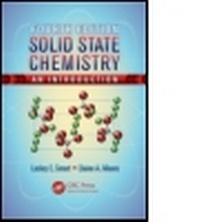
Solid State Chemistry
An Introduction, Fourth Edition
4th Edition
Published on 31. May 2012
Book
Paperback/Softback
494 pages
978-1-4398-4790-9 (ISBN)
Description
Building a foundation with a thorough description of crystalline structures, Solid State Chemistry: An Introduction, Fourth Edition presents a wide range of the synthetic and physical techniques used to prepare and characterize solids. Going beyond basic science, the book explains and analyzes modern techniques and areas of research.
The book covers:
A range of synthetic and physical techniques used to prepare and characterize solids
Bonding, superconductivity, and electrochemical, magnetic, optical, and conductive properties
STEM, ionic conductivity, nanotubes and related structures such as graphene, metal organic frameworks, and FeAs superconductors
Biological systems in synthesis, solid state modeling, and metamaterials
This largely nonmathematical introduction to solid state chemistry includes basic crystallography and structure determination, as well as practical examples of applications and modern developments to offer students the opportunity to apply their knowledge in real-life situations and serve them well throughout their degree course.
New in the Fourth Edition
Coverage of multiferroics, graphene, and iron-based high temperature superconductors, the techniques available with synchrotron radiation, and metal organic frameworks (MOFs)
More space devoted to electron microscopy and preparative methods
New discussion of conducting polymers in the expanded section on carbon nanoscience
The book covers:
A range of synthetic and physical techniques used to prepare and characterize solids
Bonding, superconductivity, and electrochemical, magnetic, optical, and conductive properties
STEM, ionic conductivity, nanotubes and related structures such as graphene, metal organic frameworks, and FeAs superconductors
Biological systems in synthesis, solid state modeling, and metamaterials
This largely nonmathematical introduction to solid state chemistry includes basic crystallography and structure determination, as well as practical examples of applications and modern developments to offer students the opportunity to apply their knowledge in real-life situations and serve them well throughout their degree course.
New in the Fourth Edition
Coverage of multiferroics, graphene, and iron-based high temperature superconductors, the techniques available with synchrotron radiation, and metal organic frameworks (MOFs)
More space devoted to electron microscopy and preparative methods
New discussion of conducting polymers in the expanded section on carbon nanoscience
Reviews / Votes
"Smart and Moore are engaging writers, providing clear explanations for concepts in solid-state chemistry from the atomic/molecular perspective. The fourth edition is a welcome addition to my bookshelves. ... What I like most about Solid State Chemistry is that it gives simple clear descriptions for a large number of interesting materials and correspondingly clear explanations of their applications. Solid State Chemistry could be used for a solid state textbook at the third or fourth year undergraduate level, especially for chemistry programs. It is also a useful resource for beginning graduate students in materials chemistry, physics and engineering programs, and for materials researchers at all levels of experience."-Mary Anne White, Dalhousie University, Halifax, Canada, Journal of Materials Education Vol. 35, 2013
More details
Edition
4th New edition
Language
English
Place of publication
Bosa Roca
United States
Publishing group
Taylor & Francis Inc
Target group
College/higher education
Undergraduates and graduates in chemistry, chemical engineering, nanoscience, and chemistry-related sciences; materials scientists; and chemical engineers.
Edition type
New edition
Illustrations
61 s/w Tabellen, 396 s/w Abbildungen
approx 142 equations; 61 Tables, black and white; 396 Illustrations, black and white
Dimensions
Height: 235 mm
Width: 156 mm
Weight
839 gr
ISBN-13
978-1-4398-4790-9 (9781439847909)
Copyright in bibliographic data and cover images is held by Nielsen Book Services Limited or by the publishers or by their respective licensors: all rights reserved.
Schweitzer Classification
Other editions
New editions
Book
08/2020
5th Edition
CRC Press
€51.98
Article exhausted; check for reprint
Additional editions
Book
07/2017
4th Edition
CRC Press
€237.70
Withdrawn from sale
Previous edition
Book
06/2005
3rd Edition
Nelson Thornes Ltd
€88.08
Article exhausted; check for reprint
Persons
Lesley Smart studied Chemistry at Southampton University, UK and after completing a Ph.D. in Raman spectroscopy, she moved to a lectureship at the (then) Royal University of Malta. After returning to the United Kingdom, she took an SRC Fellowship to Bristol University to work on X-ray crystallography. From 1977-2009 she worked at the Open University Chemistry Department as a Lecturer, Senior Lecturer and Molecular Science Programme Director, and since retiring holds an honorary senior lectureship there.
At the Open University, she was involved in the production of undergraduate courses in inorganic and physical chemistry and health sciences. She was the coordinating editor and an author of The Molecular World course, a series of eight books and DVDs co-published with the Royal Society of Chemistry, authoring two of these (2002), The Third Dimension and Separation, Purification and Identification. Her most recent books are (2007) Alcohol and Human Health and (2010) Concepts in Transition Metal Chemistry. She has an entry in Mothers in Science: 64 ways to have it all (downloadable from the Royal Society website). She has served on the Council of the Royal Society of Chemistry and as the Chair of their Benevolent Fund.
Her research interests are in the characterization of the solid state, and she has publications in single-crystal Raman studies, X-ray crystallography, zintl phases, pigments, and heterogeneous catalysis and fuel cells.
Elaine Moore studied Chemistry as an undergraduate at Oxford University and then stayed on to complete a D.Phil in Theoretical Chemistry with Peter Atkins. After a two-year post-doctoral position at Southampton, she joined The Open University in 1975 as Course Assistant, becoming a Lecturer in Chemistry in 1977, Senior Lecturer in 1998, and Reader in 2004. She has produced OU teaching texts in Chemistry for Courses at levels 1, 2, and 3 and written texts in Astronomy at level 2 and Physics at level 3. She is co-author of Metal-Ligand Bonding, and the text Molecular Modelling and Bonding, which forms part of the OU level 2 Chemistry Course, was co-published by the Royal Society of Chemistry as part of The Molecular World series. She oversaw the introduction of multimedia into chemistry courses and has designed multimedia material at levels 1, 2 and 3. She is co-author of Metals and Life and of Concepts in Transition Metal Chemistry, which are part of a level 3 Open University Course in Inorganic Chemistry and co-published with the Royal Society of Chemistry.
Her research interests are in theoretical chemistry applied to solid state systems and to NMR spectroscopy. She is author or co-author on over 50 papers in scientific journals.
At the Open University, she was involved in the production of undergraduate courses in inorganic and physical chemistry and health sciences. She was the coordinating editor and an author of The Molecular World course, a series of eight books and DVDs co-published with the Royal Society of Chemistry, authoring two of these (2002), The Third Dimension and Separation, Purification and Identification. Her most recent books are (2007) Alcohol and Human Health and (2010) Concepts in Transition Metal Chemistry. She has an entry in Mothers in Science: 64 ways to have it all (downloadable from the Royal Society website). She has served on the Council of the Royal Society of Chemistry and as the Chair of their Benevolent Fund.
Her research interests are in the characterization of the solid state, and she has publications in single-crystal Raman studies, X-ray crystallography, zintl phases, pigments, and heterogeneous catalysis and fuel cells.
Elaine Moore studied Chemistry as an undergraduate at Oxford University and then stayed on to complete a D.Phil in Theoretical Chemistry with Peter Atkins. After a two-year post-doctoral position at Southampton, she joined The Open University in 1975 as Course Assistant, becoming a Lecturer in Chemistry in 1977, Senior Lecturer in 1998, and Reader in 2004. She has produced OU teaching texts in Chemistry for Courses at levels 1, 2, and 3 and written texts in Astronomy at level 2 and Physics at level 3. She is co-author of Metal-Ligand Bonding, and the text Molecular Modelling and Bonding, which forms part of the OU level 2 Chemistry Course, was co-published by the Royal Society of Chemistry as part of The Molecular World series. She oversaw the introduction of multimedia into chemistry courses and has designed multimedia material at levels 1, 2 and 3. She is co-author of Metals and Life and of Concepts in Transition Metal Chemistry, which are part of a level 3 Open University Course in Inorganic Chemistry and co-published with the Royal Society of Chemistry.
Her research interests are in theoretical chemistry applied to solid state systems and to NMR spectroscopy. She is author or co-author on over 50 papers in scientific journals.
Content
An introduction to crystal structures
Introduction
Close-packing
Body-centred and primitive structures
Symmetry
Lattices and unit cells
Crystalline solids
Lattice Energy
?
Physical methods for characterizing solids
Introduction
X-ray Diffraction
Powder Diffraction
Single Crystal X-ray Diffraction
Neutron Diffraction
Electron Microscopy
Scanning Probe Microscopy, SPM
Atomic Force Microscopy, AFM
X-ray Absorption Spectroscopy, XAS
Solid-state Nuclear Magnetic Resonance Spectroscopy
Thermal Analysis
Temperature Programmed Reduction, TPR
Other Techniques
?
Synthesis of solids
Introduction
High temperature ceramic methods
Microwave synthesis
Combustion synthesis
High pressure methods
Chemical vapour deposition (CVD)
Preparing single crystals
Intercalation
Synthesis of Nanomaterials
Choosing a method
?
Bonding in solids and their electronic properties
Bonding in solids - free electron theory
Bonding in solids - molecular orbital theory
Semiconductors - Si and Ge
Bands in compounds - Gallium Arsenide
Bands in d-block compounds - transition metal monoxides
Classical Modelling
Defects and non-stoichiometry
Point Defects - an introduction
Defects and their concentration
Ionic conductivity in solids
Solid Electrolytes
Applications of solid electrolytes
Colour Centres
Non-stoichiometric compounds
Extended defects
Three-dimensional defects
Electronic properties of non-stoichiometric oxides
?
Microporous and Mesoporous solids
Zeolites
Other microporous framework structures
Mesoporous structures
New materials
Clay minerals
?
Optical properties of solids
Introduction
The interaction of light with atoms
Absorption and emission of radiation in continuous solids
Refraction
Photonic Crystals
Metamaterials - 'cloaks of invisibility'
Magnetic and Electrical Properties
Introduction
Magnetic susceptibility
Paramagnetism in metal complexes
Ferromagnetic metals
Ferromagnetic compounds - chromium dioxide
Antiferromagnetism - transition metal monoxides
Ferrimagnetism - ferrites
Spiral Magnetism
Giant, Tunnelling, and Colossal Magnetoresistance
Electrical polarisation
Piezoelectric crystals
The Ferroelectric Effect
Multiferroics
Superconductivity
Introduction
Conventional superconductors
High temperature superconductors
Uses of high-temperature superconductors
?
Nanostructures and solids with low-dimensional properties
Nanoscience
Consequences of the nanoscale
Low-dimensional and nano-structural carbon
Carbon-based conducting polymers
Non-carbon nanoparticles
Non-carbon nanofilms and nanolayers
Non-carbon nanotubes, nanorods and nanowires
Introduction
Close-packing
Body-centred and primitive structures
Symmetry
Lattices and unit cells
Crystalline solids
Lattice Energy
?
Physical methods for characterizing solids
Introduction
X-ray Diffraction
Powder Diffraction
Single Crystal X-ray Diffraction
Neutron Diffraction
Electron Microscopy
Scanning Probe Microscopy, SPM
Atomic Force Microscopy, AFM
X-ray Absorption Spectroscopy, XAS
Solid-state Nuclear Magnetic Resonance Spectroscopy
Thermal Analysis
Temperature Programmed Reduction, TPR
Other Techniques
?
Synthesis of solids
Introduction
High temperature ceramic methods
Microwave synthesis
Combustion synthesis
High pressure methods
Chemical vapour deposition (CVD)
Preparing single crystals
Intercalation
Synthesis of Nanomaterials
Choosing a method
?
Bonding in solids and their electronic properties
Bonding in solids - free electron theory
Bonding in solids - molecular orbital theory
Semiconductors - Si and Ge
Bands in compounds - Gallium Arsenide
Bands in d-block compounds - transition metal monoxides
Classical Modelling
Defects and non-stoichiometry
Point Defects - an introduction
Defects and their concentration
Ionic conductivity in solids
Solid Electrolytes
Applications of solid electrolytes
Colour Centres
Non-stoichiometric compounds
Extended defects
Three-dimensional defects
Electronic properties of non-stoichiometric oxides
?
Microporous and Mesoporous solids
Zeolites
Other microporous framework structures
Mesoporous structures
New materials
Clay minerals
?
Optical properties of solids
Introduction
The interaction of light with atoms
Absorption and emission of radiation in continuous solids
Refraction
Photonic Crystals
Metamaterials - 'cloaks of invisibility'
Magnetic and Electrical Properties
Introduction
Magnetic susceptibility
Paramagnetism in metal complexes
Ferromagnetic metals
Ferromagnetic compounds - chromium dioxide
Antiferromagnetism - transition metal monoxides
Ferrimagnetism - ferrites
Spiral Magnetism
Giant, Tunnelling, and Colossal Magnetoresistance
Electrical polarisation
Piezoelectric crystals
The Ferroelectric Effect
Multiferroics
Superconductivity
Introduction
Conventional superconductors
High temperature superconductors
Uses of high-temperature superconductors
?
Nanostructures and solids with low-dimensional properties
Nanoscience
Consequences of the nanoscale
Low-dimensional and nano-structural carbon
Carbon-based conducting polymers
Non-carbon nanoparticles
Non-carbon nanofilms and nanolayers
Non-carbon nanotubes, nanorods and nanowires