

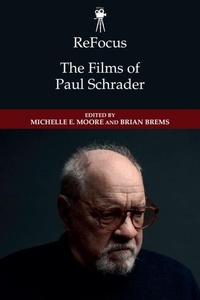
ReFocus: The Films of Paul Schrader
Published on 30. May 2022
Book
Paperback/Softback
272 pages
978-1-4744-6204-4 (ISBN)
Description
Offers the first comprehensive academic text to explore Paul Schrader's film career through analysis of his directing, screenwriting, and film criticism
Contains a chapter-length interview, in which Schrader examines the arc of his career for the first time and revises previous statements about filmmaking and film criticismProvides a valuable update to previous texts on SchraderConsiders Schrader's overlooked films and provides new insight into their connections with Schrader's better known filmsContains chapters on Schrader's work since 2008, the publication date of the last book on his filmmakingPaul Schrader's unique relationship to the role of the author (as screenwriter, director and critic) has long informed his cinema, and raises complicated questions about the definition of the auteur. This volume of essays - one of the first collections to assess Schrader's contributions to directing, screenwriting and criticism - includes the first original appraisals of his much-lauded masterpiece First Reformed (2017), as well as a chapter-length interview with Schrader himself, conducted by the editors.
Providing a comprehensive exploration of his groundbreaking achievements in cinema, the book considers Schrader's more overlooked films and provides new insights to their connection with his celebrated work in direction and screenwriting such as Taxi Driver (1976), Cat People (1982) and The Comfort of Strangers (1990).
Contains a chapter-length interview, in which Schrader examines the arc of his career for the first time and revises previous statements about filmmaking and film criticismProvides a valuable update to previous texts on SchraderConsiders Schrader's overlooked films and provides new insight into their connections with Schrader's better known filmsContains chapters on Schrader's work since 2008, the publication date of the last book on his filmmakingPaul Schrader's unique relationship to the role of the author (as screenwriter, director and critic) has long informed his cinema, and raises complicated questions about the definition of the auteur. This volume of essays - one of the first collections to assess Schrader's contributions to directing, screenwriting and criticism - includes the first original appraisals of his much-lauded masterpiece First Reformed (2017), as well as a chapter-length interview with Schrader himself, conducted by the editors.
Providing a comprehensive exploration of his groundbreaking achievements in cinema, the book considers Schrader's more overlooked films and provides new insights to their connection with his celebrated work in direction and screenwriting such as Taxi Driver (1976), Cat People (1982) and The Comfort of Strangers (1990).
Reviews / Votes
This engaging assembly of essays thoughtfully considers the output of one of cinema's most misunderstood and neglected filmmakers and stands as the defining critical publication on Schrader as creator and critic. -- S. B. Skelton, Kansas State University * CHOICE Vol. 59 No. 5 * [...] a comprehensive and accessible academic profile [...] The scholars in this volume successfully locate and interpret the essential Schrader motifs in his films - the understanding of human guilt, despair, (sexual) repression, and individual and collective responsibilities. -- Tanja Bresan, University of Arts, Belgrade * Film International * Almost every chapter of this volume contains something worthwhile for the scholar of religion and film, and some chapters are essential. [...] this is a truly outstanding volume. -- Elijah Siegler, College of Charleston * Journal of Religion & Film * This anthology uses the occasion of the director's renewed popularity to make connections between his early successes and his more recent projects. It will be useful both to those new to Schrader's work and those seeking to better understand how particular films fit within his overall filmography. -- Kenneth R. Morefield, Professor of English, Campbell University As a filmmaker and as an essayist, Paul Schrader has always been focused on the life of spirit, often under the most debased conditions and shocking circumstances. That focus, as a writer and as a director, has resulted in several truly remarkable pictures. We've worked together on and off throughout the better part of our lives. It hasn't always been easy, but it has always been fruitful and, quite often, revelatory. Truly, I don't know where the art of cinema would be without his work, his mind, and his presence. This collection is a just and illuminating tribute to the work of a very important artist. -- Martin Scorsese Paul Schrader stands almost alone as an American who has made significant contributions as screenwriter, director and film critic. This book is the first to provide an in depth study that interlaces these three aspects of Schrader's lifetime of work in film. Here is fascinating reading about an important filmmaker. -- Professor Robert K. Johnston, Fuller Theological Seminary, PasadenaMore details
Series
Language
English
Place of publication
Edinburgh
United Kingdom
Target group
Professional and scholarly
Product notice
Paperback (trade)
Unsewn / adhesive bound
Illustrations
24 black and white illustrations
Dimensions
Height: 232 mm
Width: 154 mm
Thickness: 17 mm
Weight
406 gr
ISBN-13
978-1-4744-6204-4 (9781474462044)
Copyright in bibliographic data and cover images is held by Nielsen Book Services Limited or by the publishers or by their respective licensors: all rights reserved.
Schweitzer Classification
Persons
Michelle E. Moore is Professor of English at the College of Dupage, where she teaches courses in film studies and literature. She is the author of Chicago and the Making of American Modernism: Cather, Hemingway, Faulkner and Fitzgerald in Conflict (2019) and coeditor of Refocus: The Films of Paul Schrader (2020). She has published articles in Faulkner Studies, Cather Studies, and Literature/Film Quarterly, in addition to contributing chapters to Modernism in Wonderland: Legacies of Lewis Carroll, Rape in Art Cinema, and Hemingway in the Digital Age. Brian Brems is a Professor of English at the College of DuPage, where he teaches film studies. He is the author of The Films of Walter Hill: Another Time, Another Place (2022) and the co-editor of ReFocus: The Films of Paul Schrader (2020), with other publications appearing in several edited collections on Westerns and horror films. He is also a regular contributor to a variety of online publications, including Vague Visages.
Content
AcknowledgementsContributors
Introduction: Taxi Driver Forward - Brian Brems and Michelle E. Moore
Schrader and Style - Erik M. Bachman
Movement and Meaning: The "unmotivated" Camera in Four Films by Paul Schrader - Deborah Allison
Late Schrader: From the Canon to the Canyons - BillyStevenson
"Thinking White:" Performing Racial Tension in Blue Collar - Scott Balcerzak
Prophets and Zealots: Paul Schrader's Adaptations of The Mosquito Coast and The Last Temptation of Christ - Erica Moulton
"So I find another form of expression": Art and Life/Art in Life in Paul Schrader's Mishima: A Life in Four Chapters - Thomas Prasch
Schrader's Women: Cat People and Patty Hearst - Brian Brems
Paul Schrader's Experiment in Italian Neo-decadence: The Comfort of Strangers and the Sadean System - Robert Dassanowsky
"Just Being Transparent Baby": Surveillance Culture, Digitization and Self-Regulation in Paul Schrader's The Canyons - James Slaymaker
"Every Act of Preservation Is an Act of Creation": Paul Schrader's Eco-Theology in First Reformed - Tatiana Prorokova
Leaning on the Everlasting Arms: Love and Silence in First Reformed - Robert Ribera
Interview with Paul Schrader conducted by Michelle E. Moore and Brian Brems on 9/27/2018 at the Rail Line Diner, NY
FilmographyBibliography
Introduction: Taxi Driver Forward - Brian Brems and Michelle E. Moore
Schrader and Style - Erik M. Bachman
Movement and Meaning: The "unmotivated" Camera in Four Films by Paul Schrader - Deborah Allison
Late Schrader: From the Canon to the Canyons - BillyStevenson
"Thinking White:" Performing Racial Tension in Blue Collar - Scott Balcerzak
Prophets and Zealots: Paul Schrader's Adaptations of The Mosquito Coast and The Last Temptation of Christ - Erica Moulton
"So I find another form of expression": Art and Life/Art in Life in Paul Schrader's Mishima: A Life in Four Chapters - Thomas Prasch
Schrader's Women: Cat People and Patty Hearst - Brian Brems
Paul Schrader's Experiment in Italian Neo-decadence: The Comfort of Strangers and the Sadean System - Robert Dassanowsky
"Just Being Transparent Baby": Surveillance Culture, Digitization and Self-Regulation in Paul Schrader's The Canyons - James Slaymaker
"Every Act of Preservation Is an Act of Creation": Paul Schrader's Eco-Theology in First Reformed - Tatiana Prorokova
Leaning on the Everlasting Arms: Love and Silence in First Reformed - Robert Ribera
Interview with Paul Schrader conducted by Michelle E. Moore and Brian Brems on 9/27/2018 at the Rail Line Diner, NY
FilmographyBibliography