

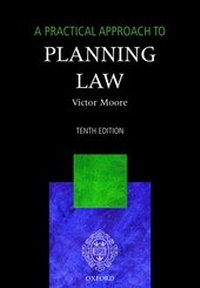
A Practical Approach to Planning Law
10th Edition
Published on 20. December 2007
Book
Paperback/Softback
712 pages
978-0-19-953211-7 (ISBN)
Description
Despite repeated attempts in recent years to simplify the planning system, planning law has continued to be so complex that practitioners and students alike have found it difficult to disentangle the complicated issues and principles involved. The tenth edition of Victor Moore's popular and accessible book aims to remove the mystery and difficulty which planning law presents to so many people. This new edition contains expanded coverage of the Planning and Compulsory Purchase Act 2004, exploring the implementation of what is arguably the most significant planning legislation since the present system of planning control was introduced by the Town and Country Planning Act 1947. The Act replaced much of the old planning regime, giving central government a larger say over planning decisions. In particular, in place of the development plan system that was in place, it introduced the concept of a Regional Spatial Strategy (RSS) for each region in the country and Development Plan Documents. This means that local planning authorities will be denied the opportunity they may once have had to avoid complying with central government targets (e.g. those aimed at new house building in their area).
Regional Planning Bodies are charged with keeping the RSS under review and to ensure compliance with its terms. The book includes the most important cases that have occurred since the publication of the ninth edition in 2005, and in particular the cases decided under the Planning and Compulsory Purchase Act 2004. The book also considers the impact that the Human Rights Act 1998 has had on overall planning strategy as well as on local development plans, including those decisions based on Article 8 (Right to Respect for Privacy and Family Life). It also looks forward to the changes to the planning system suggested in the White Paper, Planning for a Sustainable Future.
Regional Planning Bodies are charged with keeping the RSS under review and to ensure compliance with its terms. The book includes the most important cases that have occurred since the publication of the ninth edition in 2005, and in particular the cases decided under the Planning and Compulsory Purchase Act 2004. The book also considers the impact that the Human Rights Act 1998 has had on overall planning strategy as well as on local development plans, including those decisions based on Article 8 (Right to Respect for Privacy and Family Life). It also looks forward to the changes to the planning system suggested in the White Paper, Planning for a Sustainable Future.
More details
Edition
10th Revised edition
Language
English
Place of publication
Oxford
United Kingdom
Target group
Professional and scholarly
Solicitors and barristers specializing in planning law, planning officers in local government authorities, land managers and surveyors, students studying planning law, academics and reference libraries
Edition type
Revised edition
Dimensions
Height: 246 mm
Width: 171 mm
ISBN-13
978-0-19-953211-7 (9780199532117)
Copyright in bibliographic data and cover images is held by Nielsen Book Services Limited or by the publishers or by their respective licensors: all rights reserved.
Schweitzer Classification
Other editions
New editions
Victor Moore
A Practical Approach to Planning Law
Book
02/2010
11th Edition
Oxford University Press
€68.03
Article exhausted; check for reprint
Previous edition
Victor Moore
A Practical Approach to Planning Law
Book
06/2005
9th Edition
Oxford University Press
€37.08
Article exhausted; check for reprint
Person
Victor Moore, Emeritus Professor of Reading University
Content
1. Historical Introduction; 2. Planning Organization; 3. Simplified Planning Zones; 4. Development Plans: Before the Planning and Compulsory Purchase Act 2004; 5. Development Plans: After the Planning and Compulsory Purchase Act 2004; 6. Definition of Development 1: Operational Development; 7. Definition of Development 2: Material Change of Use; 8. The Need for Planning Permission 1: General Permitted Development Orders; Local Development Orders; 9. The Need for Planning Permission 2: Cases of Doubt; 10. Applications for Planning Permission 1: Pre-submission Requirements; 11. Applications for Planning Permission 2: Procedure on Receipt of Applications by the Local Planning Authority; 12. Determinations of Applications for Planning Permissions; 13. Environmental Impact Assessment; 14. Strategic Environmental Assessment; 15. Conditions; 16. The Construction, Scope, Effect, and Life of a Planning Permission; 17. Development by the Crown, Statutory Undertakers, and Local Authorities; Public Works Orders; Major Infrastructure Projects; 18. Planning Agreements; Planning Obligations; Planning Contributions; 19. Appeals; Statutory Review; Judicial Review; The Ombudsman; 20. Human Rights; 21. Enforcement; 22. Listed Buildings and Conservation Areas; 23. Ancient Monuments and Areas of Archaeological Importance; 24. Minerals; 25. The Control of Outdoor Advertisements; 26. Trees and Hedgerows; 27. Conservation of Natural Habitats; APPENDICES; 1. Town and Country Planning Act 1990, Section 5; 2. Town and Country Planning (Use Classes) Order 1987, SI 1987/764 (as amended); 3. Town and Country Planning (General Permitted Development) Order 1995, SI 1995/418 (as amended); 4. Town and Country Planning (General Development Procedure) Order 1995, SI 1995/419; 5. The Metrication of Planning Law