

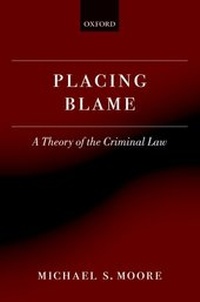
Placing Blame
A Theory of the Criminal Law
1st Edition
Published on 15. July 2010
Book
Paperback/Softback
872 pages
978-0-19-959949-3 (ISBN)
Description
This is a collection of essays written by Moore which form a thorough examination of the theory of criminal responsibility. The author covers a wide range of topics, giving the book a coherence and unity which is rare in assembled essays. Perhaps the most significant feature of this book is Moore's espousal of a retributivist theory of punishment. This anti-utilitarian standpoint is a common thread throughout the book. It is also a trend which is currently manifesting itself in all areas of moral, political and legal philosophy, but Moore is one of the first to apply such attitudes so systematically to criminal law theory. As such, this innovative, new book will be of great interest to all scholars in this field.
Reviews / Votes
The high-point of Moore's exposition ... is a fine and psychologically penetrating defense of subjective moral institutions and emotions as 'heuristic indicators' of moral truths. * Books and Culture, July/Aug. 2000. * In an elegant and masterly introductory essay, laying out in order all the tasks of a theory of criminal law, he pleads that any 'deep theory' of the way law operates must take a moral point of view and be founded on moral institutions. * Books and Culture, July/Aug. 2000. * This book belongs on the shelves of every serious criminal law theorist and every research library in the world. * M. M. Feeley, University of California, Berkeley, Choice, Feb 1999, Vol 36, no. 6 * The book has four particular qualities which mark it out as a distinctive contribution to criminal law theory... its scope is remarkably broad. Furthermore, Moore brings an unusual combination of disciplinary perspectives to bear on the wide range of questions which he considers. Moore is also unusual in giving the emotions a central place in his theory of criminal law. One has to admire the originality of Moore's position. He is a trenchant anti-consequentialist in ethics who nonetheless provides a careful analysis of the proper role of consequential arguments in shaping criminal law. * Nicola Lacey, The Modern Law Review * ... these are high-quality essays by a considerable figure, and should be read by anyone interested in criminal theory who has not done so already. * A. P. Simester, The Cambridge Law Journal, 1998. * Much appreciation goes to Professor Moore for sharing his eloquent legal mind with us and our everlasting gratitude goes to the publisher, Oxford Univesrity Press, for bringing us this marvellous book in paperback....making this wonderful journey through the law accessible to students even. * Sally Ramage, The Criminal Lawyer *More details
Language
English
Place of publication
Oxford
United Kingdom
Target group
Professional and scholarly
Scholars of criminal law and the philosophy of law.
Dimensions
Height: 234 mm
Width: 157 mm
Thickness: 51 mm
Weight
1290 gr
ISBN-13
978-0-19-959949-3 (9780199599493)
Copyright in bibliographic data and cover images is held by Nielsen Book Services Limited or by the publishers or by their respective licensors: all rights reserved.
Schweitzer Classification
Other editions
Additional editions
Book
11/1997
Clarendon Press
€113.60
Shipment within 15-20 days
Person
Professor Michael Moore holds the Charles R. Walgreen, Jr. Chair at the Univerity of Illinois. He is jointly appointed as Professor of Law in the College of Law and as Professor of Philosophy in the College of Liberal Arts and Sciences. He also holds an appointment as a Professor with the Center for Advanced Studies. His major works include Causation and Responsibility (OUP, 2009), Act and Crime (OUP, 1993), and Law and Psychiatry (CUP, 1984).
Content
Introduction ; 1. A Theory of Criminal Law Theories ; PART ONE: THE THEORY OF CRIMINAL LAW'S FUNCTION ; 2. Closet Retributivism ; 3. The Moral Worth of Retribution ; 4. Justifying Retributivism ; PART TWO: THE THEORY OF THE GENERAL PART: THE THEORY OF RESPONSIBILITY ; A. The Nature of Moral Responsibility ; 5. The Independent Moral Significance of Wrongdoing ; B. The Elements of Responsibility: Wrongdoing and Culpability ; 1. The Nature of Wrongdoing ; a. the Nature of Human Action ; 6. Moore on Act and Crime ; b. The Nature of Causation ; 7. Causation, Rights-Violations, and Wrongdoing ; 8. Foreseeing Harm Opaquely ; 2. The Nature of Culpability ; a. The Nature of Mental States ; 9. Prima Facie Moral Culpability ; 10. Mind, Brain, and the Unconscious ; 11. Intentions and Mens Rea ; The Nature of Excuse ; 12. Causation and the Excusescuse ; 13. Choice, Character, and Excuse ; PART THREE: THE THEORY OF THE SPECIAL PART: THEORIES OF LEGISLATION AND OF WRONGFUL ACTION ; A. The Theory of Proper Legislative Aim ; 16. A Non-Exclusionary Theory of Legislative Aim: Taking Aim at Moral Wrongdoing ; B. The Theory of Moral Wrongfulness ; 17. Torture and the Balance of Evils ; C. The Theory of the Limits of Criminal Legislation ; 18. Liberty's Limits on Legislation