

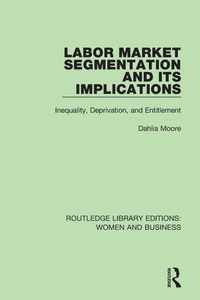
Labor Market Segmentation and its Implications
Inequality, Deprivation, and Entitlement
1st Edition
Published on 11. September 2018
Book
Paperback/Softback
358 pages
978-1-138-24490-0 (ISBN)
Description
Occupational sex segregation is one of the most universal and salient characteristics of labor markets. It indicates the different probabilities of members of both genders to take up particular occupations, and traditionally places women at a great disadvantage. This book, first published in 1992, focuses on a comparative analysis of sex-segregated occupational categories and attempts to systematically examine their implications. Since very little is known about Israeli working women, and given the cultural differences between Israel and other, more studied industrialised nations, this book focuses on the Israeli labor market. Through the utilization of several theoretical approaches, combining economic, sociological, and social-psychological perspectives, the book analyses empirical findings concerning labor market perceptions, attitudes and behaviors.
More details
Series
Language
English
Place of publication
London
United Kingdom
Publishing group
Taylor & Francis Ltd
Target group
College/higher education
Dimensions
Height: 234 mm
Width: 156 mm
Thickness: 19 mm
Weight
547 gr
ISBN-13
978-1-138-24490-0 (9781138244900)
Copyright in bibliographic data and cover images is held by Nielsen Book Services Limited or by the publishers or by their respective licensors: all rights reserved.
Schweitzer Classification
Other editions
Additional editions
E-Book
12/2016
Routledge
€37.99
Available for download
E-Book
12/2016
Routledge
€37.99
Available for download

Book
12/2016
1st Edition
Routledge
€141.12
Shipment within 10-20 days
Person
Moore, Dahlia
Content
Part 1. Inequality: Structure and Processes 1. Women's Labor Force Participation 2. Gender Stratification 3. Stereotypes, Prejudices and Discrimination 4. Joining Atypical Occupations 5. Wage Inequality Part 2. Reactions to Inequality 6. Social Comparisons and Expectations 7. The Perception of Gaps: Legitimacy and Self-Evaluation 8. Relative Deprivation and Justice 9. Entitlement 10. Conclusion