

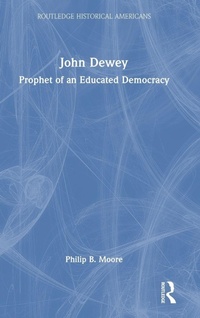
John Dewey
Prophet of an Educated Democracy
1st Edition
Published on 15. October 2024
Book
Hardback
186 pages
978-1-032-29122-2 (ISBN)
Description
This concise biography tells the story of John Dewey, a pioneer of pragmatism and the first original school of philosophy created in America. The school was born out of a specific historical context, in the wake of a country at war with itself, and in response to the rapid changes of industrialization. Dewey's pragmatism celebrated human intelligence and agency and the promise that tomorrow could be better than today. For Dewey, pragmatism was the philosophy of democracy.
Dewey lived from just before the Civil War to just before school integration. As such, the book touches on many key moments in American history, from social reform in turn of the century Chicago, to censorship during World War One, and to the government's responsibilities in the Great Depression. It covers all this in the context of the life of a man whose ideas helped shape American culture and intellectual life.
John Dewey: Prophet of an Educated Democracy will appeal to students, scholars, and all those interested in American philosophy and history of the 19th and 20th centuries. It will also complement humanities courses on American philosophy, history, and intellectual traditions.
Dewey lived from just before the Civil War to just before school integration. As such, the book touches on many key moments in American history, from social reform in turn of the century Chicago, to censorship during World War One, and to the government's responsibilities in the Great Depression. It covers all this in the context of the life of a man whose ideas helped shape American culture and intellectual life.
John Dewey: Prophet of an Educated Democracy will appeal to students, scholars, and all those interested in American philosophy and history of the 19th and 20th centuries. It will also complement humanities courses on American philosophy, history, and intellectual traditions.
Reviews / Votes
Philip B. Moore brings John Dewey to life. Packed with insights about Dewey's thinking on education, art, and democracy, and how it evolved during a pivotal time in American history, this book offers us a useful intellectual history. Moore has an eye for detail and anecdote, and this book works on so many levels: Dewey's ideas, his personal relationships, and the places and colleges where Dewey studied, taught, and lived."- Jackson Kytle, author of To Want To Learn: Insights and Provocations for Engaged Learning
More details
Series
Language
English
Place of publication
London
United Kingdom
Publishing group
Taylor & Francis Ltd
Target group
College/higher education
Undergraduate Advanced
Dimensions
Height: 235 mm
Width: 157 mm
Thickness: 15 mm
Weight
445 gr
ISBN-13
978-1-032-29122-2 (9781032291222)
Copyright in bibliographic data and cover images is held by Nielsen Book Services Limited or by the publishers or by their respective licensors: all rights reserved.
Schweitzer Classification
Other editions
Additional editions
E-Book
10/2024
1st Edition
Routledge
€51.49
Available for download
E-Book
10/2024
1st Edition
Routledge
€51.49
Available for download
Book
10/2024
1st Edition
Routledge
€57.90
Shipment within 10-20 days
Person
Philip B. Moore is an assistant professor of education at Gratz College where he teaches courses in creativity, leadership, and the history of education. His most recent written work includes essays on artist Ray Johnson, actor Sal Mineo, and punk musician Darby Crash for the Gay & Lesbian Review.
Content
Introduction: American Genius
Chapter One: The Last Vermont Transcendentalist
Chapter Two: A Tramp Upon the Highway
Chapter Three: The Great Extensionist
Chapter Four: Visionary of the Here and Now
Chapter Five: Philosopher of the American Continent
Chapter Six: Enemy Number One/ One of the Greatest Americans
Epilogue: The Dewey Project
Documents
Chapter One: The Last Vermont Transcendentalist
Chapter Two: A Tramp Upon the Highway
Chapter Three: The Great Extensionist
Chapter Four: Visionary of the Here and Now
Chapter Five: Philosopher of the American Continent
Chapter Six: Enemy Number One/ One of the Greatest Americans
Epilogue: The Dewey Project
Documents