

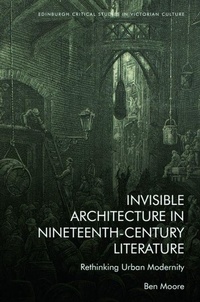
Invisible Architecture in Nineteenth-Century Literature
Rethinking Urban Modernity
Published on 12. January 2024
Book
Hardback
272 pages
978-1-3995-0848-3 (ISBN)
Description
Ben Moore presents a new approach to reading urban modernity in nineteenth-century literature, by bringing together hidden, mobile and transparent features of city space as part of a single system he calls 'invisible architecture'. Resisting narratives of the nineteenth-century as progressing from concealment to transparency, he instead argues for a dynamic interaction between these tendencies. Across two parts, this book addresses a range of apparently disparate buildings and spaces. Part I offers new readings of three writers and their cities: Elizabeth Gaskell and Manchester, Charles Dickens and London, and Emile Zola and Paris, focusing on the cellar-dwelling, the railway and river, and the department store respectively. Part II takes a broader view by analysing three spatial forms that have not usually been considered features of nineteenth-century modernity: the Gothic cathedral, the arabesque and white walls. Through these readings, the book extends our understanding of the uneven modernity of this period.
Reviews / Votes
Challenging a straightforward visible/invisible dichotomy, Invisible Architecture animates literature and architecture as a dynamic relation adept at registering the energy, transitions and turbulence of urban modernity so central to nineteenth century life. Readers interested in spatial relations, cities, and the category of literature will all gain much from this book. -- Barbara Leckie, Carleton UniversityMore details
Series
Language
English
Place of publication
Edinburgh
United Kingdom
Product notice
sewn/stitched
Cloth over boards
Illustrations
14 black and white illustrations
Dimensions
Height: 234 mm
Width: 156 mm
Thickness: 18 mm
Weight
567 gr
ISBN-13
978-1-3995-0848-3 (9781399508483)
Copyright in bibliographic data and cover images is held by Nielsen Book Services Limited or by the publishers or by their respective licensors: all rights reserved.
Schweitzer Classification
Other editions
Additional editions
E-Book
01/2023
1st Edition
Edinburgh University Press
€92.49
Available for download
E-Book
01/2023
1st Edition
Edinburgh University Press
€92.49
Available for download
Person
Ben Moore is Assistant Professor in English Literature at the University of Amsterdam. His research areas include nineteenth-century literature, cities, money, modernity, childhood and the human. He is the author of Human Tissue in the Realist Novel, 1850-1895 (Palgrave 2023) and Co-Editor of the Gaskell Journal. His work has appeared in journals including Victorian Literature and Culture, Modernism/modernity, Modern Language Review and the Journal of Victorian Culture, as well as in various handbooks and edited collections.
Content
List of Figures
Acknowledgements
Introduction: Mobility, Concealment, Transparency
Part I Writers and Cities
1. The Hidden City: James Kay, Friedrich Engels and Mary Barton's Cellars
2. The Unstable City: Rivers, Railways and Houses in Dombey and Son and Our Mutual Friend
3. The Transparent City: Mansions, Montage and Commodity Architecture in The Kill and The Ladies' Paradise
Part II Spatial Forms
4. Gothic Architecture and Urban Modernity
5. The Arabesque City
6. The Whiteness of the City
Conclusion: The Invisible Architecture of New York
Bibliography
Index
Acknowledgements
Introduction: Mobility, Concealment, Transparency
Part I Writers and Cities
1. The Hidden City: James Kay, Friedrich Engels and Mary Barton's Cellars
2. The Unstable City: Rivers, Railways and Houses in Dombey and Son and Our Mutual Friend
3. The Transparent City: Mansions, Montage and Commodity Architecture in The Kill and The Ladies' Paradise
Part II Spatial Forms
4. Gothic Architecture and Urban Modernity
5. The Arabesque City
6. The Whiteness of the City
Conclusion: The Invisible Architecture of New York
Bibliography
Index