

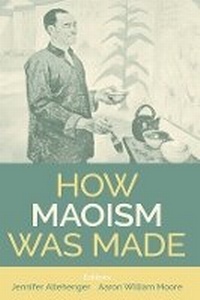
How Maoism Was Made
Reconstructing China, 1949-1965
Published on 26. December 2024
Book
Hardback
384 pages
978-0-19-726781-3 (ISBN)
Description
How Maoism Was Made focuses on the history of the early years in China after 1949, featuring new scholarship by academics across Europe and North America. The field of early PRC history has been transformed by the unprecedented accessibility of archives from the 1990s to the early 2010s. Sixteen contributors show how the revolutionary system was built and maintained by the efforts of non-elite actors, including scientists, farmers, designers, artists, cadres, and ordinary citizens. By abandoning the Cold War political work of vilifying or celebrating Chinese communism, How Maoism Was Made aims to render the history of the Maoist system comprehensible to specialists and non-specialists alike, by viewing it through the lens of people who made it. Chinese communism is revealed to be a set of beliefs and practices that inspired millions of people to (re-)build their country and find a new life within it, at times with tragic consequences.
More details
Series
Language
English
Place of publication
Oxford
United Kingdom
Target group
Professional and scholarly
Illustrations
20 b/w images
Dimensions
Height: 241 mm
Width: 163 mm
Thickness: 26 mm
Weight
724 gr
ISBN-13
978-0-19-726781-3 (9780197267813)
Copyright in bibliographic data and cover images is held by Nielsen Book Services Limited or by the publishers or by their respective licensors: all rights reserved.
Schweitzer Classification
Persons
Aaron William Moore is the Handa Chair of Japanese-Chinese Relations at the University of Edinburgh. He is the author of two books: Writing War (2013), which analysed over 200 combat soldiers' diaries from China, Japan, and the United States, and Bombing the City (2018), which compared the air raid experiences of civilians in British and Japanese regional cities. In addition to the history of early East Asian science fiction, he is currently working on a book about the global experiences of wartime youth. In 2014 he was awarded the Leverhulme Prize for his work on transnational and comparative history.
Jennifer Altehenger is associate professor of Chinese History and Jessica Rawson Fellow in Modern Asian History at the University of Oxford and Merton College. Her research focuses on the history of modern China, especially the history of industrial design, materiality, and everyday life. She is the author of Legal Lessons: Popularizing Laws in the People's Republic of China, 1949-1989 (2018) and together with Denise Y. Ho of Material Contradictions in Mao's China (2022). She is also the editor of the online resource "The Mao Era in Objects" and is currently working on a book titled Designing Socialism: Furniture and Mass Production in China.
Jennifer Altehenger is associate professor of Chinese History and Jessica Rawson Fellow in Modern Asian History at the University of Oxford and Merton College. Her research focuses on the history of modern China, especially the history of industrial design, materiality, and everyday life. She is the author of Legal Lessons: Popularizing Laws in the People's Republic of China, 1949-1989 (2018) and together with Denise Y. Ho of Material Contradictions in Mao's China (2022). She is also the editor of the online resource "The Mao Era in Objects" and is currently working on a book titled Designing Socialism: Furniture and Mass Production in China.
Editor
Handa Chair of Japanese-Chinese RelationsHanda Chair of Japanese-Chinese Relations, University of Edinburgh
Associate Professor of Chinese History, Jessica Rawson Fellow in Modern Asian HistoryAssociate Professor of Chinese History, Jessica Rawson Fellow in Modern Asian History, Merton College, Oxford
Content
Introduction: The Early People's Republic of China Between Theory and Practice
Part 1: Society and Political Economy
1: Toby Lincoln: Making a 'New Changsha': Reconstructing China's Devastated City, 1945-1959
2: Benno Weiner: Mediating Disputes, Making Minzu: Minoritization on an Ethnocultural Frontier of Early Maoist China
3: Fabio Lanza: The Political Economy of the Everyday: Theory and Praxis in the Urban Commune
4: Wenyu Jing and Felix Wemheuer: Seeing Like the Maoist State: Peasant Resistance in 1950s Court Documents
Part 2: The Revolutionary Self
5: Aaron William Moore: The Final Revolution Is in Our Hearts: Work and Study in Personal Diaries of the Early People's Republic of China
6: Aminda M. Smith: Brainwashing and World Revolution
7: Sarah Mellors Rodriguez: Constructing the Maoist Sexual Subject: 1950s Hygiene Guides and the Production of Sexual Knowledge
Part 3: Material Culture and Everyday Life
8: Jennifer Altehenger: How to Standardize Life in 'New China': The Case of Furniture
9: Christine I. Ho: Mass Muralism and Mass Creativity in the Early People's Republic of China
10: Zhejiang Xiaoxuan Wang: An Unlikely Moment of Revival? The Return of Gods in Early 1960s
Part 4: Expertise and Revolutionary Epistemology
11: Shellen Xiao Wu: How Geography Won the Battle and Geographers Lost the War
12: Covell Meyskens: Marvelling at a World so Changed': The Three Gorges Project in Mao's China
13: Robert Culp: 'Knowledge is Power': Defining Knowledge and Creating Organic Intellectuals, 1961- 1965
Part 5: Socialist Internationalism at Home
14: Mary Augusta Brazelton: Plagues from the Skies: Bacteriological Expertise in the 1952 Germ Warfare Allegations
15: Nicolai Volland: Soviet Books in Socialist China: Epoch Press and the Making of the Maoist State, 1940-1960
16: Emily Wilcox: The Japanese and Korean Roots of Maoist Dance Education, 1951-52
Coda
17: Juliane Fuerst and Jochen Hellbeck: Point Counterpoint: Temporal Interplay in the Soviet and Chinese Revolutions
Part 1: Society and Political Economy
1: Toby Lincoln: Making a 'New Changsha': Reconstructing China's Devastated City, 1945-1959
2: Benno Weiner: Mediating Disputes, Making Minzu: Minoritization on an Ethnocultural Frontier of Early Maoist China
3: Fabio Lanza: The Political Economy of the Everyday: Theory and Praxis in the Urban Commune
4: Wenyu Jing and Felix Wemheuer: Seeing Like the Maoist State: Peasant Resistance in 1950s Court Documents
Part 2: The Revolutionary Self
5: Aaron William Moore: The Final Revolution Is in Our Hearts: Work and Study in Personal Diaries of the Early People's Republic of China
6: Aminda M. Smith: Brainwashing and World Revolution
7: Sarah Mellors Rodriguez: Constructing the Maoist Sexual Subject: 1950s Hygiene Guides and the Production of Sexual Knowledge
Part 3: Material Culture and Everyday Life
8: Jennifer Altehenger: How to Standardize Life in 'New China': The Case of Furniture
9: Christine I. Ho: Mass Muralism and Mass Creativity in the Early People's Republic of China
10: Zhejiang Xiaoxuan Wang: An Unlikely Moment of Revival? The Return of Gods in Early 1960s
Part 4: Expertise and Revolutionary Epistemology
11: Shellen Xiao Wu: How Geography Won the Battle and Geographers Lost the War
12: Covell Meyskens: Marvelling at a World so Changed': The Three Gorges Project in Mao's China
13: Robert Culp: 'Knowledge is Power': Defining Knowledge and Creating Organic Intellectuals, 1961- 1965
Part 5: Socialist Internationalism at Home
14: Mary Augusta Brazelton: Plagues from the Skies: Bacteriological Expertise in the 1952 Germ Warfare Allegations
15: Nicolai Volland: Soviet Books in Socialist China: Epoch Press and the Making of the Maoist State, 1940-1960
16: Emily Wilcox: The Japanese and Korean Roots of Maoist Dance Education, 1951-52
Coda
17: Juliane Fuerst and Jochen Hellbeck: Point Counterpoint: Temporal Interplay in the Soviet and Chinese Revolutions