

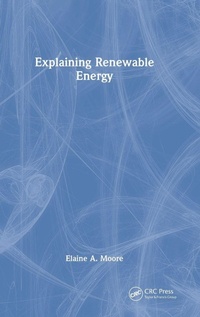
Explaining Renewable Energy
1st Edition
Published on 16. December 2022
Book
Hardback
88 pages
978-1-032-27841-4 (ISBN)
Description
This undergraduate text aimed primarily at high schoolers and lower level undergraduates focuses on explaining how the various forms of renewable energy work and the current ongoing research. It includes sections on non-scientific aspects that should be considered such as availability of resources. A final chapter covers methods of removing carbon dioxide from the atmosphere.
Renewable energy is currently on everyone's mind in the context of climate change. This text provides students with an introduction into the science behind the various types of renewable energy enabling them to access review literature in the field and options that should be considered when selecting methods.
Features
Collates the most relevant and up to date information on renewable energy systems in a user friendly format for undergraduate and high school students
Focuses on power production technologies from renewable energy sources
An introduction to how sources of renewable energy work; their advantages and drawbacks
Timely text with the need for fast adoption of renewable energy technologies around the world
Suitable for a diverse audience including students with some scientific background such as final year in high school wanting to know more about combatting climate change
Renewable energy is currently on everyone's mind in the context of climate change. This text provides students with an introduction into the science behind the various types of renewable energy enabling them to access review literature in the field and options that should be considered when selecting methods.
Features
Collates the most relevant and up to date information on renewable energy systems in a user friendly format for undergraduate and high school students
Focuses on power production technologies from renewable energy sources
An introduction to how sources of renewable energy work; their advantages and drawbacks
Timely text with the need for fast adoption of renewable energy technologies around the world
Suitable for a diverse audience including students with some scientific background such as final year in high school wanting to know more about combatting climate change
More details
Language
English
Place of publication
London
United Kingdom
Publishing group
Taylor & Francis Ltd
Target group
Adult education
College/higher education
Professional and scholarly
Postgraduate, Professional, Undergraduate Advanced, and Undergraduate Core
Illustrations
2 s/w Abbildungen, 9 Farbfotos bzw. farbige Rasterbilder, 2 s/w Zeichnungen, 33 farbige Zeichnungen, 42 farbige Abbildungen
33 Line drawings, color; 2 Line drawings, black and white; 9 Halftones, color; 42 Illustrations, color; 2 Illustrations, black and white
Dimensions
Height: 240 mm
Width: 161 mm
Thickness: 10 mm
Weight
329 gr
ISBN-13
978-1-032-27841-4 (9781032278414)
Copyright in bibliographic data and cover images is held by Nielsen Book Services Limited or by the publishers or by their respective licensors: all rights reserved.
Schweitzer Classification
Other editions
Additional editions
Elaine A. Moore
Explaining Renewable Energy
E-Book
12/2022
1st Edition
CRC Press
€40.99
Available for download
Elaine A. Moore
Explaining Renewable Energy
E-Book
12/2022
1st Edition
CRC Press
€40.99
Available for download
Elaine A. Moore
Explaining Renewable Energy
Book
12/2022
1st Edition
CRC Press
€52.80
Shipment within 10-20 days
Person
Elaine A. Moore studied chemistry as an undergraduate at Oxford University, England, and then stayed on to complete a DPhil in theoretical chemistry with Peter Atkins. After a two-year postdoctoral position at the University of Southampton, England, she joined the Open University, UK (OU), in 1975, becoming a lecturer in chemistry in 1977, senior lecturer in 1998 and reader in 2004. She retired in 2017 and currently has an honorary position at the Open University.
She has produced OU teaching texts in chemistry for courses at levels 1, 2 and 3 and written texts in astronomy at level 2 and physics at level 3. She is a co-author of Metals and Life and of Concepts in Transition Metal Chemistry, which were part of a level 3 Open University course in inorganic chemistry, and were co-published with the Royal Society of Chemistry. She was team leader for the production and presentation of an Open University level 2 chemistry module delivered entirely online. She is a Fellow of the Royal Society of Chemistry and a Senior Fellow of the Higher Education Academy. She was a co-chair for the successful departmental submission of an Athena Swan bronze award.
Her research interests are in theoretical chemistry applied mainly to solid-state systems, and she is the author or co-author of more than 50 papers in refereed scientific journals. A long-standing collaboration in this area led to her being invited to help run a series of postgraduate workshops on computational Materials Science hosted by the University of Khartoum, Sudan.
She has produced OU teaching texts in chemistry for courses at levels 1, 2 and 3 and written texts in astronomy at level 2 and physics at level 3. She is a co-author of Metals and Life and of Concepts in Transition Metal Chemistry, which were part of a level 3 Open University course in inorganic chemistry, and were co-published with the Royal Society of Chemistry. She was team leader for the production and presentation of an Open University level 2 chemistry module delivered entirely online. She is a Fellow of the Royal Society of Chemistry and a Senior Fellow of the Higher Education Academy. She was a co-chair for the successful departmental submission of an Athena Swan bronze award.
Her research interests are in theoretical chemistry applied mainly to solid-state systems, and she is the author or co-author of more than 50 papers in refereed scientific journals. A long-standing collaboration in this area led to her being invited to help run a series of postgraduate workshops on computational Materials Science hosted by the University of Khartoum, Sudan.
Content
1. Introduction
2. Solar Energy
2.1. Photovoltaic (solar) cells
2.1.1 Semiconductors
2.1.2. The p-n junction
2.1.3. Materials
2.1.4. Other solar cells
2.2. Other Considerations
2.3. Solar thermal panels
2.3.1 Materials
2.3.2 Other Considerations
Questions
3. Wind power
3.1. Wind turbines
3.2. Electrical generators
3.3. Materials
3.4. Other Considerations
Questions
4. Water power
4.1. Hydroelectric dams
4.2. River turbines
4.3. Wave power
4.4. Tidal power
4.5. Material
4.6. Other Considerations
Questions
5. Geothermal Energy
5.1. The origin of geothermal energy
5.2. Accessing geothermal energy
5.2.1 Using geothermal energy for heating
5.2.2 Using geothermal energy to produce electricity
5.3. Considerations
Questions
6. Hydrogen
6.1. Hydrogen production
6.1.1. Electrolysis
6.1.2. Chemical Reactions
6.1.3. Biohydrogen production
6.2. Storage and transport
6.3. Hydrogen use
6.3.1. Fuel cells
6.4. Considerations
Questions
7. Biomass
7.1. How is energy produced from biomass?
7.2. Why is energy derived from biomass considered renewable?
7.3. Types of biomass
7.3.1. Wood
7.3.2. Crops and Grasses
7.3.3. Algae
7.3.4. Waste
7.4. Considerations
Questions
8. Energy storage
8.1. How rechargeable batteries work
8.2. Batteries for storage
8.2.1 Kead-acid batteries
8.2.2. Lithium-ion batteries
8.2.3. Sodium based batteries
8.2.4. Redox flow batteries
8.3. Batteries for transport
8.3.1. Lithium-based batteries
8.4. Capacitors
8.5. Pumped storage hydropower
Questions
9. Carbon capture, storage and conversion
9.1. Carbon capture and storage
9.1.1. Trees and peat bogs
9.1.2. Construction materials and minerals
9.1.3. Porous solids
9.1.4. Absorbance by liquids
9.2. Conversion of captured carbon dioxide
9.2.1. Mineralisation
9.2.2 Chemicals and Fuels
Questions
2. Solar Energy
2.1. Photovoltaic (solar) cells
2.1.1 Semiconductors
2.1.2. The p-n junction
2.1.3. Materials
2.1.4. Other solar cells
2.2. Other Considerations
2.3. Solar thermal panels
2.3.1 Materials
2.3.2 Other Considerations
Questions
3. Wind power
3.1. Wind turbines
3.2. Electrical generators
3.3. Materials
3.4. Other Considerations
Questions
4. Water power
4.1. Hydroelectric dams
4.2. River turbines
4.3. Wave power
4.4. Tidal power
4.5. Material
4.6. Other Considerations
Questions
5. Geothermal Energy
5.1. The origin of geothermal energy
5.2. Accessing geothermal energy
5.2.1 Using geothermal energy for heating
5.2.2 Using geothermal energy to produce electricity
5.3. Considerations
Questions
6. Hydrogen
6.1. Hydrogen production
6.1.1. Electrolysis
6.1.2. Chemical Reactions
6.1.3. Biohydrogen production
6.2. Storage and transport
6.3. Hydrogen use
6.3.1. Fuel cells
6.4. Considerations
Questions
7. Biomass
7.1. How is energy produced from biomass?
7.2. Why is energy derived from biomass considered renewable?
7.3. Types of biomass
7.3.1. Wood
7.3.2. Crops and Grasses
7.3.3. Algae
7.3.4. Waste
7.4. Considerations
Questions
8. Energy storage
8.1. How rechargeable batteries work
8.2. Batteries for storage
8.2.1 Kead-acid batteries
8.2.2. Lithium-ion batteries
8.2.3. Sodium based batteries
8.2.4. Redox flow batteries
8.3. Batteries for transport
8.3.1. Lithium-based batteries
8.4. Capacitors
8.5. Pumped storage hydropower
Questions
9. Carbon capture, storage and conversion
9.1. Carbon capture and storage
9.1.1. Trees and peat bogs
9.1.2. Construction materials and minerals
9.1.3. Porous solids
9.1.4. Absorbance by liquids
9.2. Conversion of captured carbon dioxide
9.2.1. Mineralisation
9.2.2 Chemicals and Fuels
Questions