

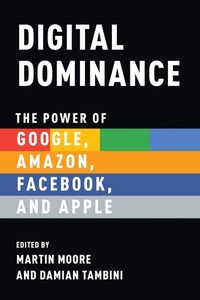
Digital Dominance
The Power of Google, Amazon, Facebook, and Apple
Published on 24. May 2018
Book
Paperback/Softback
440 pages
978-0-19-084511-7 (ISBN)
Description
Across the globe, Google, Amazon, Facebook, Apple and Microsoft have accumulated power in ways that existing regulatory and intellectual frameworks struggle to comprehend. A consensus is emerging that the power of these new digital monopolies is unprecedented, and that it has important implications for journalism, politics, and society.
It is increasingly clear that democratic societies require new legal and conceptual tools if they are to adequately understand, and if necessary check the economic might of these companies. Equally, that we need to better comprehend the ability of such firms to control personal data and to shape the flow of news, information, and public opinion.
In this volume, Martin Moore and Damian Tambini draw together the world's leading researchers to examine the digital dominance of technologies platforms and look at the evidence behind the rising tide of criticism of the tech giants. In fifteen chapters, the authors examine the economic, political, and social impacts of Google, Amazon, Facebook, Apple, and Microsoft, in order to understand the different facets of their power and how it is manifested. Digital Dominance is the first interdisciplinary volume on this topic, contributing to a conversation which is critical to maintaining the health of democracies across the world.
It is increasingly clear that democratic societies require new legal and conceptual tools if they are to adequately understand, and if necessary check the economic might of these companies. Equally, that we need to better comprehend the ability of such firms to control personal data and to shape the flow of news, information, and public opinion.
In this volume, Martin Moore and Damian Tambini draw together the world's leading researchers to examine the digital dominance of technologies platforms and look at the evidence behind the rising tide of criticism of the tech giants. In fifteen chapters, the authors examine the economic, political, and social impacts of Google, Amazon, Facebook, Apple, and Microsoft, in order to understand the different facets of their power and how it is manifested. Digital Dominance is the first interdisciplinary volume on this topic, contributing to a conversation which is critical to maintaining the health of democracies across the world.
Reviews / Votes
In the backdrop of the complex world that we live in, Digital Dominance: The Power of Google, Amazon, Facebook, and Apple, offers all readers the opportunity to learn about how the entire digital infrastructure is controlled by corporations while also posing many unanswered questions facing the future of the web. While a large number of users of social media today in the developing world are oblivious to the various concerns raised in the book, it is important for those who are at the helm of digital policymaking and those who are concerned with issues around internet governance to read this book without fail * Basheerhamad Shadrach, The International Journal of Information, Diversity, & Inclusion * For anyone with an interest in how the giant technology companies are affecting society, and the problems of regulating their activities, this volume is essential reading. Any course in economics or politics should put it on the reading list ... Moore and Tambini are to be congratulated in having assembled a group of expert authors who appear to have worked to an agreed brief to put before the reader the issues that should concern all of us. * T.D. Wilson, Information Research * Digital Dominance is a critically important volume to guide citizens and policymakers as governments around the world wake up to the power of technology giants. Convening diverse and authoritative voices in social science and law, this book presents cutting edge research that is essential to understanding the role of Google, Facebook, Apple, and Amazon in our economy and politics. This work both addresses immediate controversies and promises to be of lasting relevance to those concerned about the effect of technology on society - and how societies might better channel technological development to serve, rather than dominate, humanity. * Frank Pasquale, author of The Black Box Society: The Secret Algorithms that Control Money and Information *More details
Language
English
Place of publication
New York
United States
Target group
College/higher education
Dimensions
Height: 234 mm
Width: 156 mm
Thickness: 26 mm
Weight
738 gr
ISBN-13
978-0-19-084511-7 (9780190845117)
Copyright in bibliographic data and cover images is held by Nielsen Book Services Limited or by the publishers or by their respective licensors: all rights reserved.
Schweitzer Classification
Other editions
Additional editions
Book
07/2018
Oxford University Press Inc
€176.40
Shipment within 15-20 days
E-Book
05/2018
1st Edition
OUP eBook
€27.49
Available for download
E-Book
05/2018
1st Edition
OUP eBook
€0.00
Available for download
Persons
Martin Moore is Director of the Centre for the Study of Media, Communication and Power at King's College London, and a Senior Research Fellow at King's. His research focuses on political communication during election and referendum campaigns, and on the civic power of technology platforms. He is the author of The Origins of Modern Spin (Palgrave MacMillan, 2006) and Tech Giants and Civic Power (2016), and publishes frequently on the media and politics.
Damian Tambini is Associate Professor at the London School of Economics. He has served as an advisor and expert in numerous policymaking roles for the European Commission, the Council of Europe, the UK Government, and the UK media regulator, Ofcom. He has published numerous articles and books on the topic of communication, policy, and politics, including Codifying Cyberspace (Routledge, 2008).
Damian Tambini is Associate Professor at the London School of Economics. He has served as an advisor and expert in numerous policymaking roles for the European Commission, the Council of Europe, the UK Government, and the UK media regulator, Ofcom. He has published numerous articles and books on the topic of communication, policy, and politics, including Codifying Cyberspace (Routledge, 2008).
Editor
Director of the Centre for the Study of Media, Communication and Power, and a Senior Research Fellow in the Policy InstituteDirector of the Centre for the Study of Media, Communication and Power, and a Senior Research Fellow in the Policy Institute, King's College London
Associate Professor, Department of Media and CommunicationsAssociate Professor, Department of Media and Communications, London School of Economics
Content
Contents
Introduction, Martin Moore and Damian Tambini
Section 1: Economy
1. The Evolution of Digital Dominance: how and why we got to GAFA
Patrick Barwise and Leo Watkins
2. Platform dominance: the shortcomings of antitrust policy
Diane Coyle
3. When data evolves into market power - data concentration and data abuse under competition law
Inge Graef
4. Amazon - An Infrastructure Service and Its Challenge to Current Antitrust Law
Lina M. Khan
Section 2: Society
5. Platform reliance, information intermediaries and news diversity: A look at the evidence
Nic Newman and Richard Fletcher
6. Challenging diversity - social media platforms and a new conception of media diversity
Natali Helberger
7. The Power of Providence: the role of platforms in leveraging the legibility of users to accentuate inequality
Orla Lynskey
8. Digital agenda setting: re-examining the role of platform monopolies
Justin Schlosberg
9. Free Expression? Dominant information intermediaries as arbiters of internet speech
Ben Wagner
10. The Dependent Press: how Silicon Valley threatens independent journalism
Emily Bell
Section 3: Politics
11. Social media power and election legitimacy
Damian Tambini
12. Manipulating Minds: the power of search engines to influence votes and opinions
Robert Epstein
13. I vote for - how search informs our choice of candidate
Nick Diakopoulos, Daniel Trielli, Jennifer Stark, and Sean Mussenden
14. Social Dynamics in the Age of Credulity: the misinformation risk and its fallout
Fabiana Zollo and Walter Quattriociochi
15. Platform Power and Responsibility in the Attention Economy
John Naughton
Conclusion
Damian Tambini and Martin Moore
Introduction, Martin Moore and Damian Tambini
Section 1: Economy
1. The Evolution of Digital Dominance: how and why we got to GAFA
Patrick Barwise and Leo Watkins
2. Platform dominance: the shortcomings of antitrust policy
Diane Coyle
3. When data evolves into market power - data concentration and data abuse under competition law
Inge Graef
4. Amazon - An Infrastructure Service and Its Challenge to Current Antitrust Law
Lina M. Khan
Section 2: Society
5. Platform reliance, information intermediaries and news diversity: A look at the evidence
Nic Newman and Richard Fletcher
6. Challenging diversity - social media platforms and a new conception of media diversity
Natali Helberger
7. The Power of Providence: the role of platforms in leveraging the legibility of users to accentuate inequality
Orla Lynskey
8. Digital agenda setting: re-examining the role of platform monopolies
Justin Schlosberg
9. Free Expression? Dominant information intermediaries as arbiters of internet speech
Ben Wagner
10. The Dependent Press: how Silicon Valley threatens independent journalism
Emily Bell
Section 3: Politics
11. Social media power and election legitimacy
Damian Tambini
12. Manipulating Minds: the power of search engines to influence votes and opinions
Robert Epstein
13. I vote for - how search informs our choice of candidate
Nick Diakopoulos, Daniel Trielli, Jennifer Stark, and Sean Mussenden
14. Social Dynamics in the Age of Credulity: the misinformation risk and its fallout
Fabiana Zollo and Walter Quattriociochi
15. Platform Power and Responsibility in the Attention Economy
John Naughton
Conclusion
Damian Tambini and Martin Moore