

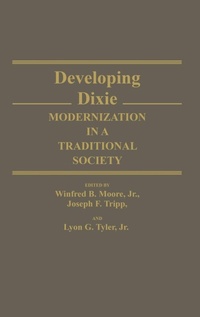
Developing Dixie
Modernization in a Traditional Society
Published on 27. June 1988
Book
Hardback
380 pages
978-0-313-26061-2 (ISBN)
Description
This collection of essays examines the development of the American South from the end of the Civil War to the end of World War II. Written by both well-known and emerging scholars, the essays are divided into sections that address some of the major issues of that era, such as race relations, economic development, political reform, the roles of southern women, the messages of folk music, and the problems of the region's historians. Each article offers fresh insights or new information on its subject, and collectively the articles help to illuminate how the most traditional of American regions tried to cope with the forces of modernization.
More details
Series
Language
English
Place of publication
United States
Publishing group
Bloomsbury Publishing Plc
Target group
College/higher education
Interest Age: From 7 to 17 years
Dimensions
Height: 240 mm
Width: 161 mm
Thickness: 25 mm
Weight
737 gr
ISBN-13
978-0-313-26061-2 (9780313260612)
Copyright in bibliographic data and cover images is held by Nielsen Book Services Limited or by the publishers or by their respective licensors: all rights reserved.
Schweitzer Classification
Other editions
Additional editions
Winfred Moore | Joseph F. Tripp | Lyon G. Tyler
Developing Dixie
Modernization in a Traditional Society
E-Book
06/1988
1st Edition
Praeger Publishers Inc
€82.49
Available for download
Persons
WINFRED B. MOORE, JR., is Associate Professor of History at The Citadel, Charleston, South Carolina.
JOSEPH F. TRIPP is Professor of History at The Citadel, South Carolina.
LYON G. TYLER Jr., is Professor of History at The Citadel, South Carolina.
JOSEPH F. TRIPP is Professor of History at The Citadel, South Carolina.
LYON G. TYLER Jr., is Professor of History at The Citadel, South Carolina.
Content
Preface
Part I. Southern Historians: Personal Reflections on Two Careers
Part II. Southern Race Relations: Continuing Complexities of the "Central Theme"
Part III. Southern Economic Development: Case Studies of Unbalanced Growth
Part IV. Southern Politics: Varieties of Liberal Reform
Part V. Southern Women: Traditional Means to Modern Ends
Part VI. Southern Folk and Country Music: Changing Images for Changing Times
Part VII. Southern Identity: Popular Perceptions of Dixie
Bibliographical Essay
Notes on the Contributors
Part I. Southern Historians: Personal Reflections on Two Careers
Part II. Southern Race Relations: Continuing Complexities of the "Central Theme"
Part III. Southern Economic Development: Case Studies of Unbalanced Growth
Part IV. Southern Politics: Varieties of Liberal Reform
Part V. Southern Women: Traditional Means to Modern Ends
Part VI. Southern Folk and Country Music: Changing Images for Changing Times
Part VII. Southern Identity: Popular Perceptions of Dixie
Bibliographical Essay
Notes on the Contributors