

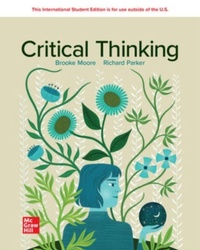
Critical Thinking: 2024 Release ISE
14th Edition
Published on 11. April 2024
Book
Paperback/Softback
480 pages
978-1-266-80886-9 (ISBN)
Description
Moore and Parker's Critical Thinking is not about critical thinking as much as it is a text in critical thinking. It provides guided practice through hundreds of exercises and examples, to help students apply content and think critically themselves. With an enjoyable, concise reading style and a visually clear layout, Critical Thinking trains students to improve information acquisition skills, recognize dubious claims, and hone critically important skills.
The authors' expanded coverage on how to recognize dubious claims is gravely applicable in the current climate of fake news, deep fakes, and AI-created information. The authors provide guided practice in what instructors say are the most important critical thinking skill sets for students.
The authors' expanded coverage on how to recognize dubious claims is gravely applicable in the current climate of fake news, deep fakes, and AI-created information. The authors provide guided practice in what instructors say are the most important critical thinking skill sets for students.
More details
Edition
14th edition
Language
English
Place of publication
OH
United States
Target group
College/higher education
US School Grade: From College Freshman to College Graduate Student
Illustrations
57 Illustrations
Dimensions
Height: 248 mm
Width: 197 mm
Thickness: 17 mm
Weight
758 gr
ISBN-13
978-1-266-80886-9 (9781266808869)
Copyright in bibliographic data and cover images is held by Nielsen Book Services Limited or by the publishers or by their respective licensors: all rights reserved.
Schweitzer Classification
Persons
Brooke Moore is a professor of philosophy at California State University, Chico, where he serves as Coordinator of the Critical Thinking Program. A former chair of the Philosophy and History departments, Moore was the University Outstanding Professor in 1996. He has served as a university Master Teacher and has coordinated the university's program for mentoring new faculty. His publications include The Power of Ideas (with Kenneth Bruder), The Cosmos, God, and Philosophy (with Ralph J. Moore), A Comprehensive Introduction to Moral Philosophy (with Robert Stewart), and other works.
Richard Parker is Professor Emeritus of philosophy at California State University, Chico. He has been three times chair of the university's Faculty Senate, Dean of Undergraduate Education, and Executive Assistant to the President and has received Professional Achievement Honors for his academic work. He has published in analytic philosophy, critical thinking, and philosophy of law, and his views on punishment and responsibility have been included in major anthologies. Outside academia, Parker is a semiprofessional flamenco guitarist, performing with dancers around and about northern California; he rides a Harley-Davidson motorcycle, plays golf for fun and pool for money, and spends as much time as possible in southern Spain.
Richard Parker is Professor Emeritus of philosophy at California State University, Chico. He has been three times chair of the university's Faculty Senate, Dean of Undergraduate Education, and Executive Assistant to the President and has received Professional Achievement Honors for his academic work. He has published in analytic philosophy, critical thinking, and philosophy of law, and his views on punishment and responsibility have been included in major anthologies. Outside academia, Parker is a semiprofessional flamenco guitarist, performing with dancers around and about northern California; he rides a Harley-Davidson motorcycle, plays golf for fun and pool for money, and spends as much time as possible in southern Spain.
Content
1 Driving Blindfolded?
2 Reasoning and Arguments?
3 Vagueness, Generality, Ambiguity, and Definition?
4 Believability of Claims and Credibility of Sources
5 Linguistic Persuasion Devices
6 Bogus Logos Part I: Relevance Fallacies
7 Bogus Logos Part II: Induction Fallacies?
8 Bogus Logos III: Formal Fallacies, Fallacies of Ambiguity, and Fallacies Involving Miscalculating Probabilities?
9 Deductive Arguments I (Natural Deduction): Categorical Logic?
10 Deductive Arguments II: Truth-Functional (Sentential) Logic?
11 Inductive Reasoning?
12 Moral, Legal, and Aesthetic Reasoning
2 Reasoning and Arguments?
3 Vagueness, Generality, Ambiguity, and Definition?
4 Believability of Claims and Credibility of Sources
5 Linguistic Persuasion Devices
6 Bogus Logos Part I: Relevance Fallacies
7 Bogus Logos Part II: Induction Fallacies?
8 Bogus Logos III: Formal Fallacies, Fallacies of Ambiguity, and Fallacies Involving Miscalculating Probabilities?
9 Deductive Arguments I (Natural Deduction): Categorical Logic?
10 Deductive Arguments II: Truth-Functional (Sentential) Logic?
11 Inductive Reasoning?
12 Moral, Legal, and Aesthetic Reasoning