

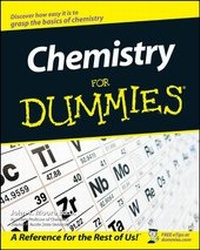
Chemistry For Dummies
1st Edition
Published on 6. December 2002
Book
Paperback/Softback
XVIII, 366 pages
978-0-7645-5430-8 (ISBN)
Description
Includes examples of chemistry in action in everyday life
See how chemistry works in everything from soaps to medicines to petroleum
Whether you're taking a chemistry course or you're curious about what chemists do, this fun and easy guide will get you up to speed in matter and energy, elements and atoms, acids and gases, and much more. You'll understand the basic concepts and discover how chemistry affects our day-to-day lives - from the home to the environment.
The Dummies Way
* Explanations in plain English
* "Get in, get out" information
* Icons and other navigational aids
* Tear-out cheat sheet
* Top ten lists
* A dash of humor and fun
More details
Edition
1., Auflage
Language
English
Place of publication
Foster City
United States
Publishing group
John Wiley & Sons Inc
Target group
Professional and scholarly
Illustrations
Illustrations
Dimensions
Height: 23.3 cm
Width: 18.8 cm
Thickness: 22 mm
Weight
539 gr
ISBN-13
978-0-7645-5430-8 (9780764554308)
Schweitzer Classification
Other editions
New editions
John T. Moore
Chemistry For Dummies
Book
05/2011
2nd Edition
Wiley
€20.90
Article exhausted; check for reprint
Person
John T. Moore Ed.D. has been a teacher for more than thirty years. Numerous grants have permitted him to focus on the professional development of elementary and middle school teachers in science.
Content
Introduction.
Part I: Basic Concepts of Chemistry.
Chapter 1: What Is Chemistry, and Why Do I Need to Know Some?
Chapter 2: Matter and Energy.
Chapter 3: Something Smaller Than an Atom? Atomic Structure.
Chapter 4: The Periodic Table (But No Chairs).
Chapter 5: Nuclear Chemistry: It'll Blow Your Mind.
Part II: Blessed Be the Bonds That Tie.
Chapter 6: Opposites Do Attract: Ionic Bonds.
Chapter 7: Covalent Bonds: Let's Share Nicely.
Chapter 8: Chemical Cooking: Chemical Reactions.
Chapter 9: Electrochemistry: Batteries to Teapots.
Part III: The Mole: The Chemist's Best Friend.
Chapter 10: The Mole: Can You Dig It?
Chapter 11: Mixing Matter Up: Solutions.
Chapter 12: Sour and Bitter: Acids and Bases.
Chapter 13: Balloons, Tires, and Scuba Tanks: The Wonderful World of Gases.
Part IV: Chemistry in Everyday Life: Benefits and Problems.
Chapter 14: The Chemistry of Carbon: Organic Chemistry.
Chapter 15: Petroleum: Chemicals for Burning or Building.
Chapter 16: Polymers: Making Big Ones from Little Ones.
Chapter 17: Chemistry in the Home.
Chapter 18: Cough! Cough! Hack! Hack! Air Pollution.
Chapter 19: Brown, Chunky Water? Water Pollution.
Part V: The Part of Tens.
Chapter 20: Ten Serendipitous Discoveries in Chemistry.
Chapter 21: Ten Great Chemistry Nerds.
Chapter 22: Ten Useful Chemistry Web Sites.
Appendix A: Scientific Units: The Metric System.
Appendix B: How to Handle Really Big or Really Small Numbers.
Appendix C: Unit Conversion Method.
Appendix D: Significant Figures and Rounding Off.
Index.