

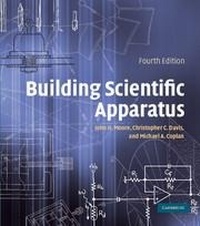
Building Scientific Apparatus
4th Edition
Will be published approx. on 25. June 2009
Book
Hardback
658 pages
978-0-521-87858-6 (ISBN)
Description
Unrivalled in its coverage and unique in its hands-on approach, this guide to the design and construction of scientific apparatus is essential reading for every scientist and student of engineering, and physical, chemical, and biological sciences. Covering the physical principles governing the operation of the mechanical, optical and electronic parts of an instrument, new sections on detectors, low-temperature measurements, high-pressure apparatus, and updated engineering specifications, as well as 400 figures and tables, have been added to this edition. Data on the properties of materials and components used by manufacturers are included. Mechanical, optical, and electronic construction techniques carried out in the lab, as well as those let out to specialized shops, are also described. Step-by-step instruction supported by many detailed figures, is given for laboratory skills such as soldering electrical components, glassblowing, brazing, and polishing.
Reviews / Votes
'This new edition includes updates throughout, and will continue to serve as a bookshelf standard in laboratories around the world. I never like to be too far from this book!' Jason Hafner, Rice University, Houston, Texas '... the first book I reach for to remind myself of an experimental technique, or to start learning a new one. With valuable additions ..., the newest addition will be a welcome replacement for our lab's well-thumbed previous editions of BSA.' Brian King, McMaster University, Canada '... a mine of useful information ranging from tables of the properties of materials to lists of manufacturers and suppliers. This book would be an invaluable resource in any laboratory in the physical sciences and beyond.' George King, University of Manchester '... concentrating several careers' worth of equipment-building experience into a single volume - a thoroughly revised and updated edition of a 25-year-old classic. It is a 'must-have' on the shelf of every research lab.' Nicholas Spencer, Eidgenoessische Technische Hochschule, Zuerich 'This book is a unique resource for the beginning experimenter, and remains valuable throughout a scientist's career. Professional engineers I know also own and enjoy using the book.' Eric Zimmerman, University of Colorado at Boulder, Colorado '... a fascinating and extremely useful reference work. Anyone who works with scientific apparatus will benefit from this book, undergraduate students, professors, technicians and postdocs. If you do not have one already, buy one now!' Contemporary PhysicsMore details
Edition
4th Revised edition
Language
English
Place of publication
Cambridge
United Kingdom
Target group
Professional and scholarly
College/higher education
Edition type
Revised edition
Product notice
Laminated cover
Dimensions
Height: 242 mm
Width: 221 mm
Thickness: 38 mm
Weight
1706 gr
ISBN-13
978-0-521-87858-6 (9780521878586)
Copyright in bibliographic data and cover images is held by Nielsen Book Services Limited or by the publishers or by their respective licensors: all rights reserved.
Schweitzer Classification
Other editions
Additional editions
John H. Moore | Christopher C. Davis | Michael A. Coplan
Building Scientific Apparatus
E-Book
09/2009
4th Edition
Cambridge University Press
€103.99
Available for download
John H. Moore
Building Scientific Apparatus
E-Book
06/2009
Cambridge University Press
€87.49
Available for download
Persons
John H. Moore is Professor Emeritus at the University of Maryland. He is a Fellow of the American Physical Society and the American Association for the Advancement of Science. His research has included plasma chemistry, high-energy electron scattering, and the design and fabrication of instruments for use in the laboratory and on spacecraft. Christopher C. Davis is Professor of Electrical and Computer Engineering at the University of Maryland. He is a Fellow of the Institute of Physics, and a Fellow of the Institute of Electrical and Electronics Engineers. Currently his research deals with free space optical and directional RF communication systems, plasmonics, near-field scanning optical microscopy, chemical and biological sensors, interferometry, optical systems, bioelectromagnetics, and RF dosimetry. Michael A. Coplan is Professor and Director of the Chemical Physics Program at the University of Maryland. He is a Fellow of the American Physical Society and has research programs in space science, electron scattering, and neutron detection. Sandra C. Greer is Professor of Chemistry and Biochemistry and Professor of Chemical and Biomolecular Engineering at the University of Maryland. She is a Fellow of the American Physical Society, and recipient of the American Chemical Society Francis P. Garvan-John M. Olin Medal. Her research deals with experimental thermodynamics and statistical mechanics of fluids and fluid mixtures, living polymers, biopolymers, and polymer solutions.
Content
1. Mechanical design and fabrication; 2. Working with glass; 3. Vacuum technology; 4. Optical systems; 5. Charged-particle optics; 6. Electronics; 7. Detectors; 8. Measurement and control of temperature; Index.