

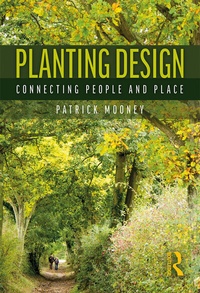
Planting Design
Connecting People and Place
1st Edition
Published on 12. November 2019
Book
Hardback
336 pages
978-1-138-02603-2 (ISBN)
Description
Landscape designers have long understood the use of plants to provide beauty, aesthetic pleasure and visual stimulation while supporting a broad range of functional goals. However, the potential for plants in the landscape to elicit human involvement and provide mental stimulation and restoration is much less well understood.
This book meshes the art of planting design with an understanding of how humans respond to natural environments. Beginning with an understanding of human needs, preferences and responses to landscape, the author interprets the ways in which an understanding of the human-environment interaction can inform planting design. Many of the principles and techniques that may be used in planting design are beautifully illustrated in full colour with examples by leading landscape architects and designers from the United Kingdom, Europe, North America and Asia, including:
Andrea Cochran, Andrea Cochran Landscape Architecture, San Francisco, CA
Design Workshop Inc.
Richard Hartlage, Land Morphology, Seattle, WA
Shunmyo Masuno, Japan Landscape Consultants Ltd., Yokohama
Piet Oudolf, Hummelo, The Netherlands
Melody Redekop, Vancouver
Christine Ten Eyck, Ten Eyck Landscape Architects Inc., Austin, TX
Kongjian Yu, Turenscape Ltd., Beijing.
The book stimulates thought, provides new direction and assists the reader to find their own unique design voice. Because there are many valid processes and intentions for landscape design, the book is not intended to be overly prescriptive. Rather than presenting a strict design method and accompanying set of rules, Planting Design provides information, insight and inspiration as a basis for developing the individual designer's own expression in this most challenging of art forms.
This book meshes the art of planting design with an understanding of how humans respond to natural environments. Beginning with an understanding of human needs, preferences and responses to landscape, the author interprets the ways in which an understanding of the human-environment interaction can inform planting design. Many of the principles and techniques that may be used in planting design are beautifully illustrated in full colour with examples by leading landscape architects and designers from the United Kingdom, Europe, North America and Asia, including:
Andrea Cochran, Andrea Cochran Landscape Architecture, San Francisco, CA
Design Workshop Inc.
Richard Hartlage, Land Morphology, Seattle, WA
Shunmyo Masuno, Japan Landscape Consultants Ltd., Yokohama
Piet Oudolf, Hummelo, The Netherlands
Melody Redekop, Vancouver
Christine Ten Eyck, Ten Eyck Landscape Architects Inc., Austin, TX
Kongjian Yu, Turenscape Ltd., Beijing.
The book stimulates thought, provides new direction and assists the reader to find their own unique design voice. Because there are many valid processes and intentions for landscape design, the book is not intended to be overly prescriptive. Rather than presenting a strict design method and accompanying set of rules, Planting Design provides information, insight and inspiration as a basis for developing the individual designer's own expression in this most challenging of art forms.
Reviews / Votes
"Planting Design begins with a comprehensive overview of the scientific theories which explain why people have such strong emotional responses to nature. Dr. Mooney then distills this research into practical design principles that help us understand how our aesthetic preferences are formed through spatial structure, pattern, colour and light. This book validated many of the intuitive decisions I made over years of practice - it will be an interesting read as well as a source of inspiration for both the novice garden designer and the seasoned landscape architect."-Andrea Cochran, Andrea Cochran Landscape Architecture
"This ambitious book attempts to ground planting design in research-based decisions that extend beyond traditional categories of knowledge such as horticulture and aesthetics to include human-centered concepts of the environment. Across seven chapters of history and theory, Patrick Mooney ASLA, a landscape architect who teaches at the University of British Columbia, includes examples from projects by Andrea Cochran Landscape Architecture, Melody Redekop, and Kongjian Yu, FASLA, among others. Mooney argues in his book for integrating new understandings of the ways humans interact with their environments, synthesizing ideas across several fields to advocate for designing multifunctional landscapes."
-Landscape Architecture Magazine, Vol. 110 No. 7
More details
Language
English
Place of publication
London
United Kingdom
Publishing group
Taylor & Francis Ltd
Target group
College/higher education
Postgraduate and Professional
Illustrations
34 s/w Abbildungen, 152 farbige Abbildungen, 1 s/w Photographie bzw. Rasterbild, 106 Farbfotos bzw. farbige Rasterbilder, 33 s/w Zeichnungen, 46 farbige Zeichnungen, 7 farbige Tabellen
7 Tables, color; 46 Line drawings, color; 33 Line drawings, black and white; 106 Halftones, color; 1 Halftones, black and white; 152 Illustrations, color; 34 Illustrations, black and white
Dimensions
Height: 246 mm
Width: 189 mm
Weight
1360 gr
ISBN-13
978-1-138-02603-2 (9781138026032)
Copyright in bibliographic data and cover images is held by Nielsen Book Services Limited or by the publishers or by their respective licensors: all rights reserved.
Schweitzer Classification
Other editions
Additional editions
Book
11/2019
1st Edition
Routledge
€85.60
Shipment within 10-20 days
E-Book
10/2019
1st Edition
Routledge
€69.99
Available for download
E-Book
10/2019
1st Edition
Routledge
€69.99
Available for download
Person
Patrick Mooney is an award-winning landscape architect who teaches at the University of British Columbia. He writes, lectures and consults in the areas of restorative landscapes, planting design and multi-functional urban landscapes that support biodiversity.
Content
1. The Preferred Landscape 2. The Restorative Landscape 3. Horticultural Considerations in Planting Design 4. Functional and Aesthetic Criteria in Planting Design 5. Space and Place 6. The Elements of Design 7. Color