

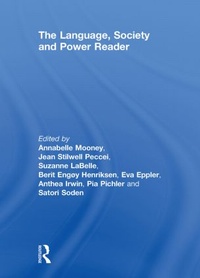
The Language , Society and Power Reader
1st Edition
Published on 25. February 2011
Book
Hardback
378 pages
978-0-415-43082-1 (ISBN)
Description
The Language, Society and Power Reader is the definitive Reader for students studying introductory modules in language and society.
Highly user-friendly, this wide-ranging collection of key readings introduces students to the thoughts and writings of major writers working within the area of sociolinguistics. The Language, Society and Power Reader:
is divided into ten thematic sections that explore the nature of language in the following areas: power, politics, media, gender, ethnicity, age, social class, identity and standardisation
includes classic foundational readings from renowned scholars, but also innovative and contemporary work from new writers in the area
provides a wealth of editorial support for each section with detailed section introductions and background information, issues to consider, annotated further reading and suggestions for further viewing
features a glossary with helpful definitions and information on how the readings link to different areas.
While it can be used as a stand-alone text, The Language, Society and Power Reader has also been fully cross-referenced with the new companion title: Language, Society and Power, third edition (Routledge, 2011). Together these books provide the complete resource for students studying modules in language and society in English language and linguistics, media, communication, cultural studies, sociology and psychology.
Highly user-friendly, this wide-ranging collection of key readings introduces students to the thoughts and writings of major writers working within the area of sociolinguistics. The Language, Society and Power Reader:
is divided into ten thematic sections that explore the nature of language in the following areas: power, politics, media, gender, ethnicity, age, social class, identity and standardisation
includes classic foundational readings from renowned scholars, but also innovative and contemporary work from new writers in the area
provides a wealth of editorial support for each section with detailed section introductions and background information, issues to consider, annotated further reading and suggestions for further viewing
features a glossary with helpful definitions and information on how the readings link to different areas.
While it can be used as a stand-alone text, The Language, Society and Power Reader has also been fully cross-referenced with the new companion title: Language, Society and Power, third edition (Routledge, 2011). Together these books provide the complete resource for students studying modules in language and society in English language and linguistics, media, communication, cultural studies, sociology and psychology.
Reviews / Votes
"A thorough introduction to language in society that directly addresses issues of power. The practical research activities it provides will prove a valuable resource for students and teachers alike." Adam Hodges, Carnegie Mellon University, USAMore details
Language
English
Place of publication
London
United Kingdom
Publishing group
Taylor & Francis Ltd
Target group
College/higher education
Product notice
Paper over boards
Illustrations
1 s/w Photographie bzw. Rasterbild, 2 s/w Zeichnungen, 20 s/w Tabellen
20 Tables, black and white; 2 Line drawings, black and white; 1 Halftones, black and white
Dimensions
Height: 246 mm
Width: 174 mm
Weight
1280 gr
ISBN-13
978-0-415-43082-1 (9780415430821)
Copyright in bibliographic data and cover images is held by Nielsen Book Services Limited or by the publishers or by their respective licensors: all rights reserved.
Schweitzer Classification
Other editions
Additional editions
Annabelle Mooney | Jean Stilwell Peccei | Suzanne LaBelle
The Language , Society and Power Reader
Book
02/2011
1st Edition
Routledge
€56.00
Shipment within 15-20 days
Persons
Annabelle Mooney is a Reader in English Language and Linguistics at Roehampton University, UK.
Jean Stilwell Peccei is a former Visiting Lecturer in the English Language and Linguistics programme at Roehampton University, UK.
Suzanne LaBelle is a Lecturer in English Language and Communication at Kingston University, UK.
Berit Engoy Henriksen attended The Norwegian University of Science and Technology (NTNU). She then studied at Roehampton University, graduating with an MRes in Sociolinguistics in 2009.
Eva Eppler is Senior Lecturer and convenor of the MRes in Sociolinguistics at Roehampton University, UK.
Satori Soden has taught at both Roehampton and Goldsmiths College, UK.
Pia Pichler is a Lecturer in Linguistics at Goldsmiths, University of London, UK.
Anthea Irwin is Programme Leader of the BA (Hons.) Media & Communication degree at Glasgow Caledonian University, UK.
Jean Stilwell Peccei is a former Visiting Lecturer in the English Language and Linguistics programme at Roehampton University, UK.
Suzanne LaBelle is a Lecturer in English Language and Communication at Kingston University, UK.
Berit Engoy Henriksen attended The Norwegian University of Science and Technology (NTNU). She then studied at Roehampton University, graduating with an MRes in Sociolinguistics in 2009.
Eva Eppler is Senior Lecturer and convenor of the MRes in Sociolinguistics at Roehampton University, UK.
Satori Soden has taught at both Roehampton and Goldsmiths College, UK.
Pia Pichler is a Lecturer in Linguistics at Goldsmiths, University of London, UK.
Anthea Irwin is Programme Leader of the BA (Hons.) Media & Communication degree at Glasgow Caledonian University, UK.
Content
Section 1: Language and Power Section 2: Language and Thought Section 3: Language and Politics Section 4: Language and Media Section 5: Language and Gender Section 6: Ethnicity Section 7: Language and Age Section 8: Language and Social Class Section 9: Language and Identity Section 10: Standard Englishes