

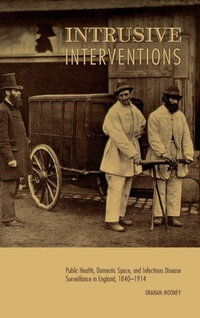
Intrusive Interventions
Public Health, Domestic Space, and Infectious Disease Surveillance in England, 1840-1914
Published on 15. October 2015
Book
Hardback
292 pages
978-1-58046-527-4 (ISBN)
Description
Examines the advent, during the mid-nineteenth century in Britain, of techniques of infectious disease surveillance, now one of the most powerful sets of tools in modern public health.
Intrusive Interventions is a history and critical study of public health in the Victorian and Edwardian period. Drawing on an array of archival sources from across provincial England and London, it investigates the emergence and consolidation of a set of government policies that came to be known as infectious disease surveillance, including compulsory infectious disease notification, domestic quarantine, mandatory removal to a hospital, contact tracing, and the disinfection of homes and belongings. Although these were a set of spatialized practices implemented in diverse settings such as hospitals, schools, and disinfecting stations, their effect was to retrain the gaze of public health onto domestic space and in the process both disrupt and reinforce the centrality of the family and domesticity in Victorian and Edwardian culture. Examining political ideologies of freedom and individuality as well associal policy, medical theory, laboratory research, material culture, and public health practice, author Graham Mooney argues that infectious disease surveillance reconfigured late nineteenth-century hygienic norms and forms of citizenship. Public health practice had to be continually reshaped in order to negate the political fallout of a tendency toward coercion and unwanted interference -- debates that, as the author of this important study points out,continue to resonate today.
Graham Mooney is Assistant Professor at the Institute of the History of Medicine, Johns Hopkins University.
Intrusive Interventions is a history and critical study of public health in the Victorian and Edwardian period. Drawing on an array of archival sources from across provincial England and London, it investigates the emergence and consolidation of a set of government policies that came to be known as infectious disease surveillance, including compulsory infectious disease notification, domestic quarantine, mandatory removal to a hospital, contact tracing, and the disinfection of homes and belongings. Although these were a set of spatialized practices implemented in diverse settings such as hospitals, schools, and disinfecting stations, their effect was to retrain the gaze of public health onto domestic space and in the process both disrupt and reinforce the centrality of the family and domesticity in Victorian and Edwardian culture. Examining political ideologies of freedom and individuality as well associal policy, medical theory, laboratory research, material culture, and public health practice, author Graham Mooney argues that infectious disease surveillance reconfigured late nineteenth-century hygienic norms and forms of citizenship. Public health practice had to be continually reshaped in order to negate the political fallout of a tendency toward coercion and unwanted interference -- debates that, as the author of this important study points out,continue to resonate today.
Graham Mooney is Assistant Professor at the Institute of the History of Medicine, Johns Hopkins University.
Reviews / Votes
Intrusive Interventions is sure to find a receptive readership among historians of medicine, urban historians, and historians of late nineteenth- and early twentieth -century Britain more generally. It is conceptually sophisticated, based on a substantial body of primary research and engagingly written. * JOURNAL OF SOCIAL HISTORY * A valuable addition to the literature on the history of public health, but also provides a critical window into the more personal relationships between patients, doctors, public health officials and legislators. * FAMILY & COMMUNITY HISTORY * Although Mooney's work is framed by the civic-focused ideas that underpinned public health in the late nineteenth and early twentieth centuries, his groundbreaking focus is the materiality and performative aspects of infectious-disease surveillance ... Intrusive Interventions is an exciting and insightful contribution to the history of public health and health care in Britain. * BRITISH JOURNAL FOR THE HISTORY OF SCIENCE * What Mooney unravels in Intrusive Interventions is exciting and insightful. . . . [T]his is the most important book on Victorian public health since Worboys's Spreading Germs. * MEDICAL HISTORY *More details
Series
Language
English
Place of publication
Rochester
United States
Publishing group
Boydell & Brewer Ltd
Target group
College/higher education
Professional and scholarly
Product notice
Cloth over boards
Illustrations
19 s/w Abbildungen, 12 s/w Zeichnungen
19 b/w, 12 line illus.
Dimensions
Height: 235 mm
Width: 157 mm
Thickness: 22 mm
Weight
631 gr
ISBN-13
978-1-58046-527-4 (9781580465274)
Copyright in bibliographic data and cover images is held by Nielsen Book Services Limited or by the publishers or by their respective licensors: all rights reserved.
Schweitzer Classification
Other editions
Additional editions
Graham Mooney
Intrusive Interventions
Public Health, Domestic Space, and Infectious Disease Surveillance in England, 1840-1914
E-Book
10/2015
1st Edition
De Gruyter
€72.99
Available for download
Person
Content
Acknowledgments
Abbreviations
Introduction
Part One: Making Infectious Disease Surveillance
1. Finding Disease in the Victorian City
2. "These Bastard Laws": Infectious Disease, Liberty, and Localism
Part Two: Spaces of Risk and Opportunity
3. Sequestration and Permeability: Isolation Hospitals
4. "Combustible Material": Classrooms, Contract Tracing, and Following-Up
5. Disinfection, Domestic Space, and the Laboratory
6. Rules for Home Living: Tuberculosis and the Consumption of Self-Help
Conclusion
Notes
Bibliography
Index
Abbreviations
Introduction
Part One: Making Infectious Disease Surveillance
1. Finding Disease in the Victorian City
2. "These Bastard Laws": Infectious Disease, Liberty, and Localism
Part Two: Spaces of Risk and Opportunity
3. Sequestration and Permeability: Isolation Hospitals
4. "Combustible Material": Classrooms, Contract Tracing, and Following-Up
5. Disinfection, Domestic Space, and the Laboratory
6. Rules for Home Living: Tuberculosis and the Consumption of Self-Help
Conclusion
Notes
Bibliography
Index