

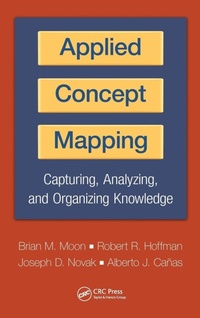
Applied Concept Mapping
Capturing, Analyzing, and Organizing Knowledge
1st Edition
Published on 7. February 2011
Book
Hardback
380 pages
978-1-4398-2860-1 (ISBN)
Description
The expanding application of Concept Mapping includes its role in knowledge elicitation, institutional memory preservation, and ideation. With the advent of the CmapTools knowledge modeling software kit, Concept Mapping is being applied with increased frequency and success to address a variety of problems in the workplace.
Supported by business application case studies, Applied Concept Mapping: Capturing, Analyzing, and Organizing Knowledge offers an accessible introduction to the theory, methods, and application of Concept Mapping in business and government. The case studies illustrate applications across a range of industries-including engineering, product development, defense, and healthcare.
The authors provide access to a free download of CmapTools, courtesy of the Institute for Human and Machine Cognition, to enable readers to create and share their own Concept Maps. Offering examples from the United States, Canada, Australia, Spain, Brazil, Scotland, and The Netherlands, they highlight a global perspective of this dynamic tool. The text is organized into three sections:
Practitioners' Views-supplies narratives, guidance, and reviews of applications from career Concept Mappers
Recent Case Studies and Results-presents in-depth examinations of specific applications and their results
Pushing the Boundaries-explores what's possible and where the boundary conditions lie
Applied Concept Mapping facilitates the fundamental understanding needed to harness the power of Concept Mapping to develop viable solutions to a virtually unlimited number of real-world problems.
Supported by business application case studies, Applied Concept Mapping: Capturing, Analyzing, and Organizing Knowledge offers an accessible introduction to the theory, methods, and application of Concept Mapping in business and government. The case studies illustrate applications across a range of industries-including engineering, product development, defense, and healthcare.
The authors provide access to a free download of CmapTools, courtesy of the Institute for Human and Machine Cognition, to enable readers to create and share their own Concept Maps. Offering examples from the United States, Canada, Australia, Spain, Brazil, Scotland, and The Netherlands, they highlight a global perspective of this dynamic tool. The text is organized into three sections:
Practitioners' Views-supplies narratives, guidance, and reviews of applications from career Concept Mappers
Recent Case Studies and Results-presents in-depth examinations of specific applications and their results
Pushing the Boundaries-explores what's possible and where the boundary conditions lie
Applied Concept Mapping facilitates the fundamental understanding needed to harness the power of Concept Mapping to develop viable solutions to a virtually unlimited number of real-world problems.
More details
Language
English
Place of publication
Bosa Roca
United States
Publishing group
Taylor & Francis Inc
Target group
Professional and scholarly
Professional Practice & Development
Illustrations
83 s/w Abbildungen, 8 s/w Tabellen
8 Tables, black and white; 83 Illustrations, black and white
Dimensions
Height: 235 mm
Width: 157 mm
Thickness: 25 mm
Weight
700 gr
ISBN-13
978-1-4398-2860-1 (9781439828601)
Copyright in bibliographic data and cover images is held by Nielsen Book Services Limited or by the publishers or by their respective licensors: all rights reserved.
Schweitzer Classification
Other editions
Additional editions
Brian Moon | Robert R. Hoffman | Joseph Novak
Applied Concept Mapping
Capturing, Analyzing, and Organizing Knowledge
E-Book
02/2011
1st Edition
CRC Press
€104.99
Available for download
Brian Moon | Robert R. Hoffman | Joseph Novak
Applied Concept Mapping
Capturing, Analyzing, and Organizing Knowledge
E-Book
02/2011
1st Edition
CRC Press
€104.99
Available for download
Persons
Brian M. Moon is the Co-Founder and Chief Technology Officer of Perigean Technologies LLC, Fredericksburg, Virginia, U.S.A. He holds a Bachelor of Arts, Psychology, from Miami University, Oxford, Ohio, U.S.A., and a Master of Science, Sociology, from the London School of Economics and Political Science, London, U.K. From 1996 to 2000, Mr. Moon provided social science support to legal defense teams. He joined the staff of Klein Associates Inc. in 2000 to apply naturalistic methods to the solution of problems in software engineering, organizational and workplace design, and training. In 2007, Brian founded Perigean Technologies with his wife, Alyson, to help organizations improve through smarter use of their own knowledge and to help improve the way knowledge moves through organizations. Perigean Technologies clients have included Westinghouse Electric Company, the New York Power Authority, the Defense Advanced Research Projects Agency, TNO, the Federal Bureau of Investigation, General Dynamics Advanced Information Systems, and Sandia National Laboratories. Mr. Moon has served on the Program Committee for International Conferences on Concept Mapping (CMC 2004, 2006, 2008, 2010), and is the Owner of the Applied Concept Mapping Group at LinkedIn. He has published extensively on topics concerning knowledge management and methodology. Robert R. Hoffman is a Senior Research Scientist at the Institute for Human and Machine Cognition (IHMC), Pensacola, Florida, U.S.A. He is recognized as one of the world leaders in the field of cognitive systems engineering and Human-Centered Computing (HCC). He is a Fellow of the Association for Psychological Science and a Fulbright Scholar. His Ph.D. is in experimental psychology from the University of Cincinnati, where he received McMicken Scholar, Psi Chi, and Delta Tau Kappa Honors. Following a Postdoctoral Associateship at the Center for Research on Human Learning at the University of Minn
Content
Introduction. Concept Mapping for Knowledge Preservation and Transfer. Concept Mapping for Analysis. Concept Mapping for Design and Ideation. Deploying Concept Mapping in Organizations.