

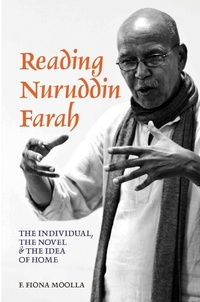
Reading Nuruddin Farah
The individual, the novel & the idea of home
Published on 20. March 2014
Book
Hardback
216 pages
978-1-84701-091-9 (ISBN)
Description
A close analysis of Farah's novels is used to track the contradictions implicit in the notion of the modern, disengaged self and how transformations of the novel in literary history attempt to negotiate this founding contradiction.
The Somali novelist, Nuruddin Farah, is one of the most important African writers today. The central question that this book investigates is the relationship between modern identity and the novel as a genre. Nuruddin Farah's novels are shown by Moolla to encompass the history of the novel: from the 'proto-realism' of the acclaimed From a Crooked Rib to the modernism of A Naked Needle and the postmodernism of, most notably, Maps, returning almost full circle with his most recent novel Crossbones.
Moolla examines his writing within the framework of Somali society and culture, Islamic traditions and political contexts, all of which are central themesin his work. She also addresses Farah's engagement with women's lives - his female characters and identities being at the heart of, rather than peripheral, to his stories - something that has distinguished him from many other male African writers.
The book finally suggests that through his literary negotiation of the central contradiction of modern identity, Farah comes close to constituting a subject who no longer is transcendentally 'homeless', butfinds a home 'everywhere' - a fitting project for a writer who has been in exile for the greater part of his life.
F. Fiona Moolla is a Senior Lecturer in the Faculty of Arts at the University of the Western Cape in South Africa as well as a freelance writer and published author of short stories.
South Africa and Zimbabwe (pb only): Blue Weaver
The Somali novelist, Nuruddin Farah, is one of the most important African writers today. The central question that this book investigates is the relationship between modern identity and the novel as a genre. Nuruddin Farah's novels are shown by Moolla to encompass the history of the novel: from the 'proto-realism' of the acclaimed From a Crooked Rib to the modernism of A Naked Needle and the postmodernism of, most notably, Maps, returning almost full circle with his most recent novel Crossbones.
Moolla examines his writing within the framework of Somali society and culture, Islamic traditions and political contexts, all of which are central themesin his work. She also addresses Farah's engagement with women's lives - his female characters and identities being at the heart of, rather than peripheral, to his stories - something that has distinguished him from many other male African writers.
The book finally suggests that through his literary negotiation of the central contradiction of modern identity, Farah comes close to constituting a subject who no longer is transcendentally 'homeless', butfinds a home 'everywhere' - a fitting project for a writer who has been in exile for the greater part of his life.
F. Fiona Moolla is a Senior Lecturer in the Faculty of Arts at the University of the Western Cape in South Africa as well as a freelance writer and published author of short stories.
South Africa and Zimbabwe (pb only): Blue Weaver
Reviews / Votes
Moolla's book is an important contribution to the expanding body of Farah criticism...her text opens a different and challenging perspective on how an author like Farah might be read. * SOCIAL DYNAMICS * Reading Nuruddin Farah is the most exhaustive critical text dedicated to Nuruddin Farah to date. Moolla's analysis is ... remarkable for its originality and intellectual rigor. * RESEARCH IN AFRICAN LITERATURES * Seeing Farah's work in the tradition of the bildungsroman, Moolla demonstrates how his fiction 'displays a concern with the subject as individual operated on by the power of both the postcolonial state and tradition.' Highly recommended. * CHOICE * 'This work represents perhaps the most original and comprehensive study of Farah's work to date.' - -- Simon S. Gikandi, Robert Schirmer Professor of English, Princeton University '... provides an insightful perspective on the concept of individualism, its philosophical genealogy, and its intimate connection to the emergence of the novel in Western Europe and subsequent expansion to its current status as a global genre.' - -- Olakunle George, Associate Professor, Brown University 'To my mind, this is the first exhaustive work on Farah which locates his works within a known genre tradition, specifically that of the modern novel, and proceeds to argue that Farah's novels represent the fundamental problematic of the individual representation through the form of the novel.' - -- James A. Ogude, Professor and Research Fellow, Centre for the Advancement of Scholarship, University of PretoriaMore details
Language
English
Place of publication
Oxford
United Kingdom
Target group
Professional and scholarly
Product notice
Cloth over boards
Dimensions
Height: 236 mm
Width: 155 mm
Thickness: 20 mm
Weight
499 gr
ISBN-13
978-1-84701-091-9 (9781847010919)
Copyright in bibliographic data and cover images is held by Nielsen Book Services Limited or by the publishers or by their respective licensors: all rights reserved.
Schweitzer Classification
Other editions
Additional editions
E-Book
03/2014
1st Edition
De Gruyter
€48.99
Available for download
Book
03/2014
James Currey
€33.61
Shipment within 3-4 weeks
Person
F. Fiona Moolla
Content
Introduction
Defining the Individual: Conceptual & Historical Limits
From a Crooked Rib & the Bildungsroman: Developing the Self, Developing the Nation
The 'Gynocentric' Bildungsroman: Sardines & Gifts
Modernism in A Naked Needle & Sweet & Sour Milk: Irony, Morality & the Aesthetic
Close Sesame& the Representation of Heteronomy
Dissolving the Boundaries of Self & Nation in Maps & Secrets
Reconstructing the Subject in the Third Trilogy: Links, Knots & Crossbones
Conclusion
Defining the Individual: Conceptual & Historical Limits
From a Crooked Rib & the Bildungsroman: Developing the Self, Developing the Nation
The 'Gynocentric' Bildungsroman: Sardines & Gifts
Modernism in A Naked Needle & Sweet & Sour Milk: Irony, Morality & the Aesthetic
Close Sesame& the Representation of Heteronomy
Dissolving the Boundaries of Self & Nation in Maps & Secrets
Reconstructing the Subject in the Third Trilogy: Links, Knots & Crossbones
Conclusion