

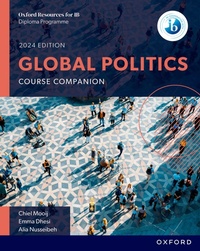
Oxford Resources for IB: DP Global Politics Course Book
1st Edition
Published on 15. February 2024
Book
Paperback/Softback
256 pages
978-1-382-03365-7 (ISBN)
Description
Please note this title is suitable for any student studying:
- Exam Board: International Baccalaureate (IB)
- Level and subject: IB Diploma Global Politics students - SL and HL
- First teaching: 2024
- First exams: 2025
Developed in cooperation with the IB and supporting the 2024 subject guide, this concept-based Course Book cements critical understanding of big picture issues and solutions. This title:
- Is published in cooperation with the IB so you can be assured the content is aligned, reviewed, and approved
- Focuses on both knowledge and skills with high quality content created by experienced IB authors, examiners, and teachers
- Contains student-centred activities that help to develop critical thinkers
- Has a new concept feature that supports student understanding on how key concepts can be linked and applied to different topics
- Nurtures outward-looking, reflective learners with student-friendly explanations of key concepts and TOK links
- Engages students with a regularly updated digital bank of relevant and topical case studies, for use both in and out of the classroom
- Prepares learners for assessment with exam-style practice questions and opportunities to hone ATL skills
- Exam Board: International Baccalaureate (IB)
- Level and subject: IB Diploma Global Politics students - SL and HL
- First teaching: 2024
- First exams: 2025
Developed in cooperation with the IB and supporting the 2024 subject guide, this concept-based Course Book cements critical understanding of big picture issues and solutions. This title:
- Is published in cooperation with the IB so you can be assured the content is aligned, reviewed, and approved
- Focuses on both knowledge and skills with high quality content created by experienced IB authors, examiners, and teachers
- Contains student-centred activities that help to develop critical thinkers
- Has a new concept feature that supports student understanding on how key concepts can be linked and applied to different topics
- Nurtures outward-looking, reflective learners with student-friendly explanations of key concepts and TOK links
- Engages students with a regularly updated digital bank of relevant and topical case studies, for use both in and out of the classroom
- Prepares learners for assessment with exam-style practice questions and opportunities to hone ATL skills
More details
Series
Language
English
Place of publication
Oxford
United Kingdom
Target group
Adult education
Dimensions
Height: 274 mm
Width: 214 mm
Thickness: 14 mm
Weight
674 gr
ISBN-13
978-1-382-03365-7 (9781382033657)
Copyright in bibliographic data and cover images is held by Nielsen Book Services Limited or by the publishers or by their respective licensors: all rights reserved.
Schweitzer Classification
Persons
Chiel Mooij, Emma Dhesi, Alia Nusseibeh
Content
Contents How to use this book Approaches to global politics 1 Core topics: Understanding power and global politics 1.1 Framing global politics and systems and interactions in global politics 1.1.1 Stakeholders and actors 1.1.2 Systems - structures and dynamics 1.1.3 Legal frameworks, norms and institutions 1.2 Power in global politics 1.2.1 Hard, soft and smart power 1.2.2 Structural and relational power 1.2.3 Economic, political, social and cultural power 1.2.4 Power to, power over, power with, power within 1.3 Sovereignty in global politics 1.3.1 Nature of state sovereignty 1.3.2 Challenges to state sovereignty 1.4 Legitimacy in global politics 1.4.1 Sources of state legitimacy 1.4.2 Challenges to state and government legitimacy 1.4.3 Sources of legitimacy of non-state actors 1.4.4 Legitimation processes and loss of legitimacy of political actors 1.5 Interdependence in global politics 1.5.1 Global governance and international law 1.5.2 The United Nations (UN) 1.5.3 Participation of intergovernmental organizations (IGOs) and non-state actors in global governa 1.6 Theoretical perspectives in global politics 1.6.1 Theories, models and analytical frameworks in global politics 1.6.2 Bias and limitations of theories and models Exam-style questions 2 Peace and conflict 2.1 Contested meanings 2.1.1 Peace (including positive and negative) 2.1.2 Conflict (including latent and overt) 2.1.3 Violence (including direct, structural and cultural) 2.1.4 Non-violence 2.2 Interactions of political stakeholders and actors 2.2.1 Parties to conflict 2.2.2 Violent and non-violent state and non-state actors 2.2.3 Third parties 2.2.4 Marginalized, vulnerable and most affected groups and individuals 2.3 Nature, practice and study of peace and conflict 2.3.1 Conflict dynamics 2.3.2 Causes of conflict 2.3.3 Types of conflict 2.3.4 Peacemaking, peacekeeping and peacebuilding 2.4 Debates on peace and conflict 2.4.1 Justifications of violence in conflict 2.4.2 Legitimacy of non-violent and violent protests 2.4.3 Effectiveness of peacebuilding efforts Exam-style questions 3 Development and sustainability 3.1 Contested meanings 3.1.1 Poverty 3.1.2 Development 3.2 Interactions of political stakeholders and actors 3.2.1 States 3.2.2 IGOs 3.2.3 Multinational and transnational companies (MNCs and TNCs) 3.2.4 Civil society 3.2.5 Marginalized, vulnerable or most affected groups and individuals 3.3 Nature, practice and study of development and sustainability 3.3.1 Dimensions and assessment of development and sustainability 3.3.2 Pathways towards development and sustainability 3.3.3 Factors affecting development 3.4 Debates on development and sustainability 3.4.1 Globalization 3.4.2 Alternative views on development, poverty and sustainability Exam-style questions 4 Rights and justice 4.1 Contested meanings 4.1.1 Rights 4.1.2 Justice 4.1.3 Liberty 4.1.4 Equality 4.2 Interactions of political stakeholders and actors 4.2.1 The state and national governments 4.2.2 IGOs 4.2.3 Regional human rights tribunals 4.2.4 Civil-society organizations 4.2.5 Marginalized, vulnerable, or most affected groups and individuals 4.2.6 Private companies and unions 4.3 Nature, practice and study of rights and justice 4.3.1 Codification, protection and monitoring 4.3.2 International and regional rights frameworks 4.3.3 Development of world norms in rights and justice 4.3.4 Responses to violations of rights and perceived injustices 4.4 Debates on rights and justice 4.4.1 Diverse standards and understandings of rights 4.4.2 Politicization of rights and justice 4.4.3 Claims on individual and collective rights Exam-style questions Skills and assessment Study skills Paper 1 guidance Paper 2 guidance Paper 3 guidance The engagement project Index