

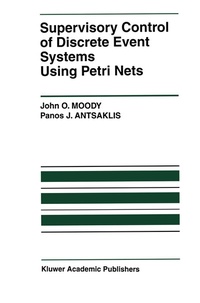
Supervisory Control of Discrete Event Systems Using Petri Nets
Published on 31. July 1998
Book
Hardback
XVII, 187 pages
978-0-7923-8199-0 (ISBN)
Description
Supervisory Control of Discrete Event Systems Using Petri Nets
presents a novel approach to its subject. The concepts of supervisory control and discrete event systems are explained, and the background material on general Petri net theory necessary for using the book's control techniques is provided. A large number of examples is used to illustrate the concepts and techniques presented in the text, and there are plenty of references for those interested in additional study or more information on a particular topic.
Supervisory Control of Discrete Event Systems Using Petri Nets is intended for graduate students, advanced undergraduates, and practicing engineers who are interested in the control problems of manufacturing, communication and computer networks, chemical process plants, and other high-level control applications. The text is written from an engineering perspective, but it is also appropriate for students of computer science, applied mathematics, or economics. The book contains enough background material to stand alone as an introduction to supervisory control with Petri nets, but it may also be used as a supplemental text in a course on discrete event systems or intelligent autonomous control.
Supervisory Control of Discrete Event Systems Using Petri Nets is intended for graduate students, advanced undergraduates, and practicing engineers who are interested in the control problems of manufacturing, communication and computer networks, chemical process plants, and other high-level control applications. The text is written from an engineering perspective, but it is also appropriate for students of computer science, applied mathematics, or economics. The book contains enough background material to stand alone as an introduction to supervisory control with Petri nets, but it may also be used as a supplemental text in a course on discrete event systems or intelligent autonomous control.
More details
Series
Edition
1998 ed.
Language
English
Place of publication
New York
United States
Target group
Professional and scholarly
Research
Product notice
sewn/stitched
Cloth over boards
Illustrations
XVII, 187 p.
Dimensions
Height: 234 mm
Width: 156 mm
Thickness: 13 mm
Weight
467 gr
ISBN-13
978-0-7923-8199-0 (9780792381990)
DOI
10.1007/978-1-4615-5711-1
Schweitzer Classification
Other editions
Additional editions
John O. Moody | Panos J. Antsaklis
Supervisory Control of Discrete Event Systems Using Petri Nets
E-Book
12/2012
Springer
€149.79
Available for download
John O. Moody | Panos J. Antsaklis
Supervisory Control of Discrete Event Systems Using Petri Nets
Book
10/2012
Springer
€160.49
Shipment within 7-9 days
Content
1. Introduction.- 2. Petri Nets.- 2.1 Petri Net Definitions.- 2.2 Structural Invariants.- 2.3 Siphons and Traps.- 2.4 Classes of Petri Nets.- 2.5 Petri Nets and Automata.- 2.6 Petri Nets in Control.- 3. Invariant Based Control Design.- 3.1 Monitor Based Supervisors.- 3.2 Supervisor Synthesis using Place Invariants.- 3.3 Maximally Permissive Supervision.- 4. Uncontrollable and Unobservable Transitions.- 4.1 Uncontrollable Transitions.- 4.2 Unobservable Transitions.- 4.3 Constraint Transformations.- 4.4 Vector Discrete Event Systems.- 4.5 Petri Net Modeled Supervisors.- 5. Constraint Transformation and Controller Synthesis.- 5.1 Computing Constraint Transformations.- 5.2 Structure of Admissible Constraints and Controls.- 5.3 Admissible Constraints and Controller Synthesis.- 5.4 Enforcing Disjunctions of Linear Constraints.- 6. Resource Management and Deadlock Avoidance.- 6.1 Modeling of Finite Resources.- 6.2 Conditions for Liveness.- 6.3 Deadlock Avoidance.- 7. Other Control Specifications.- 7.1 Equality Constraints.- 7.2 Constraints involving the Firing Vector.- 7.3 Logical Constraints on System Behavior.- 7.4 Constraints Involving Time.- 7.5 Limits of the Constraint Inequality.- 8. Example Applications.- 8.1 The Cat and Mouse Problem.- 8.2 Automated Guided Vehicle Coordination.- 8.3 The Unreliable Machine.- 8.4 Piston Rod Robotic Assembly Cell.- 8.5 Asynchronous Transfer Mode Switch.- 8.6 The Three Tanks Problem.- 8.7 Hybrid Control System Example.- 9. Summary and Conclusions.- References.- List of Symbols.- About the Authors.