

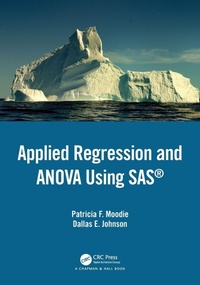
Applied Regression and ANOVA Using SAS
1st Edition
Published on 26. August 2024
Book
Paperback/Softback
406 pages
978-1-032-24466-2 (ISBN)
Description
Applied Regression and ANOVA Using SAS (R) has been written specifically for non-statisticians and applied statisticians who are primarily interested in what their data are revealing. Interpretation of results are key throughout this intermediate-level applied statistics book. The authors introduce each method by discussing its characteristic features, reasons for its use, and its underlying assumptions. They then guide readers in applying each method by suggesting a step-by-step approach while providing annotated SAS programs to implement these steps.
Those unfamiliar with SAS software will find this book helpful as SAS programming basics are covered in the first chapter. Subsequent chapters give programming details on a need-to-know basis. Experienced as well as entry-level SAS users will find the book useful in applying linear regression and ANOVA methods, as explanations of SAS statements and options chosen for specific methods are provided.
Features:
*Statistical concepts presented in words without matrix algebra and calculus
*Numerous SAS programs, including examples which require minimum programming effort to produce high resolution publication-ready graphics
*Practical advice on interpreting results in light of relatively recent views on threshold p-values, multiple testing, simultaneous confidence intervals, confounding adjustment, bootstrapping, and predictor variable selection
*Suggestions of alternative approaches when a method's ideal inference conditions are unreasonable for one's data
This book is invaluable for non-statisticians and applied statisticians who analyze and interpret real-world data. It could be used in a graduate level course for non-statistical disciplines as well as in an applied undergraduate course in statistics or biostatistics.
Those unfamiliar with SAS software will find this book helpful as SAS programming basics are covered in the first chapter. Subsequent chapters give programming details on a need-to-know basis. Experienced as well as entry-level SAS users will find the book useful in applying linear regression and ANOVA methods, as explanations of SAS statements and options chosen for specific methods are provided.
Features:
*Statistical concepts presented in words without matrix algebra and calculus
*Numerous SAS programs, including examples which require minimum programming effort to produce high resolution publication-ready graphics
*Practical advice on interpreting results in light of relatively recent views on threshold p-values, multiple testing, simultaneous confidence intervals, confounding adjustment, bootstrapping, and predictor variable selection
*Suggestions of alternative approaches when a method's ideal inference conditions are unreasonable for one's data
This book is invaluable for non-statisticians and applied statisticians who analyze and interpret real-world data. It could be used in a graduate level course for non-statistical disciplines as well as in an applied undergraduate course in statistics or biostatistics.
Reviews / Votes
"... A must for someone that wants to work with theaforementioned models using SAS and wants a step-by-step guide on how and when toimplement those models. Each chapter is organized in a very similar manner. Itprovides theminimum amount of theory in a non-technical way at first, including when to use a specificmodel, what should be checked as assumptions and what to do when assumptions are not met."David Manteigas, ISCB News, May 2024
More details
Language
English
Place of publication
Boca Raton
United Kingdom
Publishing group
Taylor & Francis Ltd
Target group
Professional and scholarly
Professional Practice & Development
Illustrations
81 s/w Abbildungen, 2 s/w Photographien bzw. Rasterbilder, 79 s/w Zeichnungen, 8 s/w Tabellen
8 Tables, black and white; 79 Line drawings, black and white; 2 Halftones, black and white; 81 Illustrations, black and white
Dimensions
Height: 254 mm
Width: 178 mm
Thickness: 23 mm
Weight
800 gr
ISBN-13
978-1-032-24466-2 (9781032244662)
Copyright in bibliographic data and cover images is held by Nielsen Book Services Limited or by the publishers or by their respective licensors: all rights reserved.
Schweitzer Classification
Other editions
Additional editions
Patricia F. Moodie | Dallas E. Johnson
Applied Regression and ANOVA Using SAS
Using SAS for Statistical Analysis and Graphics
Book
06/2022
1st Edition
Chapman & Hall/CRC
€122.60
Shipment within 15-20 days
Patricia F. Moodie | Dallas E. Johnson
Applied Regression and ANOVA Using SAS
E-Book
06/2022
1st Edition
Chapman & Hall/CRC
€64.49
Available for download
Patricia F. Moodie | Dallas E. Johnson
Applied Regression and ANOVA Using SAS
E-Book
06/2022
1st Edition
Chapman and Hall/CRC
€64.49
Available for download
Persons
Patricia F. Moodie is a Research Scholar in the Department of Mathematics and Statistics at the University of Winnipeg, Manitoba, Canada. Prior to that she was Head of Biostatistics in the Computer Department for Health Sciences in the College of Medicine, University of Manitoba, an adjunct lecturer in Biometry in the Department of Social and Preventive Medicine at the University of Manitoba, and a biostatistician in the Epidemiology and Biostatistics Department at the Manitoba Cancer Treatment and Research Foundation. Her statistical consulting and collaboration for over three decades as well as her substantive background in the biomedical sciences have made her appreciate the challenges in analyzing and interpreting real-life data. She received a BSc (Hons) in Biology at Memorial University of Newfoundland, an MSc in Zoology at the University of Alberta, and an MS in Biostatistics at the University of Illinois at Chicago. She has been an enthusiastic SAS user since 1980.
Dallas E. Johnson, Professor Emeritus in the Department of Statistics, Kansas State University, has published extensively in the areas of linear models, multiplicative interaction models, experimental design, and messy data analysis. He is the author of Applied Multivariate Methods for Data Analysts and co-author with George A. Milliken of the following books: Analysis of Messy Data, Vol. I - Designed Experiments, Vol. II - Nonreplicated Experiments, Vol. III - Analysis of Covariance, and Vol. I - Designed Experiments 2nd Edition. An active presenter of short courses, and a statistical consultant for over 50 years, he was the recipient of ASA's award for Excellence in Statistical Consulting in 2010. He received his B.S. degree in Mathematics Education, Kearney State College, a M.A.T. degree in Mathematics, Colorado State University, a M.S. degree in Mathematics, Western Michigan University, and a Ph.D. degree in Statistics, Colorado State University. He has been a SAS user and mentor since 1976.
Dallas E. Johnson, Professor Emeritus in the Department of Statistics, Kansas State University, has published extensively in the areas of linear models, multiplicative interaction models, experimental design, and messy data analysis. He is the author of Applied Multivariate Methods for Data Analysts and co-author with George A. Milliken of the following books: Analysis of Messy Data, Vol. I - Designed Experiments, Vol. II - Nonreplicated Experiments, Vol. III - Analysis of Covariance, and Vol. I - Designed Experiments 2nd Edition. An active presenter of short courses, and a statistical consultant for over 50 years, he was the recipient of ASA's award for Excellence in Statistical Consulting in 2010. He received his B.S. degree in Mathematics Education, Kearney State College, a M.A.T. degree in Mathematics, Colorado State University, a M.S. degree in Mathematics, Western Michigan University, and a Ph.D. degree in Statistics, Colorado State University. He has been a SAS user and mentor since 1976.
Content
1. Review of Some Basic Statistical Ideas
2. Introduction to Simple Linear Regression
3. Model Checking in Simple Linear Regression
4. Interpreting a Simple Linear Regression Analysis
5. Introduction to Multiple Linear Regression
6. Before Interpreting A Multiple Linear Regression
7. Additive Multiple Linear Regression
8. Two-Way Interaction Between Continuous Predictors
9. Qualitative and Continuous Predictor Interaction
10. Predictor Subset Selection
11. Evaluating Equality of Group Means
12. Simultaneous Inference
13. Adjusting Group Means for Nuisance Variables
14. Alternative Approaches
2. Introduction to Simple Linear Regression
3. Model Checking in Simple Linear Regression
4. Interpreting a Simple Linear Regression Analysis
5. Introduction to Multiple Linear Regression
6. Before Interpreting A Multiple Linear Regression
7. Additive Multiple Linear Regression
8. Two-Way Interaction Between Continuous Predictors
9. Qualitative and Continuous Predictor Interaction
10. Predictor Subset Selection
11. Evaluating Equality of Group Means
12. Simultaneous Inference
13. Adjusting Group Means for Nuisance Variables
14. Alternative Approaches