

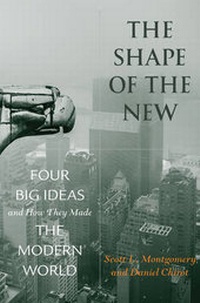
The Shape of the New
Four Big Ideas and How They Made the Modern World
Published on 26. May 2015
Book
Hardback
512 pages
978-0-691-15064-2 (ISBN)
Description
This panoramic book tells the story of how revolutionary ideas from the Enlightenment about freedom, equality, evolution, and democracy have reverberated through modern history and shaped the world as we know it today. A testament to the enduring power of ideas, The Shape of the New offers unforgettable portraits of Adam Smith, Thomas Jefferson, Alexander Hamilton, Charles Darwin, and Karl Marx--heirs of the Enlightenment who embodied its highest ideals about progress--and shows how their thoughts, over time and in the hands of their followers and opponents, transformed the very nature of our beliefs, institutions, economies, and politics. Yet these ideas also hold contradictions. They have been used in the service of brutal systems such as slavery and colonialism, been appropriated and twisted by monsters like Stalin and Hitler, and provoked reactions against the Enlightenment's legacy by Islamic Salafists and the Christian Religious Right. The Shape of the New argues that it is impossible to understand the ideological and political conflicts of our own time without familiarizing ourselves with the history and internal tensions of these world-changing ideas.
With passion and conviction, it exhorts us to recognize the central importance of these ideas as historical forces and pillars of the Western humanistic tradition. It makes the case that to read the works of the great thinkers is to gain invaluable insights into the ideas that have shaped how we think and what we believe.
With passion and conviction, it exhorts us to recognize the central importance of these ideas as historical forces and pillars of the Western humanistic tradition. It makes the case that to read the works of the great thinkers is to gain invaluable insights into the ideas that have shaped how we think and what we believe.
Reviews / Votes
One of Choice's Outstanding Academic Titles for 2016 One of The New York Times 100 Notable Books of 2015 One of Bloomberg Businessweek's Best Books of 2015, chosen by Diana Farrell "I was struck again and again by the extraordinary breadth, erudition and lucidity of this book."--Fareed Zakaria, New York Times Book Review "This is a gem of a book in that it has the audacity to paint in big strokes to portray a great intellectual history that puts our often competing, current belief systems into their 18th and 19th century contexts. In light of the increasingly perplexing news headlines, this type of bold context setting is a real gift."--Diana Farrell, President and chief executive officer, JPMorgan Chase Institute in Bloomberg Best Books of 2015 "Montgomery and Chirot offer a sweeping defense of intellectual liberalism and an examination of its indelible influence on the modern world... Thoughtful, highly readable, and provocative."--ChoiceMore details
Language
English
Place of publication
New Jersey
United States
Target group
College/higher education
Product notice
Trade binding
Dimensions
Height: 235 mm
Width: 152 mm
Weight
992 gr
ISBN-13
978-0-691-15064-2 (9780691150642)
Copyright in bibliographic data and cover images is held by Nielsen Book Services Limited or by the publishers or by their respective licensors: all rights reserved.
Schweitzer Classification
Other editions
New editions
Scott L. Montgomery | Daniel Chirot
The Shape of the New
Four Big Ideas and How They Made the Modern World
Book
10/2016
Princeton University Press
€21.00
Shipment within 10-20 days
Persons
Scott L. Montgomery is an affiliate faculty member in the Henry M. Jackson School of International Studies at the University of Washington. Daniel Chirot is professor of Russian and Eurasian studies at the University of Washington.
Content
Preface ix Acknowledgments xi Introduction: Ideas as Historical Forces 1 PART I: INVENTORS OF MODERNITY AND WHAT BECAME OF THEIR IDEAS 17 1 Adam Smith: The Science of Man, Morality, and Money 19 2 Karl Marx: The Tragic Consequences of a Brilliant Theory 81 3 Charles Darwin: Struggle and Selection in the Realm of Ideas 148 4 Making Democracy: The Jefferson-Hamilton Debates 215 PART II: SECULAR AND RELIGIOUS REACTIONS AGAINST ENLIGHTENMENT 279 5 Counter-Enlightenment: From Antimodernism to Fascism 281 6 Christian Fundamentalism: The Politics of God in America 336 7 Purifying Islam: The Muslim Reaction against the Western Enlightenment 379 Conclusion: The Power of Ideas and the Importance of the Humanities 418 Bibliography 439 Index 473