

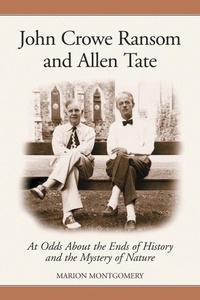
John Crowe Ransom and Allen Tate
At Odds about the Ends of History and the Mystery of Nature
Published on 19. March 2003
Book
Paperback/Softback
151 pages
978-0-7864-1435-2 (ISBN)
Description
The Fugitives were an influential literary group that began at Vanderbilt University in the 1920s. Although the philosophically driven alliance was short-lived, two of its members, John Crowe Ransom and Allen Tate, went on to become influential Southern poets and theorists.
In this work, a self-proclaimed third-generation Fugitive-Agrarian concentrates on the history and mystery of nature. The author supports the recovery of fundamental principles required for the economic, social and political health of our communities. He explores Fugitive-Agrarian concepts of nature, history, science, industry, person, family and community. His discussion focuses particular attention on John Crowe Ransom and Allen Tate and how they diverged in their philosophies of intellect and the written word.
In this work, a self-proclaimed third-generation Fugitive-Agrarian concentrates on the history and mystery of nature. The author supports the recovery of fundamental principles required for the economic, social and political health of our communities. He explores Fugitive-Agrarian concepts of nature, history, science, industry, person, family and community. His discussion focuses particular attention on John Crowe Ransom and Allen Tate and how they diverged in their philosophies of intellect and the written word.
Reviews / Votes
"taking as his starting point a philosophical antagonism between Ranson and Tate, Montgomery explores such problems as the power of 'well-ordered words' and an individual's 'essential unity of intellect' in relation to the creator and creation"-American Literature; "engaging...readers...will be rewarded in reading [Montgomery]"-Modern Age; "I regard Marion Montgomery as one of the most acute and profound criticis of present-day American culture. He brings to his discussion of it penetrating insight and solid scholarship."-Cleanth Brooks.More details
Language
English
Place of publication
Jefferson, NC
United States
Target group
College/higher education
Professional and scholarly
Interest Age: From 18 years
Product notice
Paperback (trade)
Illustrations
notes, index
Dimensions
Height: 229 mm
Width: 152 mm
Thickness: 8 mm
Weight
231 gr
ISBN-13
978-0-7864-1435-2 (9780786414352)
Copyright in bibliographic data and cover images is held by Nielsen Book Services Limited or by the publishers or by their respective licensors: all rights reserved.
Schweitzer Classification
Person
The late Marion Montgomery was professor emeritus of English at the University of Georgia. In 2003, the Intercollegiate Studies Institute honored Montgomery with the Gerhart Niemeyer Award for Distinguished Contributions to Scholarship in Liberal Arts. He lived in Crawford, Georgia.
Content
Table of Contents
Preface
I. The Setting Forth
II. Of Children and Kittens
III. Getting at the Truth: The Nature of Intellect in Act
IV. The Mystery of Nature and the Brooding Breast of Love
V. Of Natural Rights and Natural Law: A Speculative Beginning
VI. The Problem of Getting to Know Natural Rights from Natural Law
VII. Concerning the Impieties of Aberrant Will
VIII. Loving the South, at a Growing Distance
IX. The Specialization of Applied Prosody
X. Angelism and the Poet's Made World
XI. Ownership vs. Stewardship: Signposts at the Parting of Ways
XII. The "Cranky" Distinction Between Poetry and Religion
Afterword
Notes
Index
Preface
I. The Setting Forth
II. Of Children and Kittens
III. Getting at the Truth: The Nature of Intellect in Act
IV. The Mystery of Nature and the Brooding Breast of Love
V. Of Natural Rights and Natural Law: A Speculative Beginning
VI. The Problem of Getting to Know Natural Rights from Natural Law
VII. Concerning the Impieties of Aberrant Will
VIII. Loving the South, at a Growing Distance
IX. The Specialization of Applied Prosody
X. Angelism and the Poet's Made World
XI. Ownership vs. Stewardship: Signposts at the Parting of Ways
XII. The "Cranky" Distinction Between Poetry and Religion
Afterword
Notes
Index