

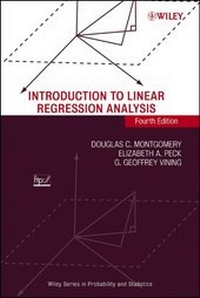
Introduction to Linear Regression Analysis
4th Edition
Published on 1. April 2006
Book
Hardback
640 pages
978-0-471-75495-4 (ISBN)
Description
A comprehensive and up-to-date introduction to the fundamentals of regression analysis
The Fourth Edition of Introduction to Linear Regression Analysis describes both the conventional and less common uses of linear regression in the practical context of today's mathematical and scientific research. This popular book blends both theory and application to equip the reader with an understanding of the basic principles necessary to apply regression model-building techniques in a wide variety of application environments. It assumes a working knowledge of basic statistics and a familiarity with hypothesis testing and confidence intervals, as well as the normal, t, x2, and F distributions.
Illustrating all of the major procedures employed by the contemporary software packages MINITAB(r), SAS(r), and S-PLUS(r), the Fourth Edition begins with a general introduction to regression modeling, including typical applications. A host of technical tools are outlined, such as basic inference procedures, introductory aspects of model adequacy checking, and polynomial regression models and their variations. The book discusses how transformations and weighted least squares can be used to resolve problems of model inadequacy and also how to deal with influential observations. Subsequent chapters discuss:
* Indicator variables and the connection between regression and analysis-of-variance models
* Variable selection and model-building techniques and strategies
* The multicollinearity problem--its sources, effects, diagnostics, and remedial measures
* Robust regression techniques such as M-estimators, and properties of robust estimators
* The basics of nonlinear regression
* Generalized linear models
* Using SAS(r) for regression problems
This book is a robust resource that offers solid methodology for statistical practitioners and professionals in the fields of engineering, physical and chemical sciences, economics, management, life and biological sciences, and the social sciences. Both the accompanying FTP site, which contains data sets, extensive problem solutions, software hints, and PowerPoint(r) slides, as well as the book's revised presentation of topics in increasing order of complexity, facilitate its use in a classroom setting.
With its new exercises and structure, this book is highly recommended for upper-undergraduate and beginning graduate students in mathematics, engineering, and natural sciences. Scientists and engineers will find the book to be an excellent choice for reference and self-study.
The Fourth Edition of Introduction to Linear Regression Analysis describes both the conventional and less common uses of linear regression in the practical context of today's mathematical and scientific research. This popular book blends both theory and application to equip the reader with an understanding of the basic principles necessary to apply regression model-building techniques in a wide variety of application environments. It assumes a working knowledge of basic statistics and a familiarity with hypothesis testing and confidence intervals, as well as the normal, t, x2, and F distributions.
Illustrating all of the major procedures employed by the contemporary software packages MINITAB(r), SAS(r), and S-PLUS(r), the Fourth Edition begins with a general introduction to regression modeling, including typical applications. A host of technical tools are outlined, such as basic inference procedures, introductory aspects of model adequacy checking, and polynomial regression models and their variations. The book discusses how transformations and weighted least squares can be used to resolve problems of model inadequacy and also how to deal with influential observations. Subsequent chapters discuss:
* Indicator variables and the connection between regression and analysis-of-variance models
* Variable selection and model-building techniques and strategies
* The multicollinearity problem--its sources, effects, diagnostics, and remedial measures
* Robust regression techniques such as M-estimators, and properties of robust estimators
* The basics of nonlinear regression
* Generalized linear models
* Using SAS(r) for regression problems
This book is a robust resource that offers solid methodology for statistical practitioners and professionals in the fields of engineering, physical and chemical sciences, economics, management, life and biological sciences, and the social sciences. Both the accompanying FTP site, which contains data sets, extensive problem solutions, software hints, and PowerPoint(r) slides, as well as the book's revised presentation of topics in increasing order of complexity, facilitate its use in a classroom setting.
With its new exercises and structure, this book is highly recommended for upper-undergraduate and beginning graduate students in mathematics, engineering, and natural sciences. Scientists and engineers will find the book to be an excellent choice for reference and self-study.
Reviews / Votes
"...written by the best in the field and I strongly recommend it both as a textbook and as a handy reference..." (Technometrics, May 2007) "...an excellent reference and...self-teaching text for anyone with a basic level of statistical knowledge." (MAA Reviews, August 21, 2006)More details
Series
Edition
4., Auflage
Language
English
Place of publication
New York
United States
Target group
Professional and scholarly
Edition type
Revised edition
Illustrations
Illustrations
Dimensions
Height: 26 cm
Width: 18.8 cm
Thickness: 33 mm
Weight
1244 gr
ISBN-13
978-0-471-75495-4 (9780471754954)
Schweitzer Classification
Other editions
New editions
Douglas C. Montgomery | Elizabeth A. Peck | G. Geoffrey Vining
Introduction to Linear Regression Analysis
Book
04/2012
5th Edition
Wiley
Unfortunately, price unknown
Article exhausted; check for reprint
Previous edition
Douglas C. Montgomery | Elizabeth A. Peck | G. Geoffrey Vining
Introduction to Linear Regression Analysis
Book
04/2001
3rd Edition
Wiley
€109.00
Article exhausted; check for reprint
Persons
DOUGLAS C. MONTGOMERY is ASU Foundation Professor of Engineering and Professor of Statistics at Arizona State University.
ELIZABETH A. PECK is Logistics Modeling Specialist at the Coca-Cola Company in Atlanta, Georgia.
G. GEOFFREY VINING is Professor and Head of the Department of Statistics at Virginia Polytechnic Institute and State University. All three authors have published extensively in both journals and books.
ELIZABETH A. PECK is Logistics Modeling Specialist at the Coca-Cola Company in Atlanta, Georgia.
G. GEOFFREY VINING is Professor and Head of the Department of Statistics at Virginia Polytechnic Institute and State University. All three authors have published extensively in both journals and books.
Content
Preface.
1. Introduction.
2. Simple Linear Regression.
3. Multiple Linear Regression.
4. Model Adequacy Checking.
5. Transformations and Weighting to Correct Model Inadequacies.
6. Diagnostics for Leverage and Influence.
7. Polynomial Regression Models.
8. Indicator Variables.
9. Variable Selection and Model Building.
10. Validation of Regression Models.
11. Multicollinearity.
12. Robust Regression.
13. Introduction to Nonlinear Regression.
14. Generalized Linear Models.
15. Other Topics in the Use of Regression Analysis.
Appendix A: Statistical Tables.
Appendix B: Data Sets For Exercises.
Appendix C: Supplemental Technical Material.
Appendix D: Introduction to SAS.
References.
Index.
1. Introduction.
2. Simple Linear Regression.
3. Multiple Linear Regression.
4. Model Adequacy Checking.
5. Transformations and Weighting to Correct Model Inadequacies.
6. Diagnostics for Leverage and Influence.
7. Polynomial Regression Models.
8. Indicator Variables.
9. Variable Selection and Model Building.
10. Validation of Regression Models.
11. Multicollinearity.
12. Robust Regression.
13. Introduction to Nonlinear Regression.
14. Generalized Linear Models.
15. Other Topics in the Use of Regression Analysis.
Appendix A: Statistical Tables.
Appendix B: Data Sets For Exercises.
Appendix C: Supplemental Technical Material.
Appendix D: Introduction to SAS.
References.
Index.