

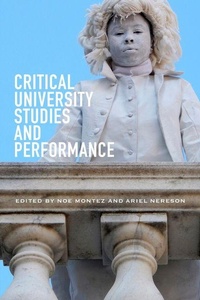
Critical University Studies and Performance
Will be published approx. on 15. June 2026
Book
Paperback/Softback
400 pages
978-0-8265-0032-8 (ISBN)
Description
Critical University Studies and Performance explores how we contend with issues of power, race, class, and gender in higher education, specifically as they relate to the complexities of theater and performance studies programs. In what ways might the fields of theater, performance, and dance studies, as they operate in institutions of higher education, support hegemonic logics as well as model reparative practices, given their perhaps unique disciplinary relationships to staging representation and their shared emphasis on embodiment as a practical and theoretical area of engagement?
Montez and Nereson bring together scholars with a diverse range of career experiences and embodied positions inside of higher learning in order to deepen the field's theoretical inquiry using an ethnic studies framework. By participating in the interdisciplinary discourse of critical university studies, the volume aims to explore how to conduct ethical research that critiques the university while remaining mindful of our always contingent place within it. The contributors examine the ways the university commodifies minoritarian knowledge, tokenizes the arts, and reproduces inequality. This book offers strategic ways to build liberatory communities and revolutionary networks among students and faculty alike in order to envision futures within and beyond the academy.
Montez and Nereson bring together scholars with a diverse range of career experiences and embodied positions inside of higher learning in order to deepen the field's theoretical inquiry using an ethnic studies framework. By participating in the interdisciplinary discourse of critical university studies, the volume aims to explore how to conduct ethical research that critiques the university while remaining mindful of our always contingent place within it. The contributors examine the ways the university commodifies minoritarian knowledge, tokenizes the arts, and reproduces inequality. This book offers strategic ways to build liberatory communities and revolutionary networks among students and faculty alike in order to envision futures within and beyond the academy.
Reviews / Votes
"This incisive anthology offers astute, resistant analyses of strategies determined to dismantle colleges, universities, and the arts, and beckons with hopeful enumerations of better futures for academic institutions, scholarly fields, and arts practices so necessary for socially just human endeavor."-Jill Dolan, author of Utopia in Performance: Finding Hope at the Theater "In an era where higher education is under scrutiny, Critical University Studies and Performance offers a provocative look at how performance studies enables understanding of institutional power. Editors Noe Montez and Ariel Nereson assemble an impressive group of scholars to ask a pressing question: How do theater, dance, and performance programs both uphold and dismantle the status quo?"
-Soyica Diggs Colbert, author of Radical Vision: A Biography of Lorraine Hansberry "Montez and Nereson curate a powerful collection that tells of how artists and performance scholars use the reframing of embodied art forms, their performance spaces, and classrooms as sites of incremental and immediate revolution to wrestle with the destruction of higher education."
-Martine Kei Green-Rogers, co-editor of Contemporary Black Theatre and Performance: Acts of Rebellion, Activism, and Solidarity
More details
Language
English
Place of publication
Tennessee
United States
Target group
Professional and scholarly
College/higher education
Illustrations
25 b&w images
Dimensions
Height: 229 mm
Width: 152 mm
Weight
454 gr
ISBN-13
978-0-8265-0032-8 (9780826500328)
Copyright in bibliographic data and cover images is held by Nielsen Book Services Limited or by the publishers or by their respective licensors: all rights reserved.
Schweitzer Classification
Persons
Noe Montez is an associate professor of theater at Emory University. He is the author of Memory, Transitional Justice, and Theatre in Postdictatorship Argentina and co-editor of Nothing to Do with Love: and Other Plays by Santiago Loza and The Routledge Companion to Latine Theatre and Performance. He is the former editor of Theatre Topics.
Ariel Nereson is an associate professor of dance studies in the Department of Theatre and Dance at the University at Buffalo, SUNY. She is the author of the award-winning book Democracy Moving: Bill T. Jones, Contemporary American Performance, and the Racial Past. She is the editor of Theatre Journal as well as a practicing choreographer and dramaturg.
Ariel Nereson is an associate professor of dance studies in the Department of Theatre and Dance at the University at Buffalo, SUNY. She is the author of the award-winning book Democracy Moving: Bill T. Jones, Contemporary American Performance, and the Racial Past. She is the editor of Theatre Journal as well as a practicing choreographer and dramaturg.
Content
List of Contributors
Introduction | Noe Montez and Ariel Nereson
Part I: Embodiment
Chapter 1: On Embodied Solidarity | Shelby Brewster
Chapter 2: A Movement Toward Liberation: The Progression of Theater Programs at Historically Black College and Universities | Khalid Y. Long
Chapter 3: Improvising Abolition: Dance, Decarceration, and Higher Education | Hannah Schwadron
Part II: Academic Labor
Chapter 4: Revising TDPS PhD Programs to Support Career Diversity Without Losing Your Soul: Strategies for Incorporating Humanist-Forward Curriculum Revision, Interdisciplinary Learning, and the Public Humanities | Noe Montez and Danielle Rosvally
Chapter 5: Challenge Inaccessibility: A Worklist for the TDPS Job Market | Samuel Yates
Chapter 6: Are Faculty Employees? The Potential for Human Resources as an Ally | Charlotte M. Canning
Part III: Pedagogies of Justice
Chapter 7: Making Space in the Curriculum: Centering Non-Western Epistemologies | Anita Gonzalez
Chapter 8: Bricks as Memory: Embodied Understandings of Racialized University Landscapes in the US South | Cortland Gilliam, Tommy Noonan, and Elizabeth Olson
Chapter 9: "Performance as Monument": An Interview with Marisa Williamson | Ariel Nereson
Chapter 10: Theater of the Anatomical Theater | Marisa Williamson
Part IV: Public Facing Engagements
Chapter 11: Defund the Season | Henry Bial
Chapter 12: "Institutional Change Is for Suckers": Higher Education and the Performance of Land Acknowledgments | Bethany Hughes
Chapter 13: Can the University Speak? | Michelle Liu Carriger
Introduction | Noe Montez and Ariel Nereson
Part I: Embodiment
Chapter 1: On Embodied Solidarity | Shelby Brewster
Chapter 2: A Movement Toward Liberation: The Progression of Theater Programs at Historically Black College and Universities | Khalid Y. Long
Chapter 3: Improvising Abolition: Dance, Decarceration, and Higher Education | Hannah Schwadron
Part II: Academic Labor
Chapter 4: Revising TDPS PhD Programs to Support Career Diversity Without Losing Your Soul: Strategies for Incorporating Humanist-Forward Curriculum Revision, Interdisciplinary Learning, and the Public Humanities | Noe Montez and Danielle Rosvally
Chapter 5: Challenge Inaccessibility: A Worklist for the TDPS Job Market | Samuel Yates
Chapter 6: Are Faculty Employees? The Potential for Human Resources as an Ally | Charlotte M. Canning
Part III: Pedagogies of Justice
Chapter 7: Making Space in the Curriculum: Centering Non-Western Epistemologies | Anita Gonzalez
Chapter 8: Bricks as Memory: Embodied Understandings of Racialized University Landscapes in the US South | Cortland Gilliam, Tommy Noonan, and Elizabeth Olson
Chapter 9: "Performance as Monument": An Interview with Marisa Williamson | Ariel Nereson
Chapter 10: Theater of the Anatomical Theater | Marisa Williamson
Part IV: Public Facing Engagements
Chapter 11: Defund the Season | Henry Bial
Chapter 12: "Institutional Change Is for Suckers": Higher Education and the Performance of Land Acknowledgments | Bethany Hughes
Chapter 13: Can the University Speak? | Michelle Liu Carriger