

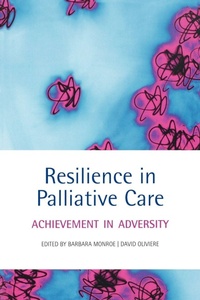
Resilience in Palliative Care
Achievement in adversity
Published on 6. September 2007
Book
Paperback/Softback
320 pages
978-0-19-920641-4 (ISBN)
Description
The first book of its kind, Resilience and Palliative Care - Achievement in adversity takes the increasing international literature on resilience and applies it to palliative and end-of-life care. The book offers an overview of all key aspects of palliative care, presented through a resilience perspective. Why do some patients and families break down while others surmounts the challenges facing them? What interventions strengthen individual, family and community coping? This book aims to facilitate change with people facing the crisis of death, dying and bereavement. Much of the existing literature has focused on risk, problems and vulnerability; the emerging concept of resilience focuses on strengths and possibilities.
The 'total pain'/'total care' approach pioneered by Dame Cicely Saunders and St Christopher's Hospice now needs reinterpreting in the light of changing contexts and challenges. The realities of demographic change and resource-constrained health and social care environments have generated an increasingly risk focused approach to service delivery. A narrowly medicalised approach has inevitable limitations; professional care alone will be unable to meet need and demand in the face of ageing populations, changing patterns of illness and the need for equity. The resilience approach offers a counterbalance that harnesses the strengths of individuals and the communities in which they live and in which most of their dying will take place. Resilience thinking emphasises the importance of public health and creates a partnership between patients, professionals and community structures, seeking to build community capacity and to deliver a preventive health care that will leave future generations less afraid of the dying and bereavement that will confront all of us.
This book offers insights into how, at all levels of planning and delivering palliative care, there is the opportunity to maximise coping, build an infrastructure for self-help, and increase the capacity of strengthened teams and organisations.
The 'total pain'/'total care' approach pioneered by Dame Cicely Saunders and St Christopher's Hospice now needs reinterpreting in the light of changing contexts and challenges. The realities of demographic change and resource-constrained health and social care environments have generated an increasingly risk focused approach to service delivery. A narrowly medicalised approach has inevitable limitations; professional care alone will be unable to meet need and demand in the face of ageing populations, changing patterns of illness and the need for equity. The resilience approach offers a counterbalance that harnesses the strengths of individuals and the communities in which they live and in which most of their dying will take place. Resilience thinking emphasises the importance of public health and creates a partnership between patients, professionals and community structures, seeking to build community capacity and to deliver a preventive health care that will leave future generations less afraid of the dying and bereavement that will confront all of us.
This book offers insights into how, at all levels of planning and delivering palliative care, there is the opportunity to maximise coping, build an infrastructure for self-help, and increase the capacity of strengthened teams and organisations.
Reviews / Votes
...a useful addition to the library shelves of anyone working in palliative care and could be used as a reference as well as to promote discussion among team members. * Speech and Language Therapy in Practice * ...well-written and easy to read and understand...I recommend this book as a must for all professionals engaged in palliative care, clinically and/or in teaching the subject. I do not know of any other book which deals exclusively and openly with resilience in palliative care... this book should have a place in every health and social care library. * Christiane Banton, Sr Lecturer Palliative Care, University of Wolverhampton *More details
Language
English
Place of publication
Oxford
United Kingdom
Target group
Professional and scholarly
Illustrations
15 black and white line illustrations
Dimensions
Height: 234 mm
Width: 156 mm
Thickness: 17 mm
Weight
485 gr
ISBN-13
978-0-19-920641-4 (9780199206414)
Copyright in bibliographic data and cover images is held by Nielsen Book Services Limited or by the publishers or by their respective licensors: all rights reserved.
Schweitzer Classification
Other editions
Additional editions
E-Book
09/2007
1st Edition
Oxford University Press
€127.59
Available for download
Persons
Barbara Monroe has been a social worker for over 30 years. She joined St Christopher's Hospice in London in 1987 and became Chief Executive in 2000. She is also Director of the Candle children's bereavement project and Chair of the National Childhood Bereavement Network. She is a member of the Commission on the Future of Volunteering and sits on the advisory group for the palliative care initiative of the Diana Princess of Wales Memorial Fund. She has an honorary senior lectureship at the University of Auckland. She is a well known lecturer and trainer and has written extensively about the psychosocial aspects of palliative care.
David Oliviere trained at Nottingham University in social administration and social work. With a background in psychiatric social work and management in the personal social services, David was involved with Pilgrim's Hospice, Canterbury, before joining the North London Hospice as Director of Social Work. Subsequently David worked as Community Care Advisor for Ethnic Minorities and Refugees, London Borough of Enfield, and more recently as Macmillan Principal Lecturer in Palliative Care at Middlesex University, whilst practising at the Macmillan Support Team at Barnet Hospital. David also works as a couple counsellor outside of St Christopher's Hospice. He has lectured internationally.
David Oliviere trained at Nottingham University in social administration and social work. With a background in psychiatric social work and management in the personal social services, David was involved with Pilgrim's Hospice, Canterbury, before joining the North London Hospice as Director of Social Work. Subsequently David worked as Community Care Advisor for Ethnic Minorities and Refugees, London Borough of Enfield, and more recently as Macmillan Principal Lecturer in Palliative Care at Middlesex University, whilst practising at the Macmillan Support Team at Barnet Hospital. David also works as a couple counsellor outside of St Christopher's Hospice. He has lectured internationally.
Content
1. Resilience and its narrative ; 2. Resilience and the psychobiological base ; 3. Resilience and bereaved children ; 4. Resilient families ; 5. Resilient carers and caregivers ; 6. Resilience and paediatric palliative care ; 7. Resilience and spirituality ; 8. Resilience and rehabilitation ; 9a Resilience and bereavement - part 1 ; 9b Resilience and bereavement - part 2 ; 10. Resilient multiprofessional teams ; 11a Resilient organisations - part 1 ; 11b Resilient organisations - part 2 ; 12. Resilient communities ; 13. Resilience in trauma and disaster ; 14. Resilience in resource-poor settings ; 15. Resilience and creativity