

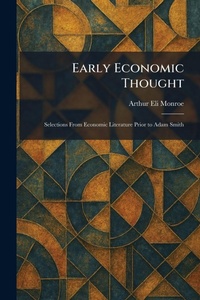
Early Economic Thought
Description
"Early Economic Thought: Selections From Economic Literature Prior to Adam Smith" is a comprehensive anthology that traces the intellectual foundations of economic science. This scholarly collection brings together essential primary texts ranging from ancient philosophy and medieval scholasticism to the dawn of the Enlightenment. By compiling these diverse perspectives, the volume offers a panoramic view of how human understanding of wealth, value, and commerce evolved over centuries.
The work features critical selections from influential thinkers such as Aristotle, Nicole Oresme, Jean Bodin, Thomas Mun, and Sir William Petty. It explores the transition from ethical and religious inquiries into money and usury toward the analytical frameworks of mercantilism and early political economy. These writings illuminate the historical context of trade, currency, and statecraft that paved the way for the classical school of economics.
As a vital resource for students of economic history and philosophy, "Early Economic Thought: Selections From Economic Literature Prior to Adam Smith" preserves the original arguments that shaped modern social science. This collection serves as a definitive guide to the pre-modern economic ideas that continue to inform contemporary theory and historical analysis.
This work has been selected by scholars as being culturally important, and is part of the knowledge base of civilization as we know it. This work was reproduced from the original artifact, and remains as true to the original work as possible. Therefore, you may see the original copyright references, library stamps (as most of these works have been housed in our most important libraries around the world), and other notations in the work.
This work is in the public domain in the United States of America, and possibly other nations. Within the United States, you may freely copy and distribute this work, as no entity (individual or corporate) has a copyright on the body of the work.
As a reproduction of a historical artifact, this work may contain missing or blurred pages, poor pictures, errant marks, etc. Scholars believe, and we concur, that this work is important enough to be preserved, reproduced, and made generally available to the public. We appreciate your support of the preservation process, and thank you for being an important part of keeping this knowledge alive and relevant.