


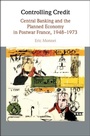
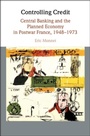
Controlling Credit
Central Banking and the Planned Economy in Postwar France, 1948-1973
Will be published approx. on 15. November 2018
Book
Hardback
350 pages
978-1-108-41501-9 (ISBN)
Description
It is common wisdom that central banks in the postwar (1945-1970s) period were passive bureaucracies constrained by fixed-exchange rates and inflationist fiscal policies. This view is mostly retrospective and informed by US and UK experiences. This book tells a different story. Eric Monnet shows that the Banque de France was at the heart of the postwar financial system and economic planning, and that it contributed to economic growth by both stabilizing inflation and fostering direct lending to priority economic activities. Credit was institutionalized as a social and economic objective. Monetary policy and credit controls were conflated. He then broadens his analysis to other European countries and sheds light on the evolution of central banks and credit policy before the Monetary Union. This new understanding has important ramifications for today, since many emerging markets have central bank policies that are similar to Western Europe's in the decades of high growth.
Reviews / Votes
'How central banks and governments used directed credit to positively influence post-World War II economic recovery and growth - and why similar policies do not work today - is one of the great unsolved mysteries of twentieth-century economic history. In this pathbreaking volume, Eric Monnet uses the French case to shed important new light on the question.' Barry Eichengreen, George C. Pardee and Helen N. Pardee Professor of Economics and Political Science, University of California, Berkeley 'Monnet's intensive study of the Banque de France during the Trente Glorieuses sheds new light on the development of credit policy in the decades before the central banking orthodoxy of the 2000s. It thus makes an important contribution to understanding the development of central banking in Europe and reminds us of the heterogeneity of central bank practice in the twentieth century.' Catherine Schenk, University of Oxford 'Controlling Credit is a valuable book and will remain an inescapable reference in the emerging literature about postwar central banking.' Stefano Ugolini, Journal of Interdisciplinary HistoryMore details
Series
Language
English
Place of publication
Cambridge
United Kingdom
Target group
Professional and scholarly
Illustrations
Worked examples or Exercises
Dimensions
Height: 235 mm
Width: 157 mm
Thickness: 24 mm
Weight
664 gr
ISBN-13
978-1-108-41501-9 (9781108415019)
Copyright in bibliographic data and cover images is held by Nielsen Book Services Limited or by the publishers or by their respective licensors: all rights reserved.
Schweitzer Classification
Other editions
Additional editions

Book
10/2019
Cambridge University Press
€58.10
Shipment within 15-20 days
E-Book
11/2018
Cambridge University Press
€29.49
Available for download
E-Book
10/2018
Cambridge University Press
€100.99
Available for download
Person
Eric Monnet is a senior economist at the Bank of France, a Professor in Economic History at the Paris School of Economics, and a research affiliate at the Centre for Economic Policy Research (CEPR).
Content
Introduction; Part I. Institutionalizing Credit: Introduction to Part I: chronology and methodology; 1. French credit policies before 1945; 2. The nationalization of credit from 1945 to the late 1950s; 3. Development then gradual de-institutionalization: the 1960s and 1970s; Part II. Managing Credit: 4. Monetary policy without interest rates. Domestic macroeconomic effects and international issues of credit controls; 5. Blurred lines. The two faces of Banque de France loans to the Treasury (1948-73); 6. Financing the postwar Golden Age. The Banque de France, 'investment credit' and capital allocation; 7. The rise and fall of national credit policies. Implications for the history of European varieties of capitalism and monetary integration; Conclusion.